




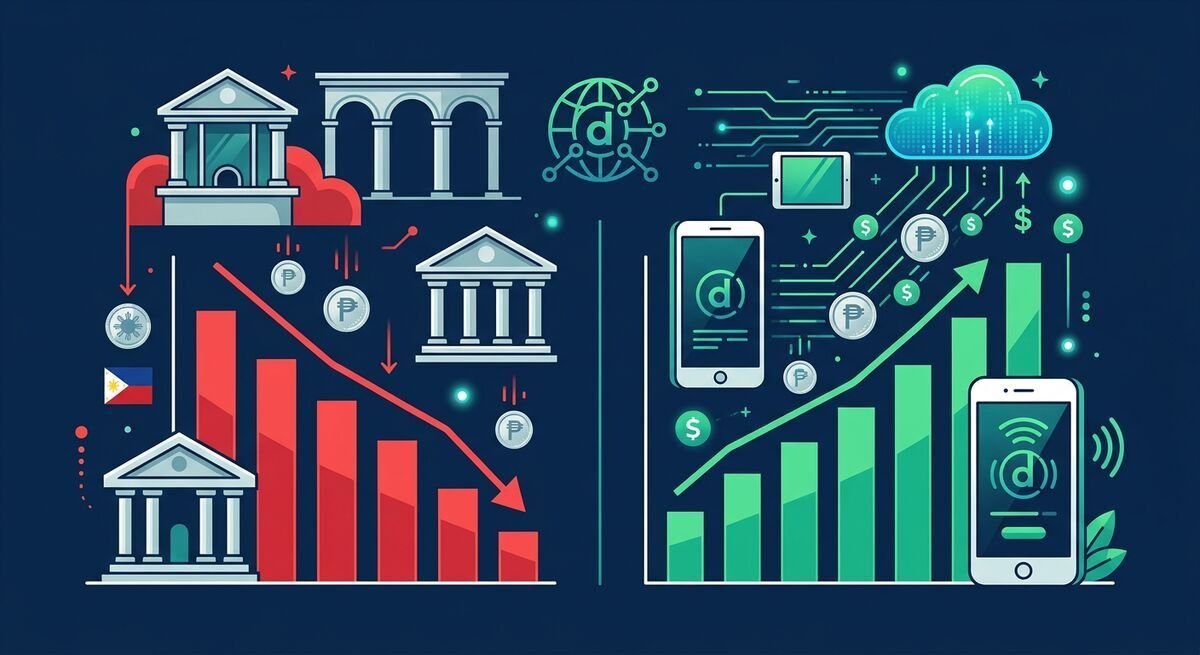
Short answer: most Philippine digital banks are still losing money. The sector posted a combined net loss of P7.07 billion in 2024, and only two of the six BSP-licensed digital banks — Maya Bank and Overseas Filipino Bank — have reached profitability.
But here is what makes this story more interesting than a simple red-ink headline. Deposits in Philippine digital banks blew past P100 billion in early 2025. Customer accounts surged 81% year-over-year to 22.4 million. And Maya Bank is now eyeing a US IPO worth up to $1 billion.
So is this a sector on life support — or one burning cash on purpose to build something massive?
This article breaks down the real numbers behind Philippines digital bank profitability. You will get the bank-by-bank financial scorecard for 2024, the reasons behind the losses, the one success story worth studying, and a realistic timeline for when the sector might turn the corner. Whether you are a depositor checking if your digital bank is stable, an investor watching PH fintech, or just curious about where your savings app stands financially — this is the most complete picture available right now.
The Big Picture: How Much Are Philippine Digital Banks Losing?
The Bangko Sentral ng Pilipinas (BSP) began consolidating financial data from digital banks in March 2023. The numbers have been consistently red since then.
By end-2024, the six licensed digital banks reported a combined net loss of P7.07 billion. That figure narrowed to P3.97 billion by September 2025 — an improvement, but still deep in negative territory.
BSP Deputy Governor Chuchi Fonacier has been blunt about the outlook: digital banks “must demonstrate capacity to achieve business goals to realize positive margins.” The central bank estimates it takes five to seven years for a digital bank to become profitable — a timeline consistent with global trends, where only about 5% of digital banks worldwide are in the black.
Key Sector Metrics (End of 2024)
| Metric | Digital Banks | Traditional Banks |
|---|---|---|
| Combined Net Income/Loss | -P7.07 billion | Profitable sector-wide |
| Total Deposits | ~P96 billion | P17+ trillion |
| Deposit Accounts | ~22.4 million | Majority of market |
| Gross NPL Ratio | 6-14% (varies by period) | 3.3% |
| Loan-to-Deposit Ratio | ~36% | ~70-75% |
| Licensed Institutions | 6 | 40+ universal/commercial |
The loan-to-deposit ratio tells a critical story. At just 36%, digital banks are sitting on mountains of deposits they have not figured out how to lend profitably. Traditional banks typically deploy 70-75% of their deposits as loans. This gap is the single biggest factor keeping the sector underwater.
Bank-by-Bank Profitability Scorecard (2024)
Not all six digital banks are created equal. Their financial performance in 2024 ranged from modest profitability to billions in losses.
2024 Financial Performance by Bank
| Digital Bank | Owner / Backer | Net Income/Loss (2024) | YoY Change | Status |
|---|---|---|---|---|
| Maya Bank | Voyager Innovations | +P72.78 million | Turnaround (from -P826.83M) | Profitable |
| OFBank | Land Bank of the Philippines | +P86.28 million | +71.4% growth | Profitable |
| GoTyme Bank | JG Summit + TymeBank | -P3.44 billion | Widened | Unprofitable |
| UnionDigital Bank | Union Bank of PH | -P3.13 billion | Reversed (was +P155M in 2023) | Unprofitable |
| Tonik Digital Bank | Tonik Financial (Singapore) | -P1.126 billion | Widened (from -P744.92M) | Unprofitable |
| UNO Digital Bank | DigibankASIA (Singapore) | -P1.04 billion | Widened | Unprofitable |
A few things jump out from this table.
GoTyme Bank leads in losses at P3.44 billion, but it also grew its customer base to nearly 8 million and total assets to P29.96 billion. The company originally targeted profitability by end-2025 but has since pushed that goal to 2027 — a significant revision that signals just how expensive rapid customer acquisition can be.
UnionDigital Bank’s reversal is the most dramatic swing. It booked a P155 million profit in 2023, only to post a P3.13 billion loss in 2024. That kind of volatility raises questions about the sustainability of early profitability claims in this sector.
Tonik Digital Bank widened its losses to P1.126 billion, up from P744 million in 2023. However, CEO Greg Krasnov has stated the bank is targeting breakeven after achieving contribution margin positivity in Q4 2024. Tonik raised US$12 million in December 2025 to bolster its capital position.
Why Are Philippine Digital Banks Losing Money?
The losses are not random. They stem from a specific set of structural challenges that almost every digital bank in the Philippines shares.
The Deposit-Lending Paradox
Digital banks have been remarkably successful at attracting deposits — thanks largely to interest rates as high as 15% per annum. Total deposits crossed P100 billion in Q1 2025 and reached P138.5 billion by end-2025, spread across 33.9 million accounts.
But lending has not kept pace. Gross loans stood at just P29.78 billion as of September 2024, giving the sector a loan-to-deposit ratio of roughly 36%. For every P100 deposited, digital banks lend out only P36. The rest sits earning lower returns while banks pay out high interest to depositors.
This is the paradox: the same high-interest strategy that attracts customers also squeezes margins when those deposits cannot be deployed into profitable loans.
High NPL Ratios and Credit Risk
Digital banks lend to customers that traditional banks historically avoided — thin-file borrowers with little or no credit history. The result: nonperforming loan ratios significantly higher than the industry average.
The digital bank NPL ratio hit 14.1% in July 2024 before declining to around 7% by mid-2025. Compare that to the overall banking sector’s 3.3%. S&P Global Ratings warned that digital banks’ heavy reliance on unsecured personal loans — about 65% of their portfolios — makes them especially vulnerable to credit losses.
Sky-High Operating Costs
Customer acquisition in the Philippine market does not come cheap. Digital banks spend heavily on marketing, technology infrastructure, and personnel. Operating expenses for some digital banks exceed 100% of revenue — meaning they spend more than a peso for every peso they earn. Traditional banks typically run at cost-to-income ratios around 56%.
Identity Verification and Fraud
Tonik Bank CEO Greg Krasnov has flagged fraud risk as “very, very high” for digital banks, particularly around identity verification. In a country where digital financial infrastructure is still maturing, verifying remote customers remains costly and imperfect.
The Maya Bank Success Story: What One Digital Bank Got Right
Among the six licensed digital banks, Maya Bank stands out as the clearest profitability success story — and its path offers lessons for the entire sector.

Maya reported its first profitable quarter in Q1 2025, just about three years after converting from the PayMaya e-wallet to a full digital bank. By Q3 2025, it had posted its third consecutive profitable quarter, recording net income of P532 million.
What Separates Maya from the Pack
- Integrated ecosystem. Maya combines digital banking, lending, savings, investments, cryptocurrency trading, and QR payments into one platform. Multiple revenue streams mean higher engagement per user.
- Disciplined lending. While competitors struggled with NPL ratios above 14%, Maya maintained an NPL ratio of 3.8% — well below the industry average. Cumulative loan disbursements have reached P187 billion since launch.
- Deposit dominance. Maya holds the largest deposit market share among digital banks at approximately 38%, with balances reaching P57 billion by mid-2025.
- Financial inclusion at scale. Over half of Maya’s 2.1 million borrowers are first-time formal borrowers. With 8.2 million bank customers, its user base generates meaningful economies of scale.
The payoff? Maya is now exploring a US IPO that could raise between $500 million and $1 billion. As Maya Group President Shailesh Baidwan told reporters: “We became profitable in December, and we continue to be profitable month on month since then.”
What the Future Holds: Profitability Timeline and New Competition
When Will Each Digital Bank Turn Profitable?
| Bank | Projected Profitability | Basis |
|---|---|---|
| Maya Bank | Already profitable (since Q1 2025) | 3 consecutive profitable quarters |
| OFBank | Already profitable | Government-backed, niche OFW market |
| GoTyme Bank | ~2027 | CEO revised from original 2025 target |
| Tonik Digital Bank | Late 2025 – 2026 | Targeting breakeven after margin turnaround |
| UnionDigital Bank | Unknown | Dramatic 2024 loss reversal complicates forecasts |
| UNO Digital Bank | Unknown | No public profitability timeline disclosed |
Four New Players Are Coming
The BSP lifted its moratorium on new digital bank licenses in August 2024, allowing up to 10 total. Four additional licenses are under review as of early 2026. European fintech Revolut has been rumored as a potential applicant.
More competition could accelerate innovation and improve pricing for consumers. But it also means more margin pressure for incumbents already bleeding cash. Union Bank’s chief economist warned of “prolonged margin pressure if competition stays focused on pricing rather than differentiated services.”
Digital Lending: The Billion-Dollar Opportunity
One bright spot: digital lending in the Philippines is projected to exceed $1 billion in the second half of 2025, with digital banks accounting for nearly 45% of that market. If digital banks can capture more of this lending market while keeping NPL ratios in check, the path to profitability shortens considerably.
How Philippine Digital Banks Stack Up Globally
Putting the Philippine experience in global context helps calibrate expectations. Digital banking profitability is elusive everywhere — not just in Manila.
| Market | Notable Digital Bank | Years to Profitability |
|---|---|---|
| Philippines | Maya Bank | ~3 years (from bank license) |
| Brazil | Nubank | ~10 years |
| South Korea | KakaoBank | ~2 years |
| United Kingdom | Revolut | ~9 years |
| Indonesia | Bank Jago | ~2 years |
| India | Various neobanks | Most still unprofitable |
The BSP’s five-to-seven-year estimate aligns with international benchmarks. South Korea’s KakaoBank was an outlier, reaching profitability in just two years thanks to massive platform integration with the KakaoTalk messaging app — a model that bears resemblance to Maya’s ecosystem approach.
The takeaway: Philippine digital banks are not uniquely behind. They are roughly where most digital banking sectors are at the same stage of development.
Frequently Asked Questions
Are digital banks in the Philippines profitable?
Most are not. As of 2024, only 2 of the 6 BSP-licensed digital banks — Maya Bank and Overseas Filipino Bank — reported net income. The sector as a whole posted a combined net loss of P7.07 billion in 2024.
Which Philippine digital bank is the most profitable?
Maya Bank leads in profitability momentum, posting three consecutive profitable quarters by Q3 2025 with net income of P532 million. OFBank has been modestly profitable since 2023 with P86.28 million net income in 2024.
How long does it take for a digital bank to become profitable?
The BSP estimates five to seven years from launch. This is consistent with global patterns — Brazil’s Nubank took about 10 years, while UK-based Revolut needed roughly 9 years to post its first annual profit.
Is my money safe in a Philippine digital bank?
Yes. All six BSP-licensed digital banks are insured by the Philippine Deposit Insurance Corporation (PDIC) for up to P500,000 per depositor per bank. Corporate-level losses do not affect depositor funds.
Why are Philippine digital banks losing money?
Key factors include high customer acquisition costs, a low loan-to-deposit ratio (~36%), elevated nonperforming loan ratios (up to 14% at peak), heavy investment in technology infrastructure, and reliance on high-interest deposits that compress margins.
How many digital banks are licensed by the BSP?
Six are currently licensed and operating: Maya Bank, GoTyme Bank, Tonik Digital Bank, UnionDigital Bank, UNO Digital Bank, and Overseas Filipino Bank. The BSP has approved expanding to up to 10 licenses total.
Will Philippine digital banks survive?
The BSP has expressed confidence that the sector will reach profitability in the medium term. Deposit growth has been strong (P138.5 billion by end-2025), customer adoption is accelerating (33.9 million accounts), and digital lending is a projected $1 billion market. The structural foundations are being laid even as profits remain elusive short-term.
The Bottom Line
Philippines digital bank profitability is not a question of if — it is a question of when. The sector’s P7.07 billion loss in 2024 looks alarming in isolation. But deposits surging past P138 billion, customer accounts multiplying to 33.9 million, and Maya Bank proving that profitability is achievable within three years — these are not signs of a failing experiment.
The real story is a sector in its investment phase, burning cash to build infrastructure and capture market share in a country where tens of millions of adults still lack formal bank accounts. The banks that figure out how to convert their deposit mountains into disciplined lending — while keeping NPL ratios manageable — will be the ones that survive and thrive.
For depositors: your money is PDIC-insured and safe. For investors: watch the loan-to-deposit ratios and NPL trends, not just the headline losses. For the industry: Maya Bank has drawn the blueprint. The question is whether the other five can follow it.