




You open a job listing marked “entry level,” scroll to the requirements, and find “2-3 years of professional experience required.” It’s maddening, and it’s everywhere. Entry level jobs for software developer candidates have somehow become a category that demands a resume you can’t yet have.
The barrier is more myth than wall. CS graduates, bootcamp alumni, and career changers are all landing their first developer roles right now — with the right positioning, the right skills on display, and a clear understanding of what hiring managers actually want versus what job postings claim to want.
What follows is a practical breakdown of everything that matters: the distinct role types worth targeting, the technical and soft skills that actually get interviews, realistic salary expectations backed by data, and concrete tactics for building a portfolio, writing a resume, finding openings, and handling the technical interview.
Types of Entry-Level Software Developer Roles
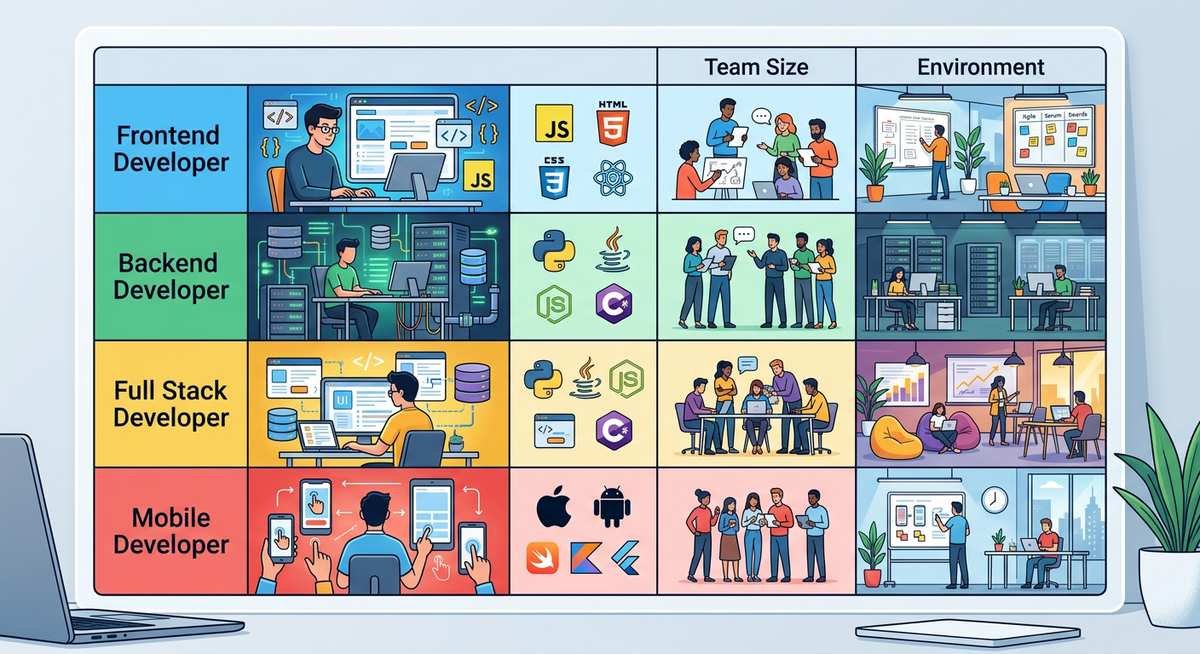
Entry-level software developer jobs span a spectrum of distinct specializations, each with its own tech stack, daily rhythm, and hiring bar. Knowing which lane you’re targeting lets you build the right portfolio, study the right tools, and write a resume that actually matches what a recruiter is scanning for.
Front-End Developer
Front-end development is the layer users see and touch. The core toolkit is HTML, CSS, and JavaScript — and in practice, most job postings now expect familiarity with a framework like React or Vue.js on top of those fundamentals. Day-to-day work involves translating design mockups into functional interfaces, collaborating with UX/UI designers, and ensuring layouts render correctly across browsers and screen sizes.
Accessibility and performance are increasingly part of the job, not afterthoughts. Entry-level front-end roles are common at agencies, e-commerce companies, and SaaS startups where visual output is directly tied to revenue.
Back-End Developer
Back-end developers build the machinery behind the interface — server logic, database queries, authentication systems, and the APIs that connect everything together. Common languages at the entry level include Python, Java, and Node.js, with SQL appearing in nearly every job description regardless of the primary language.
A junior back-end developer might spend a week building a REST API endpoint, writing unit tests, and debugging why a database query is running slowly. The work is less visible but arguably more foundational. Companies in fintech, healthcare, and enterprise software hire heavily on the back-end side.
Full-Stack Developer
Full-stack roles ask one person to operate competently across both front-end and back-end layers. Startups favor this configuration because a single developer can ship a feature end-to-end without handoffs slowing things down. The tradeoff for entry-level candidates is real — the skill surface area is wider, which means a thinner portfolio in any one area may hurt your candidacy at more specialized companies.
Full-stack job postings are among the most common in entry-level listings, but “full-stack” can mean very different things depending on the employer. Read the tech stack requirements carefully before applying.
Mobile and QA/Testing Roles
Mobile development splits into two tracks: iOS (Swift) and Android (Kotlin), each with its own ecosystem and tooling. Entry-level mobile roles are less abundant than web roles, but the competition is also thinner — fewer bootcamp graduates target mobile, which can work in your favor.
Quality Assurance and automation testing roles represent a genuinely lower-barrier entry point into software teams, often requiring less algorithmic knowledge and more systematic thinking. QA engineers who learn tools like Selenium, Cypress, or Appium can transition into development roles over time. Many engineers who now hold senior developer titles started their careers in QA.
| Role Type | Primary Languages/Tools | Typical Employer | Entry Barrier |
|---|---|---|---|
| Front-End | HTML, CSS, JavaScript, React/Vue | Agencies, SaaS, e-commerce | Moderate |
| Back-End | Python, Java, Node.js, SQL | Fintech, healthcare, enterprise | Moderate-High |
| Full-Stack | JavaScript + Python or Java | Startups, mid-size tech | Higher (wider skill set) |
| Mobile | Swift (iOS), Kotlin (Android) | App-first companies, agencies | Moderate |
| QA/Testing | Selenium, Cypress, Appium, Python | Enterprise, consulting firms | Lower |
Skills and Technologies Entry-Level Developers Actually Need
Entry-level software developer job postings consistently require proficiency in at least one high-demand language, working knowledge of Git, and the ability to collaborate within a team. Employers are screening for foundational competence and coachability, not mastery.
Core Technical Skills
Python and JavaScript are the two most hirable first languages for entry-level roles right now. Python dominates back-end, data-adjacent, and automation positions; JavaScript is non-negotiable for front-end work and increasingly common on the server side via Node.js. Pick one and go deep before branching out.
Git and version control are effectively mandatory. Employers expect candidates to understand branching, pull requests, and merge conflicts — not just git commit. Beyond that, a working understanding of basic data structures (arrays, hash maps, linked lists) and REST APIs rounds out what most entry-level job descriptions actually list as requirements.
Familiarity with at least one framework matters too. React for front-end roles, Django or Express for back-end positions, and Spring for Java-heavy environments are the names that appear most frequently in real postings. You don’t need production experience — you need to demonstrate you’ve used them in a real project.
Soft Skills Employers Prioritize
Technical ability gets a resume past the first screen. Soft skills determine whether a candidate gets an offer. Hiring managers consistently rank communication, receptiveness to code review feedback, and the ability to work through ambiguous problems as top differentiators at the entry level.
Most software teams operate in Agile or Scrum environments, which means standups, sprint planning, and iterative delivery are daily realities. Candidates who can speak to that workflow — even from a bootcamp or academic project — signal readiness for a real team.
Nice-to-Have vs. Must-Have
One of the most damaging habits job seekers have is treating every line of a job posting as a hard requirement. It isn’t. Employers routinely list preferred qualifications alongside required ones, and research from LinkedIn has found that many candidates — women in particular — tend to apply only when they meet nearly all listed criteria, costing them real opportunities.
| Skill / Technology | Typically Required | Typically Preferred |
|---|---|---|
| One programming language (Python or JavaScript) | Yes | |
| Git / version control | Yes | |
| Basic data structures and algorithms | Yes | |
| REST API familiarity | Yes | |
| Framework experience (React, Django, etc.) | Yes | |
| Cloud platforms (AWS, GCP, Azure) | Yes | |
| CI/CD pipeline knowledge | Yes | |
| Docker / containerization | Yes |
What Entry-Level Software Developers Earn
Entry-level software developers in the United States typically earn between $65,000 and $95,000 annually, with the median landing around $78,000-$82,000 based on aggregated data from the U.S. Bureau of Labor Statistics and major job boards. Role type, geography, and company size can push that number significantly higher or lower.
National Salary Ranges
According to the U.S. Bureau of Labor Statistics (2024), the median annual wage for software developers across all experience levels was $132,270. Entry-level positions cluster well below that ceiling. Front-end roles tend to start at $65,000-$75,000. Back-end and full-stack positions command slightly more, frequently opening at $75,000-$95,000 given the broader technical scope they require.
QA and testing roles are the notable outlier. Starting salaries often fall between $55,000 and $70,000 — but they offer a legitimate foot in the door for candidates who want to grow into development roles over time.
How Location and Company Size Affect Pay
A first job at a major tech company in San Francisco or Seattle can realistically clear $110,000-$130,000 in total compensation when stock and bonuses are included. Regional employers in mid-tier markets like Austin, Denver, or Raleigh typically offer $70,000-$90,000 — lower sticker price, but often a lower cost of living to match.
Remote roles complicate the picture. Some companies pay location-adjusted salaries; others pay a flat national rate regardless of where you live. That distinction alone can mean a $15,000-$20,000 swing for the same job title.
| Employer Type | Typical Entry-Level Range | Notes |
|---|---|---|
| FAANG / Large Tech | $100,000-$130,000+ | Includes equity and bonus; highly competitive |
| Mid-Size Tech Company | $80,000-$100,000 | Strong growth potential, more mentorship |
| Startup (Seed-Series B) | $70,000-$90,000 | Lower base, equity upside varies widely |
| Regional / Non-Tech Employer | $60,000-$80,000 | Stable, but slower salary progression |
Bootcamp vs. Degree: Does It Affect Starting Salary?
The pay gap between CS degree holders and bootcamp graduates at the entry level is smaller than most people expect. A 2023 report from Course Report found that bootcamp graduates reported a median starting salary of approximately $70,000 — competitive with many four-year degree holders entering non-FAANG roles. The delta widens primarily at elite tech companies, where a CS degree from a target school still carries meaningful weight in the hiring process.
What matters more than credential type is demonstrable skill. A bootcamp graduate with three polished GitHub projects and a clean deployment history will consistently outperform a CS graduate with no public code. Hiring managers at most companies care about what you can build, not where you learned to build it.
How to Land Your First Software Developer Job
Getting hired as an entry-level software developer comes down to four things done consistently well: a portfolio that proves you can build, a resume that survives automated screening, knowing where the actual jobs are posted, and showing up to technical interviews prepared.
Build a Portfolio That Gets Noticed
Aim for three to five projects on GitHub — not tutorial clones, but things that solve a real problem you or someone else actually has. A budget tracker, a local event finder, a tool that automates something tedious: these signal genuine initiative. Each repository needs a clean README with setup instructions, a description of the problem being solved, and a live demo link wherever possible.
Recruiters spend roughly 30 seconds scanning a GitHub profile. Make that scan easy. Pin your best repositories, write clear commit messages, and keep dead projects private. Contributing to open-source projects — even small bug fixes or documentation improvements — adds credibility that personal projects alone cannot match.
Write a Resume That Passes ATS Filters
Most applications pass through an Applicant Tracking System before a human ever reads them. Mirror the exact language from the job description — if the posting says “REST APIs,” your resume should say “REST APIs,” not “web services.” One page, clean formatting, no tables or columns that confuse parsing software.
Quantify everything you reasonably can. “Built a React app used by 200+ classmates” lands harder than “developed a web application.” Even academic and personal projects can carry numbers if you look for them.
| Resume Element | Weak Version | Strong Version |
|---|---|---|
| Project description | Built a to-do app in React | Built a React task manager with user auth; 150+ GitHub stars |
| Skills section | Programming, databases, web | Python, JavaScript, PostgreSQL, Git, REST APIs, React |
| Length | Two pages, padded | One page, every line earns its place |
Where to Find Entry-Level Developer Jobs
LinkedIn is obvious — and also the most competitive surface. Dice specializes in tech roles and surfaces positions that never appear elsewhere. Wellfound (formerly AngelList Talent) connects candidates directly with startup founders, often bypassing the formal ATS process entirely. Indeed and Glassdoor aggregate broadly, while company career pages frequently post openings before syndicating them to job boards.
Local tech Meetup groups and developer Slack communities are underused channels for finding entry level jobs for software developer candidates. A warm introduction from someone inside a company converts at a dramatically higher rate than a cold application. Recruiter outreach on LinkedIn works too — a short, specific message referencing a real role beats a generic connection request every time.
Ace the Technical Interview
Most entry-level technical interviews test data structures, algorithms, and basic system design. LeetCode’s “Easy” and “Medium” problem sets cover the majority of what hiring managers actually ask — consistent daily practice over six to eight weeks beats cramming the night before.
Behavioral rounds matter just as much at the junior level. Prepare two or three stories about debugging a tough problem, collaborating on a team project, or handling a disagreement over a technical approach. Use the STAR format (Situation, Task, Action, Result) to keep answers focused and under two minutes.
Take-home assignments are common for entry-level roles. Treat them like real work: write clean code, include tests, add a README explaining your approach, and submit on time. These exercises are often weighted more heavily than whiteboard problems because they mirror actual job responsibilities.
Frequently Asked Questions
What qualifications do you need for an entry-level software developer job?
Most entry-level software developer positions require proficiency in at least one programming language (Python or JavaScript are the most in-demand), working knowledge of Git, and an understanding of basic data structures and algorithms. A bachelor’s degree in computer science is preferred by many employers but is not universally required — bootcamp certificates and strong portfolios are accepted at a growing number of companies, particularly startups and mid-size tech firms.
How much does an entry-level software developer make per year?
Entry-level software developers in the United States earn between $65,000 and $95,000 annually, with the national median around $78,000-$82,000. Salaries vary significantly by role type (back-end and full-stack roles pay more than front-end or QA), geography (major tech hubs pay 20-40% more than regional markets), and employer size. Total compensation at large tech companies can exceed $130,000 when equity and bonuses are included.
Is it hard to get an entry-level software developer job with no experience?
Competitive, yes. Impossible, no. The key is redefining “experience.” Personal projects, open-source contributions, freelance work, and bootcamp capstone projects all count as demonstrable experience on a resume. Candidates who combine a polished GitHub portfolio with targeted applications and networking consistently report shorter job searches than those who rely on mass-applying through job boards alone.
What programming languages should I learn for an entry-level developer job?
Start with Python or JavaScript — these two languages appear in the majority of entry-level job postings across all specializations. JavaScript is essential for any front-end or full-stack role; Python dominates back-end, automation, and data-adjacent positions. Once you’re comfortable with one, add SQL (required for almost every back-end role) and pick up a framework: React for front-end, Django or Express for back-end.
Can you get an entry-level software developer job without a degree?
Yes. A growing number of employers — including Google, Apple, IBM, and many startups — have dropped the four-year degree requirement for software developer roles. Bootcamp graduates reported a median starting salary of approximately $70,000 according to Course Report’s 2023 outcomes data, which is competitive with many CS degree holders entering similar roles. The deciding factor is almost always your portfolio and demonstrated ability to write production-quality code.
Charting Your Path Forward
Entry level jobs for software developer candidates are genuinely accessible — but accessible is not the same as easy. The market rewards specificity: pick a role type, build a targeted portfolio, write a resume that speaks ATS, and practice for the interview format you’ll actually face. Candidates who do these four things methodically land roles faster than those who scatter applications and hope for the best.
The demand for software developers continues to grow. The U.S. Bureau of Labor Statistics projects 17% job growth for software developers through 2033, well above the average for all occupations. Your first role is a starting point, not a ceiling — and the skills you build getting there transfer to every job that follows.