


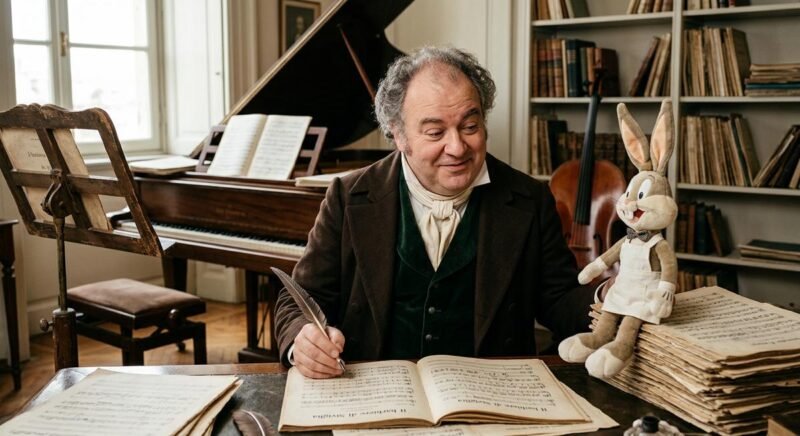
The composer parodied in Rabbit of Seville is Gioachino Rossini. The 1950 Looney Tunes cartoon takes its entire musical score from Rossini’s 1816 comic opera The Barber of Seville (Il barbiere di Siviglia), turning the Italian maestro’s overture into the backdrop for seven minutes of Bugs Bunny chasing Elmer Fudd around an opera stage with a straight razor.
Chuck Jones directed the short, and he did something unusual for a cartoon: he let the music run the show. Every gag, every pratfall, every absurd escalation lands on a beat from Rossini’s score. The result introduced millions of viewers to 19th-century Italian opera without them ever opening a program book.
If you landed here chasing a crossword answer, the seven-letter solution is ROSSINI. Stick around, though. The story of how a 200-year-old opera ended up soundtracking one of the greatest cartoon shorts ever made is worth the read.
Who Is the Composer Parodied in Rabbit of Seville?
Gioachino Rossini (1792-1868) is the composer whose music drives every frame of Rabbit of Seville. The cartoon does not simply use his opera as background music. It adapts the overture to The Barber of Seville as a full dramatic structure, with Bugs Bunny and Elmer Fudd’s physical comedy synchronized beat for beat against Rossini’s melodies.
The Quick Answer
| Detail | Answer |
|---|---|
| Composer parodied | Gioachino Rossini (1792-1868) |
| Opera parodied | Il barbiere di Siviglia (The Barber of Seville, 1816) |
| Cartoon title | Rabbit of Seville (1950) |
| Director | Chuck Jones |
| Studio | Warner Bros. / Looney Tunes |
| Crossword answer | ROSSINI (7 letters) |
Why People Search for This
Crossword constructors love this clue. Variations like “Composer spoofed by Bugs Bunny” and “Opera behind Rabbit of Seville” appear regularly in daily puzzles, and ROSSINI fits neatly into standard grid lengths. Trivia nights lean on it too, since the answer sits at that sweet spot between “too obscure” and “everyone knows it.”
A common source of confusion: many people mix up Rabbit of Seville with What’s Opera, Doc? (1957), another Chuck Jones masterpiece. That one parodies Richard Wagner, not Rossini. The two cartoons represent different composers, different musical traditions, and entirely different moods. Rossini is comic; Wagner is dramatic. The cartoons reflect that split perfectly.
Gioachino Rossini and The Barber of Seville
Rossini: The Man Behind the Music
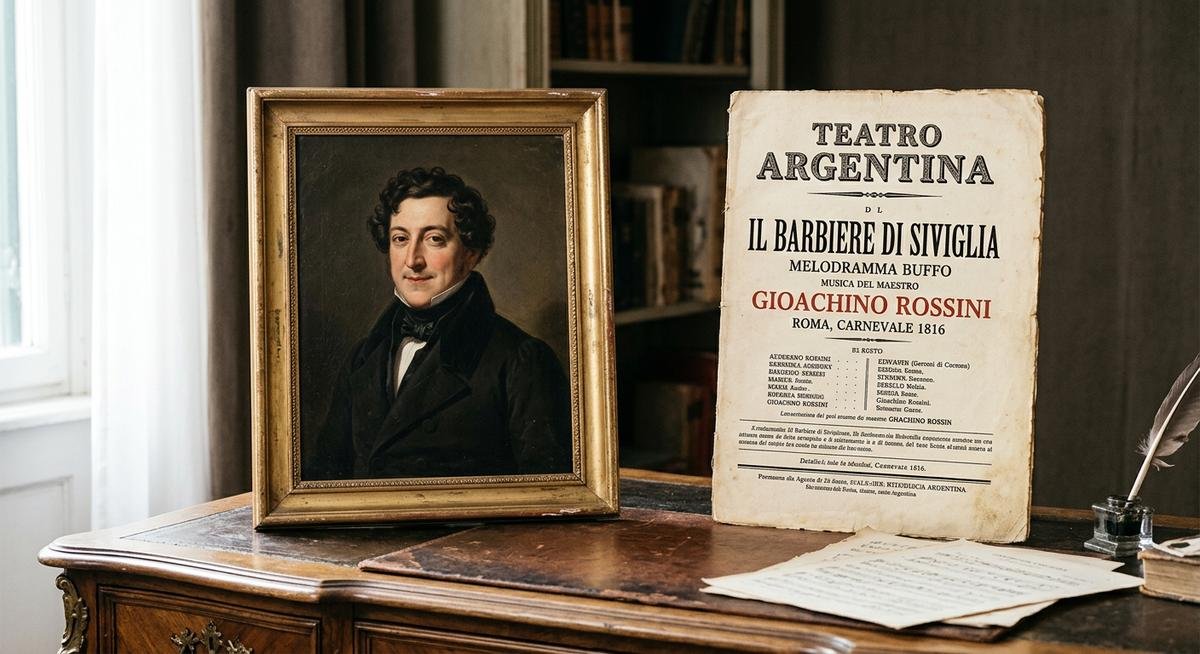
Gioachino Antonio Rossini was born on February 29, 1792, in Pesaro, a coastal town in central Italy. Both his parents were musicians — his father played the horn, his mother sang — and he was composing operas by his late teens. By 25, he was the most famous opera composer in Europe.
His output was staggering: 39 operas in roughly 19 years. He wrote with notorious speed, reportedly composing the overture to The Barber of Seville on the morning of the premiere. Whether that particular story is embellished or not, Rossini’s facility was real. He could produce a full opera in weeks.
Then, at 37, he stopped. After completing William Tell in 1829, Rossini essentially retired from opera and spent his remaining decades in Paris, hosting legendary dinner parties and composing minor works he called his “sins of old age.” He died in 1868. The question of why he quit has puzzled musicologists for nearly two centuries.
| Biographical Detail | Information |
|---|---|
| Full name | Gioachino Antonio Rossini |
| Born | February 29, 1792, Pesaro, Italy |
| Died | November 13, 1868, Passy, France |
| Operas composed | 39 |
| Age at retirement from opera | 37 (after William Tell, 1829) |
| Best-known opera | Il barbiere di Siviglia (1816) |
| Other famous work | William Tell overture (used in The Lone Ranger) |
The Barber of Seville: Rossini’s Comic Masterpiece
Il barbiere di Siviglia premiered at the Teatro Argentina in Rome on February 20, 1816. Opening night was a fiasco. The audience booed, a cat wandered across the stage, a singer tripped through a trapdoor, and a string on one performer’s guitar snapped mid-aria. By the second performance, the crowd was cheering. Within a year, it was the most performed comic opera in Italy.
The plot follows Figaro, a clever barber in Seville who helps the lovesick Count Almaviva win the hand of Rosina, a young woman kept under the jealous watch of her elderly guardian, Dr. Bartolo. Figaro outsmarts Bartolo through a series of increasingly elaborate disguises and schemes. The humor is physical, fast, and built on escalating absurdity — which explains why it translated so naturally into a Bugs Bunny cartoon 134 years later.
The overture is the piece most people recognize, even if they cannot name it. Its galloping string motifs and building crescendos have appeared in television, film, and advertising for over a century. Rossini’s so-called “Rossini crescendo” technique — repeating a melodic phrase while layering more instruments and increasing volume — gives the overture its unmistakable sense of momentum. That propulsive energy is exactly what Chuck Jones needed for slapstick.
Rabbit of Seville: The Cartoon and How It Parodies Rossini
Plot of the 1950 Short
The cartoon opens mid-chase. Elmer Fudd pursues Bugs Bunny through the Hollywood Bowl, and Bugs ducks through a stage door — stranding both of them on an opera stage in front of a live audience. The curtain rises. Rossini’s overture begins. Bugs, ever the opportunist, grabs a barber’s apron and casts himself as Figaro.
What follows is an escalating series of “grooming” gags. Bugs lathers Elmer’s face, whacks his scalp with increasingly violent massages, and shaves him with theatrical flair. Elmer retaliates. Bugs one-ups him. The weapons grow more absurd — axes, mallets, dynamite — but the rhythm never breaks from Rossini’s score. A flower garden sprouts from Elmer’s head. Bugs dresses in drag. The finale features a mock wedding ceremony and Elmer plummeting off a high platform, mirroring the opera’s tradition of chaotic comic resolution.
How the Parody Maps to the Opera
Jones did not merely slap Rossini’s music under a standard cartoon. He built the entire short as a structural parallel to the opera. Bugs takes on Figaro’s role — the wily barber who controls every situation through cleverness and showmanship. Elmer becomes Dr. Bartolo, the fool who tries to assert authority but is perpetually outmaneuvered. The opera stage setting grounds the parody in the source material’s own environment.
| Element | Rossini’s Opera | Bugs Bunny’s Parody |
|---|---|---|
| Clever protagonist | Figaro, the scheming barber | Bugs Bunny as the barber |
| Outwitted antagonist | Dr. Bartolo, Rosina’s guardian | Elmer Fudd, the hapless hunter |
| Setting | A barber shop in Seville, Spain | A Hollywood opera stage |
| Musical backbone | Full opera score with arias and recitatives | Rossini’s overture, arranged by Carl Stalling |
| Comedic method | Disguises, deception, verbal wit | Physical slapstick timed to the music |
| Resolution | Lovers united, Bartolo outwitted | Elmer in a wedding dress, dropped off a cliff |
Chuck Jones and the Music-First Approach
Jones worked with composer and arranger Carl Stalling, who adapted Rossini’s score for the Warner Bros. orchestra. Stalling had a gift for matching musical phrasing to physical comedy, and Rabbit of Seville may be his finest collaboration with Jones. Every razor swipe, every slap, every exaggerated take hits a beat.
Jones described his philosophy in interviews: the music is not accompaniment. It is the script. The animator’s job is to understand the emotional arc of each musical phrase and build the visual gag to serve that arc. A rising Rossini crescendo calls for escalating chaos. A soft melodic passage invites a moment of false calm before the next gag lands. This principle made Rabbit of Seville feel less like a cartoon with music and more like a piece of music that happens to contain a cartoon.
Cultural Legacy: Why Rabbit of Seville Still Matters
A Gateway to Classical Music
Generations of children encountered Rossini’s music for the first time through this cartoon. That is not a small thing. Surveys of classical music listeners frequently cite Looney Tunes as their earliest exposure to the repertoire, and Rabbit of Seville ranks alongside What’s Opera, Doc? as one of the most effective — if unintentional — pieces of music education ever produced.
The short was selected for preservation in the United States National Film Registry by the Library of Congress in 2003, recognized as “culturally, historically, or aesthetically significant.” It regularly appears on “greatest cartoons of all time” lists compiled by animation historians and critics.
Rossini vs. Wagner: Looney Tunes’ Two Opera Parodies
Warner Bros. parodied classical composers repeatedly during the golden age of animation, but two shorts tower above the rest. Rabbit of Seville (1950) takes on Rossini. What’s Opera, Doc? (1957) takes on Wagner. The contrast is revealing.
Rossini’s comedy lends itself to slapstick. The music bounces, accelerates, and builds toward punchlines. Wagner’s drama invites epic grandeur — lightning bolts, helmet horns, and Elmer Fudd singing “Kill the wabbit!” to the melody of Ride of the Valkyries. Jones understood that each composer demanded a different comedic register, and he delivered both flawlessly.
Frequently Asked Questions
Who is the composer parodied in Rabbit of Seville?
Gioachino Rossini (1792-1868), the Italian opera composer. The cartoon parodies his 1816 comic opera The Barber of Seville (Il barbiere di Siviglia), building every gag around the opera’s famous overture.
What opera is Rabbit of Seville based on?
The Barber of Seville by Gioachino Rossini, which premiered in Rome on February 20, 1816. The cartoon adapts the opera’s overture and its central premise — a barber outwitting his adversary through trickery — into a slapstick contest between Bugs Bunny and Elmer Fudd.
What is the crossword answer for “composer parodied in Rabbit of Seville”?
The answer is ROSSINI (7 letters). This clue appears frequently in daily crossword puzzles, sometimes phrased as “Composer spoofed by Bugs Bunny” or “Barber of Seville composer.”
What classical music is used in the Bugs Bunny Rabbit of Seville cartoon?
The cartoon uses the overture and selected passages from Rossini’s The Barber of Seville, arranged for the Warner Bros. studio orchestra by Carl Stalling. The music runs continuously throughout the seven-minute short, with all character actions choreographed to match the score.
What year was the Rabbit of Seville Looney Tunes cartoon released?
Rabbit of Seville was released on December 16, 1950. It was directed by Chuck Jones, animated by Ben Washam and Lloyd Vaughan, and produced by Edward Selzer at the Warner Bros. Cartoons studio.
What is the difference between Rabbit of Seville and What’s Opera, Doc?
Rabbit of Seville (1950) parodies Rossini’s comic opera The Barber of Seville. What’s Opera, Doc? (1957) parodies Wagner’s dramatic operas, particularly Der Ring des Nibelungen and Tannhauser. Both feature Bugs Bunny and Elmer Fudd, both were directed by Chuck Jones, but they draw from opposite ends of the operatic spectrum — comedy versus tragedy.
Is Rabbit of Seville in the National Film Registry?
Yes. The Library of Congress selected Rabbit of Seville for preservation in the National Film Registry in 2003, recognizing it as culturally, historically, and aesthetically significant. It is one of a handful of animated shorts to receive this honor.
Who arranged the music for Rabbit of Seville?
Carl Stalling, the legendary Warner Bros. music director, arranged Rossini’s score for the cartoon. Stalling worked at the studio from 1936 to 1958 and scored over 600 Looney Tunes and Merrie Melodies shorts during his career.
Rossini’s Overture, Bugs Bunny’s Stage
Gioachino Rossini composed The Barber of Seville in 1816. Chuck Jones turned it into a cartoon in 1950. The gap between those two dates — 134 years — is a testament to how durable great music can be. Rossini wrote an overture so rhythmically alive, so perfectly structured for escalation and comedy, that a rabbit with a razor could perform it without changing a note.
Whether you arrived here from a crossword grid, a trivia night, or a childhood memory of Bugs lathering Elmer’s head, the answer is the same: the composer parodied in Rabbit of Seville is Rossini. And the cartoon he inspired remains one of the finest seven minutes in animation history.