




OpenAI is reportedly consolidating its flagship products into a single desktop application. According to The Wall Street Journal and The Information, the company plans to merge ChatGPT, Codex, and a proprietary AI browser codenamed Atlas into one unified platform — a move the industry is already calling the OpenAI superapp.
The strategy borrows from a playbook that worked spectacularly in Asia. WeChat and Grab proved that bundling high-utility services under one roof drives retention, reduces churn, and generates richer user data. OpenAI appears to be betting the same logic applies to AI-powered knowledge work — and that a standalone app can compete with rivals who already control the operating system layer.
No official release date has been confirmed. But the leaked details, combined with OpenAI’s recent product cadence, paint a clear picture of where the company is headed.
What Is a Superapp — and Why Is OpenAI Building One?
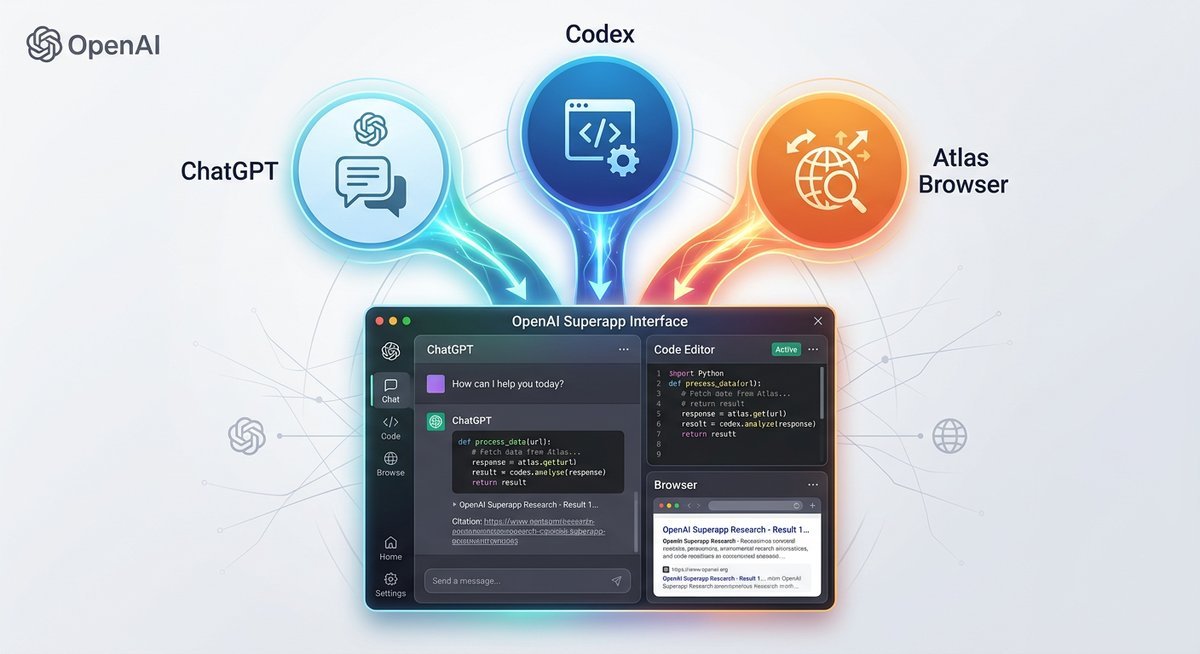
A superapp consolidates multiple high-utility services into a single application, eliminating context-switching and capturing a user’s entire workflow in one place. OpenAI’s reported version would combine conversational AI, code generation, and web browsing — three tools that developers and knowledge workers currently access through separate products.
The Superapp Model, Briefly
Tencent’s WeChat is the textbook case. Launched in 2011 as a messaging app, it expanded into payments, commerce, government services, and ride-hailing — all inside one interface. Grab followed a similar arc across Southeast Asia. The strategic logic is the same every time: keep users inside the platform, capture behavioral data across tasks, and make the product progressively harder to leave.
OpenAI’s version targets a different domain — AI-powered productivity — but the mechanics are identical. Every time a user Alt-Tabs from ChatGPT to a browser to an IDE, OpenAI loses context, data, and engagement. A unified app solves that.
| Superapp | Region | Services Bundled | Key Metric |
|---|---|---|---|
| China | Messaging, payments, commerce, services | 1.3B+ monthly active users | |
| Grab | Southeast Asia | Rides, food delivery, finance | Dominant in 8 countries |
| OpenAI Superapp (reported) | Global | AI chat, code generation, AI-native browsing | Not yet launched |
Why OpenAI Is Making This Move Now
Microsoft Copilot ships pre-installed on every new Windows machine. Google Gemini is embedded in Search, Workspace, and Android. Apple Intelligence runs at the OS level on iPhones and Macs. All three enjoy a distribution advantage OpenAI simply cannot match — their AI products reach users before those users ever make a conscious choice.
A standalone superapp is OpenAI’s counterpunch. Instead of depending on Microsoft’s platform (which hosts ChatGPT through a partnership, but also competes with it via Copilot), OpenAI would own the full user experience. Persistent cross-tool memory, shared context between chat and code, and a built-in browser — these features create switching costs that a chatbot alone cannot.
There is also a timing factor. The early-adopter phase of AI tools is fading. The next cohort of users — enterprise teams, freelance developers, analysts — expects integrated tooling, not a collection of browser tabs. OpenAI needs to meet that expectation before someone else does.
Inside the App: ChatGPT, Codex, and Atlas
The OpenAI superapp reportedly combines three products that currently exist as separate offerings: ChatGPT for conversation and reasoning, Codex for code generation, and Atlas for AI-native web browsing. Each component serves a distinct function, but the real value proposition is shared context — the ability to pass information seamlessly between all three without leaving the app.
ChatGPT — The Conversational Layer
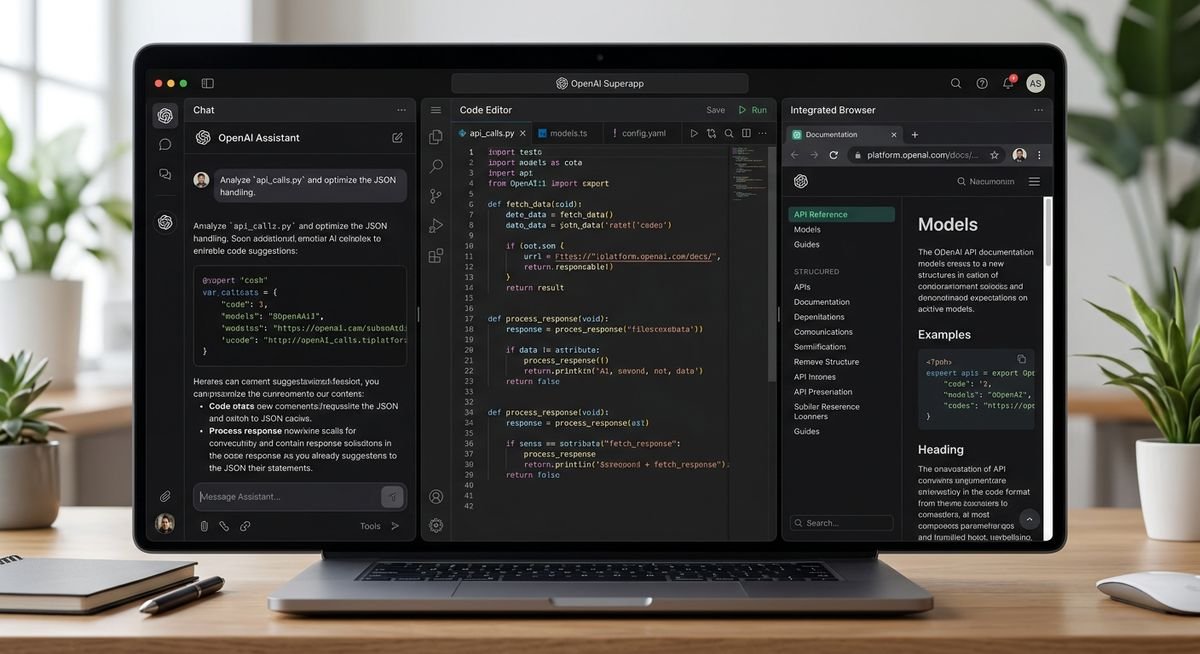
ChatGPT serves as the front door. Every interaction — a question, a vague idea, a request to summarize a 40-page PDF — starts here. Inside the superapp, ChatGPT reportedly acts as the orchestration layer too: it can hand tasks to Codex for code generation or instruct Atlas to fetch and summarize web content, then stitch the results into a single response.
That orchestration role is what separates a superapp from a bundle. ChatGPT would not just coexist with Codex and Atlas — it would coordinate them.
Codex — The Coding Engine
Codex handles software development. OpenAI fine-tuned it specifically for code generation across multiple programming languages. Inside the superapp, a developer could describe a feature in plain English to ChatGPT, have Codex generate the implementation, then use Atlas to pull in relevant API documentation — all within the same session, with full context preserved.
The standalone version of Codex already powers GitHub Copilot. Embedding it directly into a unified platform removes the dependency on a third-party IDE and gives OpenAI more control over the developer experience.
Atlas — The AI-Native Browser
Atlas is the least confirmed and most interesting component. Reported by The Information, it is described as a proprietary browser built from the ground up with AI at the browsing layer — not bolted on as an extension. That would mean real-time page summarization, agentic multi-step web research, and the ability to carry findings directly into ChatGPT or Codex without manual copy-pasting.
Standard browsers treat AI as an afterthought. Atlas, if the reports are accurate, treats it as the default mode of interaction. That distinction matters. Browser data is among the richest behavioral signals available, and controlling that layer gives OpenAI visibility into how users research, decide, and act online.
| Component | Primary Function | Superapp Role |
|---|---|---|
| ChatGPT | Conversation, reasoning, summarization | Orchestration hub — routes tasks to Codex and Atlas |
| Codex | Code generation, debugging, refactoring | Development engine with natural-language input from ChatGPT |
| Atlas (reported) | AI-native web browsing and research | Data and context pipeline — feeds research into the other two |
Who Benefits Most — Real-World Use Cases
Three audience segments stand to gain the most from a unified OpenAI superapp: developers who currently split their work across an IDE, a browser, and a chat window; knowledge workers who run research-to-report pipelines across disconnected tools; and power users tired of managing multiple AI subscriptions.
For Developers
A backend engineer scoping a new authentication feature currently opens at least three tools: a ChatGPT tab for reasoning through edge cases, a code editor for implementation, and a browser for documentation. The OpenAI superapp would collapse that into one session. Prompt ChatGPT to outline the requirements, hand it to Codex for the initial code, and let Atlas pull live API docs — all with shared context, no copy-pasting between windows.
That uninterrupted flow is where productivity actually compounds. Every Alt-Tab is a micro-interruption. Eliminate enough of them and the cumulative time savings are significant.
For Business and Knowledge Workers
A marketing analyst researching competitive positioning currently bounces between a search engine, a note-taking app, and ChatGPT. With the superapp, Atlas handles the browsing and aggregation, ChatGPT summarizes and identifies patterns, and the platform remembers everything from an hour ago without needing to be re-prompted.
Persistent memory across research, synthesis, and drafting phases is the key differentiator. Point solutions lose context between sessions. An integrated platform retains it.
For Power Users and Early Adopters
General-purpose AI users face a quieter problem: subscription fatigue. A separate web search AI, a separate writing assistant, a separate coding helper — the costs and cognitive overhead add up. One app that handles all three reduces both financial and mental friction.
Early adopters are also the users most likely to push agentic features — automated multi-step tasks, autonomous web research — to their limits. They will be the first real stress test of whether the superapp model works for AI the way it worked for WeChat.
| Audience | Primary Workflow Gain | Key Features Used |
|---|---|---|
| Developers | Uninterrupted code-research-debug loop | Codex + Atlas + ChatGPT context sharing |
| Knowledge Workers | Persistent research-to-report pipeline | Atlas browsing + ChatGPT summarization |
| Power Users | Subscription consolidation, reduced tab-switching | Unified AI assistant + agentic automation |
OpenAI Superapp vs. Copilot, Gemini, and Apple Intelligence
OpenAI’s superapp is the only major AI platform being built as a standalone, cross-platform desktop application. Microsoft Copilot, Google Gemini, and Apple Intelligence are all tightly coupled to ecosystems their parent companies already control — and that architectural difference shapes everything about how each product competes.
| Platform | Deployment | Native Browser | Code Generation | Ecosystem Lock-in |
|---|---|---|---|---|
| OpenAI Superapp | Standalone desktop app | Yes (Atlas, reported) | Yes (Codex, built-in) | None — cross-platform |
| Microsoft Copilot | Embedded in Windows/Office | No (Edge is separate) | Via GitHub Copilot (separate product) | High — Microsoft 365 |
| Google Gemini | Embedded in Search/Workspace | No (Chrome is separate) | Limited (Gemini Code Assist) | High — Google ecosystem |
| Apple Intelligence | OS-level, Siri-integrated | No | No | Very high — Apple hardware only |
Copilot is powerful inside Microsoft’s walls but remains an enhancement layer, not a destination. Gemini faces the same constraint — it strengthens Google’s existing products rather than replacing the browser as a primary workspace. Apple Intelligence is the most locked-in of all, restricted to Apple hardware and tied to Siri’s existing architecture.
OpenAI’s independence is both its vulnerability and its weapon. No pre-installed distribution. No captive user base. But also no ecosystem constraints — the superapp can run on any desktop OS and does not need to serve another company’s product priorities. A developer on a Linux machine running the OpenAI superapp would have integrated chat, code, and browsing in one place. None of the other three platforms can offer that.
Frequently Asked Questions
What is the OpenAI superapp?
The OpenAI superapp is a reported desktop application that combines ChatGPT (conversational AI), Codex (code generation), and a proprietary AI browser called Atlas into a single unified platform. Instead of switching between separate tools, users would access all three inside one interface with shared context and persistent memory.
When will the OpenAI superapp be available?
No official release date has been announced. Reports from The Wall Street Journal (March 2026) indicate the superapp is in active development. OpenAI has not confirmed a public timeline, though the company’s recent pace of product launches suggests a release could come within 2026.
What is the Atlas browser?
Atlas is a proprietary web browser OpenAI is reportedly building from scratch with AI embedded at the core — not as an extension. It would offer real-time page summarization, autonomous multi-step research, and direct integration with ChatGPT and Codex. Details remain limited, as OpenAI has not made an official announcement about Atlas.
How does the OpenAI superapp compare to Microsoft Copilot?
Microsoft Copilot is an AI layer embedded within Windows and Microsoft 365 — powerful inside that ecosystem, but not a standalone platform. The OpenAI superapp is being designed as an independent desktop application with its own browser, code engine, and conversational AI. Copilot enhances existing Microsoft products; the superapp aims to replace several separate tools entirely.
Will the OpenAI superapp be free?
Pricing has not been announced. Given that ChatGPT Plus currently costs $20/month and ChatGPT Pro costs $200/month, the superapp will likely follow a tiered subscription model. Enterprise pricing for team features is also probable, based on OpenAI’s existing business tiers.
What platforms will the superapp support?
Reports describe a desktop application, and OpenAI already distributes a macOS and Windows version of ChatGPT. The superapp would likely support both operating systems. Linux support has not been mentioned in any reports, though a web-based fallback is possible.
What Comes Next
OpenAI’s superapp bet is straightforward: own the workspace, not just the chatbot. If the company can ship a desktop application that genuinely makes ChatGPT, Codex, and Atlas feel like one product — with shared memory, seamless task handoffs, and a browser that treats AI as native rather than accessory — it would represent the most significant shift in how people interact with AI tools since ChatGPT launched in late 2022.
The competitive stakes are equally clear. Microsoft, Google, and Apple all have distribution advantages OpenAI lacks. A superapp does not change that overnight. But it gives OpenAI something those rivals do not currently offer: a single, platform-independent workspace where conversation, code, and web browsing share the same context. Whether that vision ships intact — and whether users actually prefer it over ecosystem-integrated alternatives — is the question that 2026 will answer.