




Imagine this scenario: a property has been on the market for three weeks, and the seller has finally accepted a strong offer. Just days before the final inspection, the fifteen-year-old HVAC system fails completely. Suddenly, an $8,000 replacement bill threatens to derail the entire transaction. This is the exact moment when a seller’s home warranty transforms from an optional perk into a critical financial safety net.
Navigating real estate transactions requires strategic foresight, and understanding how to leverage warranty products can significantly impact both the final sale price and the speed of the transaction. This guide explores the mechanics of home warranties from the seller’s perspective, analyzes the concrete return on investment, identifies situations where they provide the most value, and reveals when they may be an unnecessary expense.
1. Understanding the Seller’s Home Warranty
Answer Capsule: A seller’s home warranty is a service contract that covers the repair or replacement of major household systems and appliances while a property is listed for sale. Unlike homeowners insurance, which covers structural damage from catastrophic events, a home warranty addresses mechanical failures caused by normal wear and tear. Coverage typically activates during the listing period and transfers to the buyer upon closing for a full year of protection.
The architecture of a home warranty is fundamentally different from standard property insurance. Homeowners insurance acts as a shield against external perils — fires, storms, theft — whereas a home warranty functions as an operational safety net for the internal machinery of the house. When a seller purchases this contract, the warranty company agrees to dispatch licensed technicians to resolve covered breakdowns, charging only a nominal service fee rather than the full retail cost of the repair.
Many major providers offer a specific “Seller Coverage Option.” This feature provides the seller with protection for up to six months while the property is actively listed. Remarkably, the premium for this coverage is often deferred until the closing date, meaning the seller pays nothing upfront to secure listing period protection. The cost is simply deducted from the sale proceeds at settlement.
It is equally important to understand what a home warranty does not cover. Standard contracts explicitly exclude pre-existing conditions, cosmetic damage, improper installation, and routine maintenance failures. A system that was already malfunctioning before the policy’s effective date will not be covered, which is why purchasing the warranty at the time of listing — rather than after a breakdown occurs — is the only sound strategy.
2. How Much Does a Home Warranty Cost a Seller?
Answer Capsule: The average cost of a comprehensive home warranty ranges from $400 to $700 per year, though premium plans with extensive add-ons can reach $1,050. In addition to the annual premium, the policyholder pays a service call fee — typically between $75 and $150 — each time a technician is dispatched for a repair. For sellers, the premium is usually deducted directly from the sale proceeds at closing, requiring zero out-of-pocket capital during the listing phase.
Understanding the cost-to-benefit ratio requires examining the potential expenses a seller might face without coverage. The service fee acts as a deductible, capping the financial exposure for sudden breakdowns. Replacing a central air conditioning unit can cost between $6,500 and $12,000 out of pocket, while a new water heater installation averages $1,200. A warranty effectively mitigates these high-severity, low-frequency financial shocks for a fraction of the potential cost.
| System / Appliance | Average Out-of-Pocket Replacement Cost | Seller’s Cost with Home Warranty |
|---|---|---|
| HVAC System | $6,500 – $12,000 | $75 – $150 (service fee only) |
| Water Heater | $800 – $1,500 | $75 – $150 (service fee only) |
| Refrigerator | $1,000 – $2,500 | $75 – $150 (service fee only) |
| Electrical Panel | $1,200 – $2,000 | $75 – $150 (service fee only) |
| Annual Warranty Premium | N/A | $400 – $1,050 (paid at closing) |
It is crucial to note that warranty contracts enforce specific coverage limits. Some providers cap HVAC replacement payouts at $1,500 during the seller’s listing period, regardless of the actual replacement cost. Sellers must meticulously review the contract terms to understand these financial ceilings before assuming total immunity from repair costs. The fine print determines the real value of the policy.
3. The Concrete ROI of Offering a Home Warranty
Answer Capsule: Offering a home warranty delivers a measurable return on investment by accelerating the sale process and preserving the asking price. Survey data cited by American Home Shield indicates that homes sold with a warranty spend 16.14% fewer days on the market and command a 0.91% higher final sale price compared to properties without coverage. The presence of a warranty also significantly reduces buyer friction during the inspection phase, preventing costly post-inspection price renegotiations.
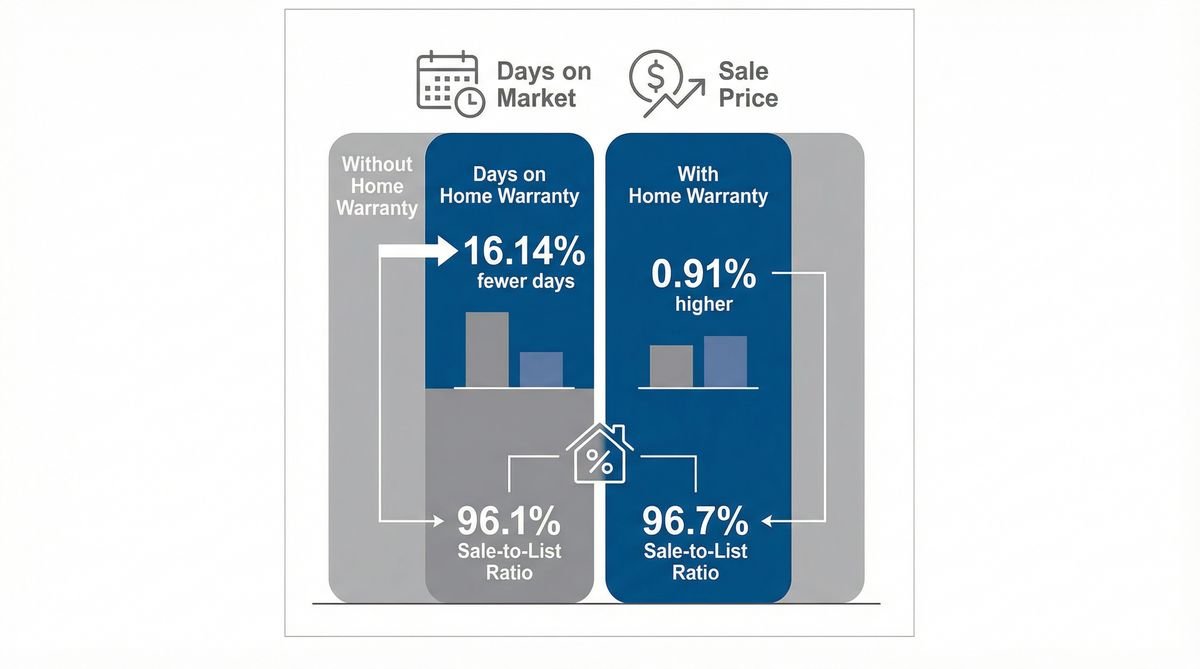
The psychological impact of a home warranty on prospective buyers cannot be overstated. First-time homebuyers, in particular, often deplete their liquid savings to secure a down payment, leaving them highly vulnerable to immediate post-closing repair costs. By attaching a one-year warranty to the listing, the seller neutralizes this anxiety. This enhanced buyer confidence translates directly into stronger, more competitive offers and a reduced likelihood of buyers walking away after the inspection.
During the critical home inspection period, minor defects frequently trigger aggressive renegotiation tactics. If an inspector notes that a furnace is nearing the end of its functional lifespan, a buyer might demand a $5,000 credit. A pre-existing home warranty preempts this demand — the seller can point to the warranty as the designated solution for future mechanical failures, thereby protecting the seller’s net equity. Trading a $500 annual premium for a $5,000 concession is a straightforward financial calculation.
4. When Is a Home Warranty NOT Worth It for Sellers?
Answer Capsule: A home warranty is not a universal necessity and may be a wasted expense in specific scenarios. Sellers of newly constructed homes, properties that have undergone recent gut-renovations, or homes where all major appliances are already covered by active manufacturer warranties derive little value from these contracts. Additionally, in hyper-competitive seller’s markets where buyers routinely waive inspection contingencies, offering a warranty provides no meaningful strategic advantage.
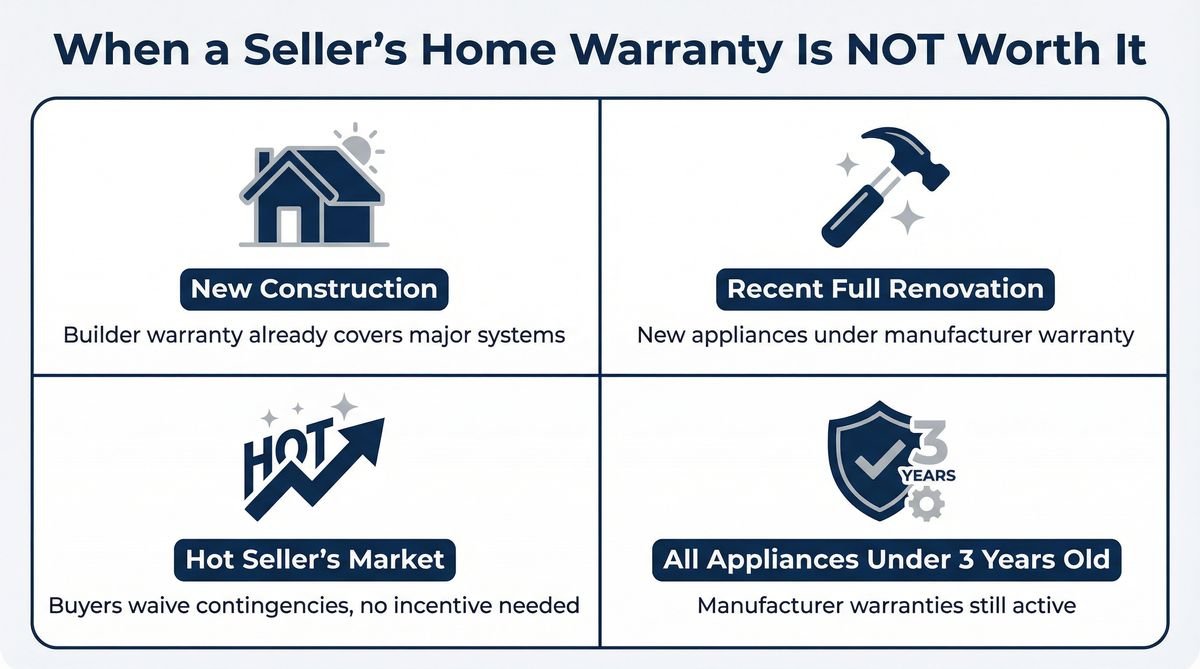
While warranty companies heavily market their products to all real estate demographics, discerning sellers must evaluate their specific property profile. New construction homes inherently include builder warranties that comprehensively cover structural and mechanical components for one to ten years. Layering a third-party home warranty over these existing guarantees creates redundant coverage and wastes capital that could be better deployed elsewhere in the transaction.
Market dynamics also dictate the necessity of warranty incentives. In a fierce seller’s market characterized by bidding wars and cash offers, buyers are highly motivated to secure the property regardless of the mechanical age of appliances. In these environments, sellers hold the leverage and do not need to sweeten the deal with a service contract. Conversely, in a sluggish buyer’s market, the warranty becomes a vital differentiation tool that makes the listing stand out against competing inventory and gives hesitant buyers the confidence to proceed.
5. Strategic Negotiation: Using the Warranty as a Closing Tool
Answer Capsule: The home warranty serves as a highly effective negotiation instrument during real estate transactions. When a seller proactively offers a warranty, it signals transparency and confidence in the property’s condition. Alternatively, if a buyer requests a warranty during negotiations, the seller can agree to fund it in exchange for the buyer waiving minor repair requests — effectively trading a fixed $500 premium for thousands of dollars in potential concession savings.
The allocation of the warranty premium is entirely negotiable. While it is customary for the seller to pay the premium to incentivize the buyer, the buyer’s agent will occasionally purchase the warranty as a closing gift for their client. The most strategic use of the warranty for a seller occurs during the resolution of inspection contingencies.
Consider a practical scenario: an inspection reveals an aging but currently functional water heater. The buyer requests a $1,500 credit for future replacement. The seller can counter this demand by offering a $500 home warranty that covers the water heater if it fails during the buyer’s first year of ownership. This strategy satisfies the buyer’s need for security while saving the seller $1,000 in closing credits. The warranty becomes a precision tool for protecting the seller’s bottom line, not merely a marketing amenity.
Frequently Asked Questions
Does the seller’s home warranty transfer to the buyer?
Yes, transferability is the core design of a real estate home warranty. The seller utilizes the listing period coverage while the home is on the market. Upon the successful closing of the transaction, the contract officially transfers to the buyer, initiating a full 12-month period of coverage for the new homeowner. The transfer mechanics vary by provider — some transfer automatically, while others require a brief administrative step at closing.
What happens if a claim is denied during the listing period?
Warranty providers can deny claims if the breakdown is attributed to pre-existing conditions, improper installation, or a severe lack of routine maintenance. If a claim is denied while the seller occupies the home, the seller is responsible for the full out-of-pocket repair cost. Maintaining accurate service records for all major systems is essential to prevent denial based on maintenance neglect. Sellers should request a copy of the warranty’s exclusions list before purchasing the policy.
Can a seller purchase a home warranty after listing the property?
Sellers can purchase a home warranty after the property has been listed on the market. However, most warranty companies impose a mandatory 30-day waiting period before coverage activates, specifically to prevent homeowners from buying a policy only after a system has already broken down. Purchasing the policy concurrently with the listing agreement — before any issues arise — is the most secure and strategically sound approach.
Are pre-existing conditions covered under a seller’s warranty?
Standard home warranties explicitly exclude pre-existing conditions. If an appliance or system was broken or visibly deteriorating before the warranty contract was initiated, the provider will not cover the repair. The item must be in safe, working order on the effective date of the policy. Some premium plans offer limited “unknown pre-existing condition” coverage for buyers after closing, but this provision rarely applies to the seller’s listing period coverage.
Conclusion
Determining whether a home warranty is worth it for a seller requires a calculated assessment of the property’s age, the current market climate, and the seller’s risk tolerance. For the vast majority of sellers with homes older than five years, the strategic advantages heavily outweigh the costs. By providing listing period protection against catastrophic mechanical failures and serving as a powerful negotiation tool to secure buyer confidence, a home warranty acts as a highly effective insurance policy for the real estate transaction itself.
Sellers of new construction or those operating in hyper-aggressive seller’s markets can safely bypass this expense. For everyone else, a $500 investment at closing is a small price to pay for accelerated sales, protected equity, and the kind of peace of mind that keeps a deal on track from listing day to closing day.
References
- CRES Insurance. “Home Warranties: Do they Really Help Sell Homes?” 2025. Data sourced from American Home Shield survey on sale price and days-on-market impact.
- American Home Shield. “Benefits of a Home Warranty for Sellers.” February 2026.
- Today’s Homeowner. “Home Warranty Statistics & Facts.” March 2026.
- Angi. “Sellers Home Warranty: Should You Get One?” March 2026.