



Tencent rolled out official WeChat OpenClaw integration in early 2026, according to reporting by Channel News Asia and the Times of India, enabling AI agents built on large language models to operate natively inside WeChat conversations, group chats, and Official Account interfaces. That single move dropped a fully orchestrated agent framework into an app already handling payments, social networking, mini-programs, and enterprise communication for 1.3 billion monthly active users.
OpenClaw itself is an open-source AI agent runtime — think of it as the middleware layer between any LLM backend (GPT-4, Claude, Qwen, DeepSeek) and WeChat’s messaging infrastructure. Developers who have been manually wiring chatbots to WeChat through fragile web-protocol hacks or limited Official Account webhooks now have a structured, Tencent-endorsed path. That path runs through the WeChat Open Platform, relies on OAuth2 and OpenID for authentication, and opens doors to both personal WeChat and enterprise WeCom deployments.
The practical question for developers, businesses, and curious technical users is the same: how do you actually build on this stack? Everything below breaks down the platform architecture, the key developer tools, the top open-source projects, and the compatibility issues that trip people up most often.
What Is OpenClaw and How Does It Connect to WeChat?
OpenClaw is an open-source AI agent framework that routes large language model outputs through messaging platforms, handling context management, tool-calling, and multi-turn conversation logic so developers avoid rebuilding that infrastructure from scratch. Tencent’s March 2026 integration made WeChat a first-class OpenClaw channel, allowing agents to send and receive text, images, voice messages, and mini-program cards through WeChat’s native message types.
On GitHub, the OpenClaw WeChat ecosystem spans over 200 repositories as of early 2026. The most prominent — freestylefly/openclaw-wechat (1,500+ stars) — provides a TypeScript-based connector for personal WeChat accounts using QR code authentication and proxy-based architecture. For enterprise deployments, dingxiang-me/OpenClaw-Wechat (499 stars) connects directly to WeCom’s official API with streaming output, group chat support, and visual configuration dashboards.
According to Tencent Cloud’s developer documentation (2026), the integration supports three operating modes: standalone agent, Bot API callback, and persistent WebSocket connection. Each mode trades off latency against infrastructure complexity. The WebSocket path delivers sub-second response times but requires a persistent server; the Bot API callback works with serverless deployments but adds round-trip overhead.
OpenClaw vs. OpenClash — Clearing Up the Name Confusion
Search results for “openclash wechat” consistently mix up two completely unrelated products. OpenClash (vernesong/OpenClash, 24,900+ GitHub stars) is a Clash proxy client for OpenWrt routers — it handles network-level traffic routing for Shadowsocks, Vmess, and Trojan protocols. Zero overlap with AI agents, chatbots, or WeChat development. The phonetic similarity causes genuine confusion, and developers have wasted hours reading OpenClash documentation expecting to find WeChat integration instructions. If the project README mentions router firmware or proxy rules, wrong repo.
WeChat Open Platform, Official Accounts, and WeChat Pay
The WeChat Open Platform (open.weixin.qq.com) is Tencent’s unified developer portal governing third-party access to WeChat’s user base — and every OpenClaw integration ultimately routes through its authorization and identity infrastructure. Registered developers gain access to mobile and web SDKs, Mini Program APIs, Official Account management endpoints, and the OAuth2 authentication flow that gates all user data access.
According to Tencent’s 2025 annual report, over 4.5 million Mini Programs operate on the WeChat Open Platform, processing transactions across retail, travel, healthcare, and government services. That ecosystem scale matters for OpenClaw developers because an AI agent can be embedded not just in chat conversations but also inside Mini Programs — serving as an intelligent assistant within a booking flow, a customer service layer, or an interactive product advisor.
Official Accounts (WeChat OA)
WeChat Official Accounts split into two types: Subscription Accounts for content publishing (daily push notifications, article feeds) and Service Accounts for transactional interactions (customer service, order notifications, payment triggers). Service Accounts get verified API access with higher rate limits and richer message types — making them the natural home for OpenClaw agent deployments facing external customers.
A WeChat OA with Service Account verification can receive user messages via webhook callback, process them through an OpenClaw agent pipeline, and return structured responses including text, images, articles, and mini-program cards. The five-second response timeout on synchronous replies means latency-sensitive agent architectures must use asynchronous customer-service messaging mode instead.
WeChat Pay Open Platform
The WeChat Pay Open Platform enables merchants and developers to integrate payment processing directly into their applications via JSAPI, Native, H5, and Mini Program payment flows. For OpenClaw agents handling commercial interactions — product recommendations, subscription management, booking confirmations — WeChat Pay integration means the agent can trigger and track transactions without pushing users to an external checkout page. According to Tencent’s Q4 2025 earnings call, WeChat Pay processes over 1 billion transactions daily across its merchant network.
Developer Authentication — OpenSDK, OpenID, and OAuth2
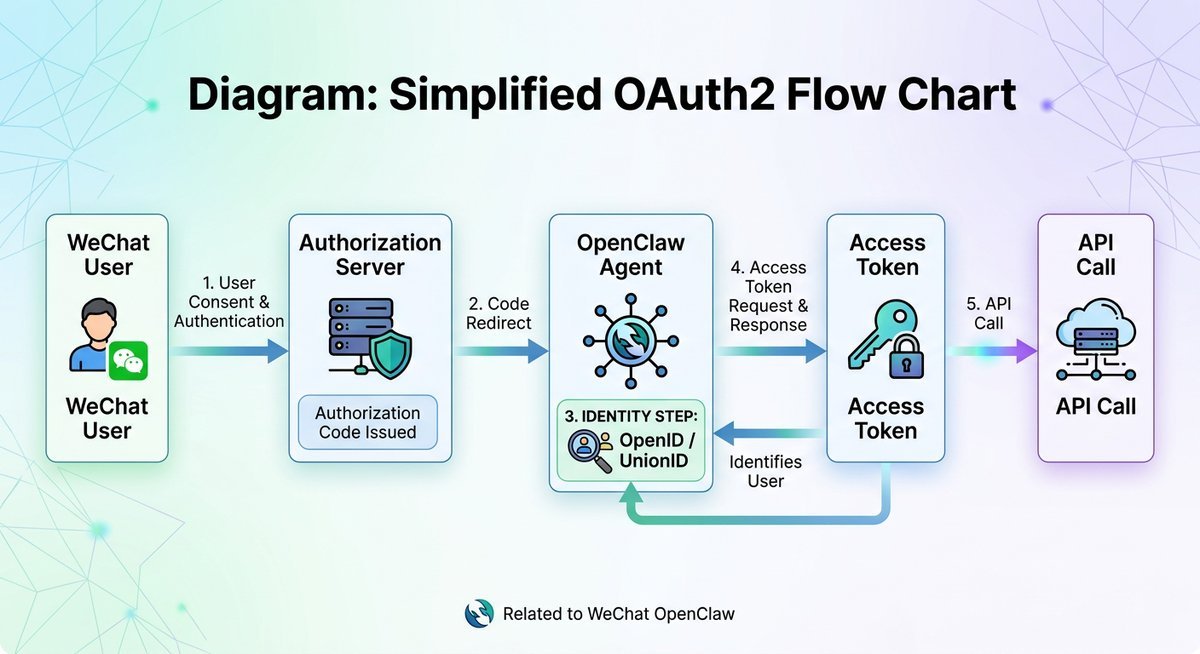
WeChat OpenSDK, OpenID, and OAuth2 form the three-layer authentication stack that every OpenClaw agent must navigate before it can send or receive a single message. The SDK handles client-side integration, OAuth2 manages the authorization handshake, and OpenID resolves user identity. Get any one of these layers wrong and the agent fails silently — no error message, just a dead connection. Most first-time developers hit this wall within the first hour.
WeChat OpenSDK
The WeChat OpenSDK ships as native libraries for iOS (Swift/Objective-C) and Android (Java/Kotlin), plus a JavaScript SDK for web applications. Core capabilities include social login (one-tap WeChat sign-in), content sharing to conversations and Moments, and payment invocation. For OpenClaw developers, the SDK’s primary role is bootstrapping the OAuth2 flow — the SDK handles the platform-specific handshake with WeChat’s authorization server so the agent backend receives a clean authorization code without managing platform quirks directly.
OpenID vs. UnionID — The Identity Split
WeChat OpenID is scoped per application: the same user generates a different OpenID for each Official Account, Mini Program, or Open Platform app they interact with. UnionID solves cross-application identity — a single stable identifier tied to all apps registered under one developer account on the WeChat Open Platform.
| Identifier | Scope | Use Case | Requires Open Platform? |
|---|---|---|---|
| OpenID | Per-app | Single-surface agent, basic user tracking | No |
| UnionID | Cross-app (same developer) | Multi-surface OpenClaw deployments, unified user profiles | Yes |
In practice, developers building an OpenClaw agent that spans a WeChat OA and a Mini Program must use UnionID to recognize the same person across both surfaces. Skipping the Open Platform linkage step is one of the most common reasons cross-surface integrations silently treat one user as two separate identities.
WeChat implements the OAuth2 authorization code grant. The user scans a QR code or taps an authorization button, WeChat issues a temporary code, the application backend exchanges that code for an access token and refresh token, and the token gates all subsequent API calls. Two scope levels exist: snsapi_base (silent redirect, returns only OpenID) and snsapi_userinfo (explicit consent screen, returns profile data including nickname, avatar, and region).
For OpenClaw agents, the scope choice has architectural consequences. A passive assistant that just needs to identify callers operates cleanly on snsapi_base. An agent personalizing responses by location or user history needs snsapi_userinfo — and must surface the consent prompt, which adds friction but unlocks richer context.
Building AI Chatbots on WeChat — GPT, OpenAI, and Open Group Chat
Connecting OpenAI’s GPT models (or any OpenAI-compatible endpoint) to WeChat is the single most popular use case driving the OpenClaw ecosystem, with zhayujie/chatgpt-on-wechat accumulating 42,400+ GitHub stars (as of March 2026) as the dominant open-source solution. The project supports GPT-4, Claude, Gemini, DeepSeek, and locally hosted models through a unified plugin architecture — and it works across personal WeChat, WeCom, and Official Accounts from a single codebase.
For personal WeChat open group chat automation, the setup involves authenticating via QR code scan, configuring trigger keywords or mention-based activation, and routing messages through the OpenClaw agent pipeline. Group chat deployments face a hard practical ceiling: Tencent actively detects bot-like behavior patterns and suspends accounts exhibiting automated message loops. Developers have lost months of work overnight to sudden bans. Realistic personal WeChat use cases stay narrow — private assistant bots, small group automation, or quick prototyping before committing to an enterprise WeCom deployment.
| Repository | Stars | WeChat Target | AI Backend Support | Best For |
|---|---|---|---|---|
| zhayujie/chatgpt-on-wechat | 42.4k | Personal + WeCom + OA | GPT-4, Claude, Gemini, DeepSeek, local LLMs | Production multi-channel deployment |
| freestylefly/openclaw-wechat | 1.5k | Personal WeChat | OpenClaw-native, OpenAI-compatible | Personal WeChat AI assistant |
| dingxiang-me/OpenClaw-Wechat | 499 | Enterprise WeChat (WeCom) | OpenClaw agents, multi-model | Enterprise customer service bots |
| HenryXiaoYang/wechat-openclaw-channel | 612 | Personal WeChat | OpenClaw via WebSocket gateway | Personal bot with OpenClaw runtime |
WeCom deployments sidestep the account-ban risk entirely. Tencent’s enterprise API provides stable, versioned REST endpoints specifically designed for programmatic access — message sending, contact management, and event callbacks all work through official channels with documented rate limits and no reverse-engineering required.
WeChat Compatibility — Zscaler, OpenKylin, Klook, and Open Class
Several frequently searched compatibility topics fall outside the core OpenClaw developer workflow but directly affect teams trying to use WeChat in enterprise, Linux, or travel contexts. Each one has a specific resolution path that is frustratingly absent from Tencent’s official documentation.
| Topic | Issue | Resolution |
|---|---|---|
| WeChat + Zscaler | SSL inspection breaks WeChat connections | Add *.weixin.qq.com and *.wechat.com to Zscaler SSL bypass list; configure PAC file exceptions |
| WeChat + OpenKylin | No native Linux WeChat client | Use Wine-based installation, Flatpak community package, or web.wechat.com (limited features) |
| WeChat + Klook | Booking integration via Mini Programs | Klook operates a WeChat Mini Program for tour and attraction bookings accessible directly in-app |
| WeChat Open Class | Finding official developer training | Tencent’s annual WeChat Open Class conference shares platform updates, API roadmaps, and case studies |
Zscaler and WeChat — The SSL Inspection Problem
Organizations running Zscaler Internet Access (ZIA) frequently discover that WeChat stops connecting after Zscaler is deployed. The root cause is SSL/TLS inspection: Zscaler intercepts and re-signs HTTPS traffic, and WeChat’s client performs certificate pinning that rejects the re-signed certificates. According to Zscaler’s own knowledge base (2025), the fix requires adding WeChat domains (*.weixin.qq.com, *.wechat.com, and *.wx.qq.com) to the SSL inspection bypass list and configuring URL category exceptions. Without these exceptions, WeChat login, messaging, and payment functions all fail silently.
WeChat on OpenKylin
OpenKylin, China’s first community-driven open-source desktop operating system, lacks an official native WeChat client. Current workarounds include running the Windows WeChat binary through Wine (functional but resource-heavy), using community-maintained Flatpak or Snap packages that bundle compatibility layers, or falling back to the web-based WeChat at web.wechat.com — which Tencent has been progressively restricting in functionality since 2023.
Klook and WeChat Open Class
Klook, the Hong Kong-based travel booking platform, operates a WeChat Mini Program that lets users browse and book tours, theme park tickets, airport transfers, and travel SIM cards without leaving the WeChat interface. The integration leverages WeChat Pay for seamless checkout — a pattern that over 4,000 travel and hospitality brands now replicate through the Mini Program framework.
WeChat Open Class (wechat open class, or 微信公开课) is Tencent’s annual developer conference series where product teams share platform updates, new API capabilities, upcoming policy changes, and real-world case studies from high-performing Mini Programs and Official Accounts. The 2025 edition focused heavily on AI integration pathways — including the OpenClaw framework — signaling Tencent’s strategic commitment to making WeChat the default deployment surface for conversational AI in China.
Frequently Asked Questions
Is WeChat popular in China?
WeChat is the dominant messaging and super-app platform in China, with over 1.3 billion monthly active users as of late 2025 according to Tencent’s official earnings reports. Virtually every smartphone user in mainland China has WeChat installed, and the app handles everything from personal messaging and social networking to mobile payments, government services, and business communication. No competing app in China comes close to matching its daily usage penetration.
What is the difference between OpenClaw and OpenClash?
OpenClaw is an AI agent framework for connecting large language models to messaging platforms like WeChat. OpenClash is a Clash proxy client for OpenWrt routers used for network traffic routing. They share phonetically similar names but have zero technical overlap — OpenClash manages VPN and proxy connections at the router firmware level, while OpenClaw orchestrates conversational AI agents at the application level.
How does WeChat OAuth2 authentication work?
WeChat uses the OAuth2 authorization code grant flow. Users scan a QR code or tap an authorize button, WeChat generates a temporary authorization code, and the developer’s backend exchanges that code for an access_token and openid. The process supports two scopes: snsapi_base for silent login (returns only OpenID) and snsapi_userinfo for explicit consent (returns full user profile data).
Can I use ChatGPT or GPT models on WeChat?
Yes, through open-source projects like chatgpt-on-wechat (42,400+ GitHub stars), which connects OpenAI’s GPT-4 and other LLMs to personal WeChat, WeCom, and Official Accounts. The setup requires a WeChat account for authentication, an API key from your chosen LLM provider, and a server to run the bot. Enterprise deployments through WeCom are more stable than personal WeChat bots, which risk account suspension from automated messaging detection.
What is the difference between WeChat OpenID and UnionID?
OpenID is a per-application user identifier — the same person gets a different OpenID for each Official Account or Mini Program they use. UnionID provides a single consistent identifier across all applications registered under the same developer account on the WeChat Open Platform. Developers running multi-surface deployments (OA plus Mini Program) need UnionID to recognize users consistently across touchpoints.
Does WeChat work with Zscaler security?
WeChat can break when Zscaler SSL inspection is active because WeChat performs certificate pinning that rejects re-signed certificates. The fix is adding WeChat domains (*.weixin.qq.com, *.wechat.com, *.wx.qq.com) to Zscaler’s SSL inspection bypass list. Without these exceptions, WeChat login, messaging, and payment functions fail.
Conclusion
The WeChat OpenClaw integration marks a structural shift in how AI agents reach Chinese users — not through standalone apps competing for downloads, but embedded directly inside the platform where 1.3 billion people already spend their digital lives. For developers, the building blocks are now in place: the WeChat Open Platform provides the authorization and identity infrastructure, OpenSDK and OAuth2 handle the authentication handshake, and a growing ecosystem of open-source GitHub projects offers production-tested connectors for both personal WeChat and enterprise WeCom deployments.
The competitive dynamics are clear. Tencent is betting that WeChat’s distribution moat — the sheer impossibility of replicating 1.3 billion captive users on a single surface — gives OpenClaw agents an adoption advantage that no amount of raw model performance from Alibaba’s Tongyi Qianwen or ByteDance’s Doubao can overcome. Whether that bet holds depends on execution: developer experience, API stability, and whether Tencent loosens or tightens the content policy constraints that currently limit what agents can do inside WeChat conversations.