



FictionLab AI launched in 2024 as a collaborative interactive fiction platform where users build characters, craft narrative worlds, and drive branching stories powered by large language models. The platform at fictionlab.ai runs in any browser and ships native apps for Android (via Google Play) and iOS, reaching a user base that has grown steadily since its public beta.
What separates FictionLab from simpler chatbot interfaces is structural control. Story cards, memory cards, custom personas, Oracle commands, and group chat scenes give writers a toolkit for sustaining complex narratives without context drift. According to a 2025 SimilarWeb traffic analysis, FictionLab AI ranks among the fastest-growing AI roleplay platforms by monthly visits, alongside Character AI, Janitor AI, and Chai. A thorough FictionLab review covering pricing, model quality, and community sentiment helps determine whether the platform fits specific use cases.
One quick disambiguation: FictionLab AI (fictionlab.ai) is entirely unrelated to the Polish robotics company Fictionlab (fictionlab.pl) that builds the Leo Rover. Different industry, different product, same name.
What Is FictionLab AI and How Does It Work?
FictionLab AI is a web-based interactive fiction platform that pairs users with selectable large language models to co-write branching stories, roleplay scenarios, and character-driven narratives in real time. Users define characters, attach structured context blocks, and exchange turns with an AI that responds as narrator, character, or both.
Each session loads with configurable context layers: story cards for static world-building, memory cards for dynamic plot tracking, and user personas that define who you are inside the fiction. These feed into the AI model’s context window before every response, producing prose that maintains continuity across hundreds of exchanges.
The platform supports multiple LLM backends. Users pick their preferred model at the session level, meaning different stories can run on different engines. According to the FictionLab documentation on Gitbook, supported models span a range from lightweight options suitable for casual chat to premium models that handle larger context windows and more nuanced character voices.
Platform Availability
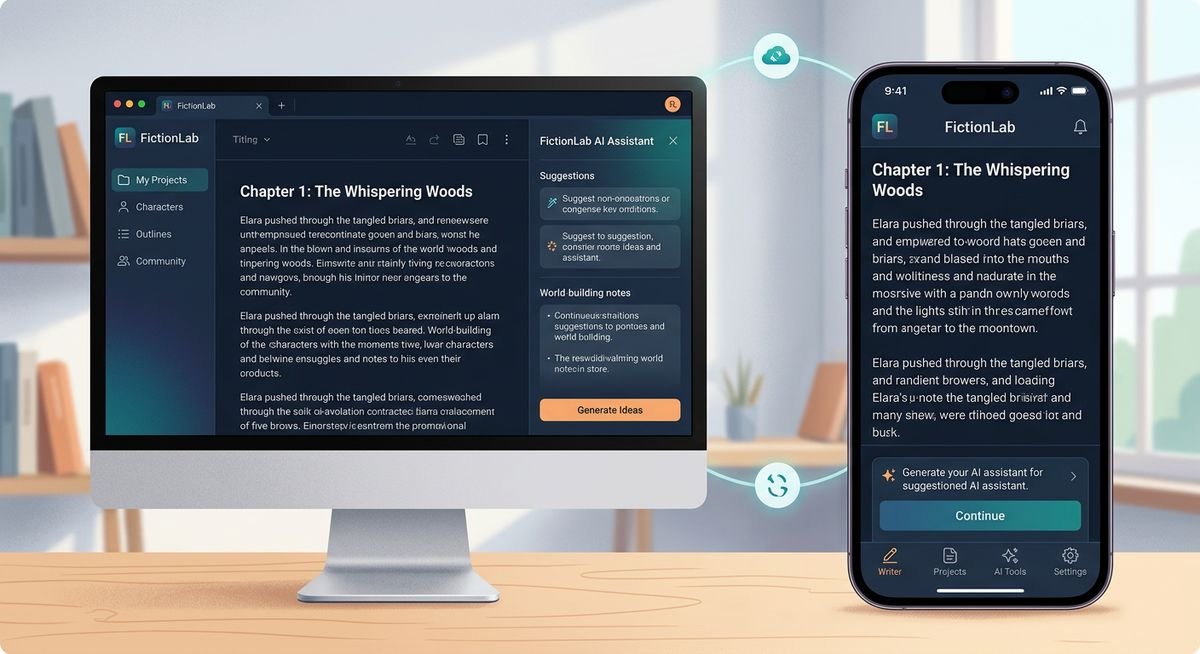
FictionLab AI is accessible across every major platform. Sessions sync automatically, so a story started on desktop continues seamlessly on mobile.
| Access Point | Type | Primary Use |
|---|---|---|
| fictionlab.ai (Web App) | Browser-based | Full-feature story creation, scenario management |
| Android App (Google Play) | Native mobile | On-the-go sessions, notifications |
| iOS App (App Store) | Native mobile | Mobile roleplay and reading |
| FictionLab Discord Server | Community | Real-time support, feature announcements, user tips |
| Reddit (r/FictionLab) | Community | Shared scenarios, platform discussion, troubleshooting |
| FictionLab GitHub | Developer | Bug reports, changelogs, open contributions |
| FictionLab Twitter/X | Social | Release announcements, platform updates |
The FictionLab documentation hub on Gitbook covers formatting conventions, custom instruction syntax, and scenario creation rules. For a step-by-step walkthrough of setup, scenario building, and advanced features, the tutorial covers everything from first login to image generation. The Discord server doubles as an unofficial changelog, with the development team posting feature updates before they appear anywhere else.
Core Features: Story Cards, Memory Cards, and Personas
Three structural components form the backbone of every FictionLab AI session: story cards for static world-building, memory cards for evolving plot state, and personas for user identity. Together, they solve context drift, the single biggest problem in AI-powered roleplay.
Story Cards
Story cards are structured context blocks injected at the system level. A card might contain a character backstory, a magic system’s rules, a city’s political factions, or relationship dynamics between NPCs. The AI consults these silently, maintaining awareness of established lore even when the chat has moved 50 exchanges past the last mention.
Story cards are static by design. Once written, their content holds firm unless the user manually edits the card. This makes them ideal for world-building constants: geography, faction hierarchies, species traits, and fixed character attributes that should never change mid-story.
Memory Cards
Memory cards track what has actually happened during a session. Where story cards define the world, memory cards record the plot. A memory card might note that two characters became enemies after a betrayal in chapter three, ensuring the AI writes future interactions accordingly.
Without memory cards, long-running narratives develop contradictions as the model’s attention drifts toward recent messages and away from earlier events. Memory cards serve as persistent plot anchors. According to community discussions on the FictionLab Discord (2025), users running campaigns longer than 20 exchanges see noticeably more coherent narratives when memory cards are actively maintained.
Personas and Character Descriptions
Personas define the user’s in-world identity. A persona entry specifies name, appearance, personality traits, occupation, and relationships. Once active, the AI addresses and references the user as that specific character rather than a generic second-person “you.”
Character descriptions work on the NPC side. Each AI character in a scenario gets its own description block that shapes voice, motivation, and behavior patterns. Detailed character descriptions produce measurably more consistent and distinctive AI performances.

| Feature | Type | Purpose | Updates Automatically? |
|---|---|---|---|
| Story Cards | Static context | World-building, lore, fixed attributes | No (manual edits only) |
| Memory Cards | Dynamic context | Plot tracking, relationship changes | Yes (updates as narrative progresses) |
| Personas | User identity | Player character definition | No (set by user) |
| Character Descriptions | NPC identity | AI character voice and behavior | No (set by scenario creator) |
Advanced Tools: Oracle Commands, Branching Narratives, and Group Chat
FictionLab AI’s power-user features go beyond basic chat, providing structural narrative control that most competing AI roleplay platforms lack entirely. Oracle commands, branching forks, and multi-character scenes represent the platform’s most distinctive capabilities.
Oracle Commands
Oracle is FictionLab AI’s meta-command layer for issuing instructions to the story engine itself. Rather than speaking as a character, the user directs the narrative architecture directly. Practical uses include forcing time jumps, retconning contradictions, requesting story summaries, and adjusting tone mid-scene. Oracle operates outside the fiction, preserving immersion while giving genuine authorial control.
Branching Narratives
At any point in a session, users can fork the story using the “branch from here” function, creating an alternate timeline from that exact moment. The original thread stays intact while the fork runs independently. A user might branch at a critical decision, explore one outcome, discard it, and return to try another direction. This mirrors how fiction actually gets written: through drafts, reversals, and what-if experiments. No other major AI chat platform surfaces narrative version control as a native, accessible feature.
Group Chat and Multi-Character Scenes
Group chat places multiple AI personas in a single scene simultaneously. Each character draws from its own story card, persona, and memory context. Turn order is configurable: direct specific characters to respond, let the AI rotate organically, or trigger simultaneous replies. This flexibility serves ensemble-driven genres particularly well, from political intrigue to heist narratives.
| Advanced Feature | Function | Best Use Case |
|---|---|---|
| Oracle Commands | Meta-level narrative instructions outside the fiction | Plot jumps, retcons, summaries, tone shifts |
| Branching Narratives | Fork story at any point, explore alternate outcomes | Decision points, draft experiments, what-if scenarios |
| Group Chat | Multiple AI characters in one scene | Ensemble casts, faction dynamics, courtroom scenes |
| Custom Instructions | Scenario-level behavior rules for the AI | Writing style, content boundaries, response formatting |
| Image Generation | AI-generated visuals for scenes and characters | Character portraits, scene illustrations, references |
LLM Models and Subscription Tiers
FictionLab AI supports multiple large language model backends with model selection available at the session level, giving users flexibility most competitors restrict behind a single default engine. Free-tier users access baseline models, while Plus and Premium subscribers unlock the full model roster and priority generation speeds.
Choosing the Best Model
Model choice impacts response quality, context handling, and generation speed. Lighter models handle casual roleplay efficiently. Premium models manage larger context windows, produce more nuanced character voices, and sustain coherence across longer sessions. Community consensus on the FictionLab Reddit (2025) suggests the best free model varies by use case, with lighter models working well for simple chat and heavier models justified for multi-character group scenes with dense story card setups.
Free Tier vs Plus vs Premium
The free tier provides genuine access to core features: story cards, memory cards, personas, Oracle commands, and basic model options. Usage caps and model restrictions apply. Paid tiers remove those limits and add priority generation speed during peak hours. Users experiencing slow response times or generation errors can find solutions for common FictionLab issues including timeouts, errors, and server outages.
| Feature | Free Tier | Plus / Premium |
|---|---|---|
| Model access | Baseline models | All models including top-tier LLMs |
| Generation speed | Standard (throttled at peak) | Priority queue |
| Daily message limits | Capped | Significantly higher or unlimited |
| Context window | Standard | Extended for longer sessions |
| Content filtering | Standard filters active | Expanded content options |
| Image generation | Limited | Full access |
Content Moderation, Privacy, and Terms of Service
FictionLab AI applies content filters that moderate AI-generated output, with filter strictness varying between models. The platform’s terms of service and privacy policy, accessible at fictionlab.ai, outline data handling practices and prohibited content categories.
The FictionLab content filter system operates at the model level. Users on the FictionLab Reddit (2025) report that filter behavior differs between backends, with certain models applying tighter restrictions than others. The platform’s overall moderation approach sits between Character AI’s heavily filtered environment and more permissive alternatives like Janitor AI. A detailed head-to-head comparison of FictionLab with Character AI, Janitor AI, and other platforms breaks down the trade-offs across content freedom, features, and pricing.
On privacy, FictionLab processes conversation data to generate AI responses. The platform’s guidelines state that scenario content is not shared publicly unless the creator explicitly publishes it. Private scenarios remain visible only to their creator. The full FictionLab terms of service and privacy documentation are available on the website.
Frequently Asked Questions
Does FictionLab have a content filter?
FictionLab AI applies content moderation filters that vary by the selected LLM model. Some models enforce stricter filters than others. The platform occupies a middle ground between Character AI’s heavy filtering and Janitor AI’s more permissive approach, with specific filter behavior documented in the FictionLab guidelines.
Does FictionLab have personas?
FictionLab supports full persona customization. Users define their in-world identity with name, appearance, personality traits, and relationships. The AI then addresses and references the user as that specific character throughout the session rather than using generic second-person narration.
What are story cards in FictionLab?
Story cards are static context blocks that inject world-building information into the AI’s context window. They hold fixed reference data like character backstories, magic system rules, and political factions that the AI consults silently during every response, maintaining consistency without cluttering the visible chat.
How does FictionLab work?
FictionLab AI uses large language models to generate interactive fiction. Users create scenarios, define characters and world rules via story cards, set a persona, and exchange turns with the AI. The platform layers context from story cards, memory cards, and personas into each model call, producing narratives that maintain continuity across long sessions.
Is FictionLab available in Spanish (Espanol)?
FictionLab AI’s interface is primarily in English, but the underlying language models can generate and respond in Spanish and many other languages. Users write prompts and story cards in their preferred language, and the AI responds accordingly. Platform documentation and community channels currently operate in English.
Where can I find FictionLab documentation and support?
The official FictionLab documentation lives on Gitbook and covers feature guides, formatting rules, and custom instruction syntax. For real-time help, the FictionLab Discord server offers community support and direct interaction with the development team. The Reddit community at r/FictionLab provides user tips, scenario recommendations, and troubleshooting threads.
Does FictionLab have a mod system?
FictionLab enables extensive customization through custom instructions, LLM instructions, and scenario-level settings that function similarly to mods. Users configure AI behavior, writing style, content boundaries, and response formatting at the scenario level. Community-shared scenarios on the platform effectively serve as user-created content modifications.
Conclusion
FictionLab AI has carved a distinctive position in the AI roleplay space by offering structural storytelling tools that most competitors either lack or bury behind technical barriers. Story cards, memory cards, Oracle commands, branching narratives, and group chat give users genuine authorial control over AI-generated fiction.
The platform’s multi-model approach means users can match the AI backend to their specific needs, from lightweight casual chat to extended campaigns with dense world-building. A functional free tier makes the platform accessible, while paid subscriptions unlock the full toolkit for power users running complex, long-running narratives.
The active FictionLab community on Discord and Reddit provides ongoing support, shared scenarios, and platform discussions that help both new and experienced users get more out of the platform. As AI roleplay technology continues to evolve rapidly, FictionLab AI’s combination of structural narrative tools, model flexibility, and cross-platform availability positions it as a serious contender in the interactive fiction space.