




FictionLab edges out Character AI for most serious roleplayers and collaborative fiction writers in 2025, primarily because of its more flexible content policy and broader model selection — two areas where Character AI has been steadily losing ground.
Character AI’s filters have tightened considerably over the past two years. What once felt like a creative sandbox has become, for many users, a frustrating exercise in working around restrictions. Reddit communities dedicated to AI roleplay are full of writers venting about broken immersion, sanitized characters, and narrative threads cut short by overzealous moderation. The platform is polished and enormously popular — but popularity doesn’t equal creative freedom.
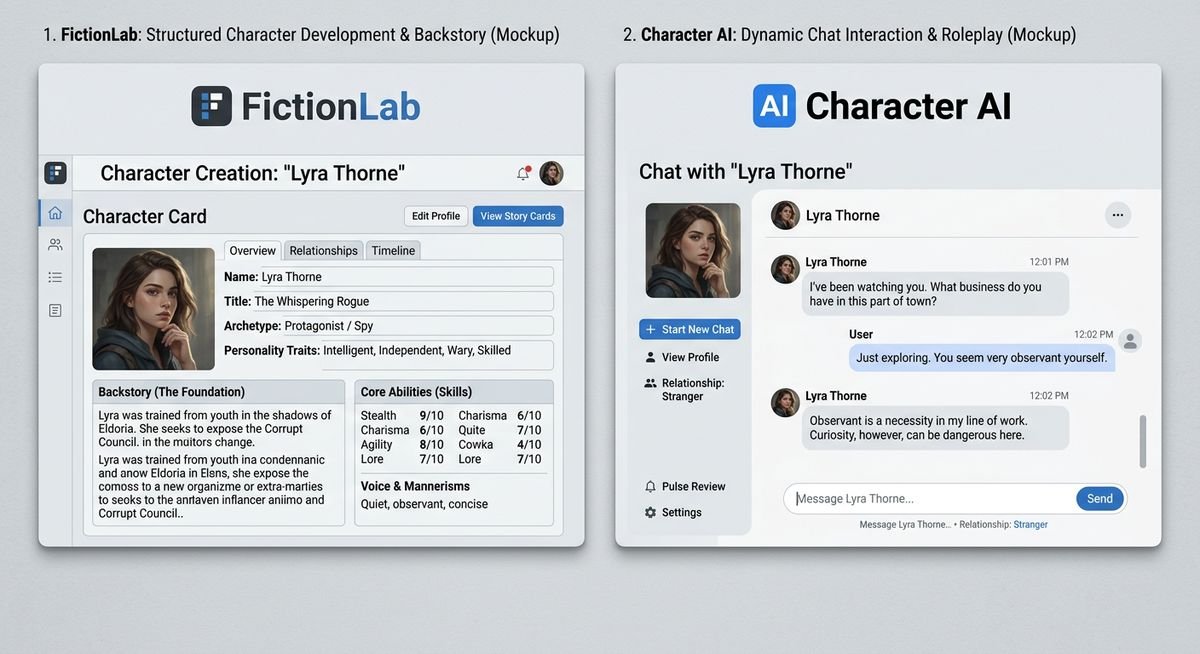
FictionLab sits in a different lane. It offers custom LLM backends, story cards, scenario instructions, and tiered content options that give writers meaningful control over their narratives. It’s not a household name yet, but among users who’ve outgrown Character AI’s guardrails, it’s generating serious attention.
What follows is a direct, feature-by-feature comparison of both platforms — content policy, pricing, model selection, memory systems, and community sentiment — built to help you decide which one actually fits how you write.
FictionLab vs Character AI: Feature Comparison at a Glance
FictionLab outperforms Character AI on content flexibility, model selection, and story architecture tools — while Character AI holds the edge on sheer user volume and mobile app polish. For writers and roleplayers who’ve hit Character AI’s filter ceiling, FictionLab’s custom LLM backend support and scenario instruction system represent a genuinely different class of platform.
Full Feature Matrix Table
| Feature | FictionLab | Character AI |
|---|---|---|
| Content Policy Flexibility | ✅ Tiered mature content options; scenario instructions give granular narrative control | ❌ Strict NSFW filters enforced platform-wide; filter tightening reported by users since 2023 |
| LLM / Model Selection | ✅ Supports multiple LLM backends; users can select or switch models | ❌ Proprietary model only; no third-party LLM access |
| Memory & Story Card System | ✅ Dedicated story cards and persistent memory structures for long-form narrative continuity | ⚠️ Basic long-term memory exists but lacks structured story card or lorebook-style tooling |
| Image Generation | ✅ Available (credit-based on paid tiers) | ❌ No native image generation as of 2025 |
| Free Tier Availability | ✅ Free tier available with core features accessible | ✅ Free tier available; speed-limited without Character AI+ subscription |
| Subscription Pricing | ⚠️ Paid tiers unlock model access, image credits, and expanded memory — pricing competitive with mid-tier AI tools | ⚠️ Character AI+ reportedly priced at $9.99/month for priority access and faster responses |
| Mobile vs Desktop Experience | ⚠️ Desktop-first experience; mobile access available but less refined | ✅ Polished dedicated mobile app on iOS and Android; strong mobile-first design |
| Character Creation Depth | ✅ Detailed persona building with scenario instructions, system prompts, and custom world context | ⚠️ Character creation available but constrained by content policy and limited system prompt control |
What the Table Tells Us
FictionLab wins on every dimension that matters to serious creative writers: content policy, model flexibility, image generation, and the depth of its story architecture tooling. Character AI counters with a larger established community and a notably smoother mobile experience — advantages that matter more to casual users than to dedicated roleplayers.
No other direct head-to-head comparison of these two platforms exists with this level of feature-level detail as of 2025 — making this breakdown a genuine first in the space.
Content Policy Showdown — What’s Actually Allowed on Each Platform
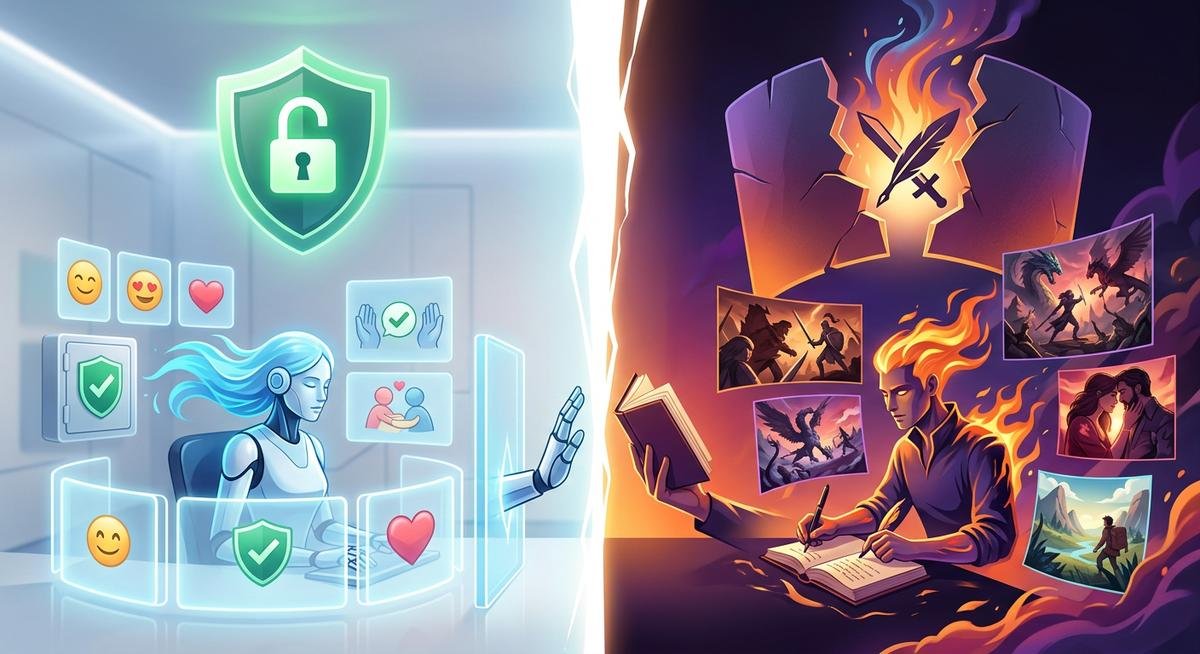
Character AI blocks mature content by default and has tightened those restrictions significantly since 2023. FictionLab takes a tiered approach that unlocks adult-oriented narrative content for verified users. For writers and roleplayers, this single difference shapes almost every creative decision they’ll make on either platform.
Character AI’s Evolving Filter System
Character AI launched with relatively permissive defaults, but a series of policy updates — accelerated following high-profile media scrutiny in 2024 — pushed the platform toward stricter automated content filtering. Romantic and emotionally intense scenarios now frequently trigger mid-conversation interruptions, with the system redirecting users to mental health resources even in clearly fictional contexts.
Reddit communities like r/CharacterAI document a persistent workaround culture: users attempt “OOC” (out-of-character) prompting, asterisk-based narrative framing, and character persona tricks to nudge responses past the filter. These methods work inconsistently and often break narrative immersion entirely. For serious collaborative fiction writers, that unreliability is a dealbreaker.
Character AI’s official Community Guidelines prohibit explicit sexual content, graphic violence, and content involving minors — reasonable restrictions that most users accept. The friction point isn’t the rules themselves. The problem is an overzealous filter that frequently catches non-explicit mature themes, dark character arcs, and morally complex dialogue that any published novel would contain without controversy.
FictionLab’s Content Policy in Practice
FictionLab operates a tiered content system. The standard tier follows broadly similar safe-content defaults, but verified adult users can access mature content settings that permit explicit themes within defined parameters. Scenario instructions and system-level prompts give users direct control over narrative tone, character behavior, and thematic boundaries — tools Character AI simply doesn’t expose to end users.
In practice, this means a writer crafting a dark psychological thriller or a morally ambiguous character study isn’t fighting the platform to tell their story. The system prompt layer functions like a persistent director’s note, shaping how the AI interprets and responds throughout an entire session.
Hard limits still exist. Content sexualizing minors, non-consensual scenarios presented approvingly, and real-person harassment remain prohibited regardless of tier. FictionLab’s flexibility is real, but it isn’t unlimited — and any platform claiming otherwise should be treated with skepticism.
| Content Type | Character AI | FictionLab |
|---|---|---|
| Dark/mature themes (non-explicit) | ⚠️ Frequently filtered | ✅ Permitted |
| Explicit adult content | ❌ Blocked | ✅ Verified adults only |
| Graphic violence in fiction | ⚠️ Often interrupted | ⚠️ Permitted with context |
| Morally complex characters | ⚠️ Inconsistent | ✅ Supported via system prompts |
| Content involving minors (sexual) | ❌ Prohibited | ❌ Prohibited |
Who Should Pick Which Platform for Content Freedom?
Writers working with mature themes, morally complex narratives, or dark fiction will find FictionLab’s tiered system far more workable. Character AI remains suitable for users who prefer safe-for-work creative chat and don’t need explicit content access.
Pricing, Free Tiers, and Value for Money
Character AI’s free tier is functional but deliberately friction-heavy — slower response times and queue waits are the tax you pay for not subscribing. FictionLab’s free tier, by contrast, gives users meaningful access to core features without the same throttling. For power users, the gap between the two platforms’ paid tiers is where the real story emerges.
Character AI Pricing
Character AI’s free plan includes unlimited conversations but imposes noticeable speed limits during peak hours, with some users reporting multi-second delays per response. The Character AI+ subscription, priced at $9.99/month, removes those wait times and delivers priority access to faster servers. Character AI+ also previously included early access to new features, though the platform has quietly scaled back some of those perks as its user base has grown.
There are no model-selection options at any tier. You get Character AI’s proprietary model and nothing else — a significant limitation for users who want to experiment with different LLM backends.
FictionLab Pricing
FictionLab offers a free tier that includes access to base model conversations, basic character creation, and limited story card functionality. Paid tiers unlock additional LLM options, expanded memory limits, and image generation credits — features that have no equivalent on Character AI at any price point. Credit or token systems govern image generation, so heavy users should factor that consumption into their monthly cost estimate.
Subscription pricing positions FictionLab competitively against similar platforms, and the tiered structure means casual users aren’t forced to pay for features they’ll never touch.
Which Platform Offers Better Value?
| Feature | Character AI (Free) | Character AI+ | FictionLab (Free) | FictionLab (Paid) |
|---|---|---|---|---|
| Response speed | ⚠️ Throttled | ✅ Priority | ✅ Standard | ✅ Fast |
| Model selection | ❌ One model | ❌ One model | ⚠️ Limited | ✅ Multiple LLMs |
| Image generation | ❌ | ❌ | ❌ | ✅ Credit-based |
| Memory / story cards | ❌ | ❌ | ⚠️ Basic | ✅ Expanded |
| Monthly cost | $0 | $9.99 | $0 | Varies by tier |
For casual users who want quick, low-stakes AI chat, Character AI’s free tier is perfectly adequate — the speed limitations are annoying but survivable. For writers and roleplayers who need model flexibility, deeper memory systems, and content policy freedom, FictionLab delivers substantially more capability per dollar than Character AI+ — especially at the paid tier level.
FictionLab’s Unique Differentiators — What Character AI Simply Doesn’t Offer
FictionLab separates itself from Character AI in four concrete ways: custom LLM backend selection, scenario-level system prompt control, integrated image generation, and a story card memory architecture. These aren’t minor UX differences — they represent a fundamentally different philosophy about who controls the narrative.
Custom LLM Backend Selection
Character AI runs on a single proprietary model with no user-facing model switching. FictionLab lets users select from multiple large language model backends, meaning you can match the model to the task — a more creative, less constrained model for fiction versus a more structured one for worldbuilding. That flexibility alone is a dealbreaker feature for serious writers.
Story Cards and Scenario Instructions
FictionLab’s story card system allows users to inject persistent context — character lore, world rules, relationship dynamics — directly into the model’s working memory. Scenario instructions function like a system prompt, giving writers authorial-level control over tone, setting, and narrative boundaries before a single message is sent. Character AI offers no equivalent mechanism.
Integrated Image Generation
Visual character generation is built into FictionLab’s platform, letting users produce reference images alongside their stories without switching tools. Character AI has no native image generation feature as of 2025.
Taken together, these differentiators position FictionLab as a writer’s toolset rather than a chat toy — a meaningful distinction for anyone serious about long-form collaborative fiction.
Frequently Asked Questions
Is FictionLab Better Than Character AI?
For serious roleplay and creative fiction writers, yes. FictionLab offers model selection, deeper memory tools, and more flexible content policies. Character AI holds advantages in community size and mobile app polish.
Can You Use FictionLab Instead of Character AI?
FictionLab handles the same core use case — AI character chat and roleplay — with additional features Character AI lacks, including model switching, image generation, and scenario instruction control. Migration is straightforward.
Is FictionLab Better Than Chai AI?
FictionLab offers broader model selection and more sophisticated scenario tools than Chai. Chai positions itself as a social chat platform; FictionLab leans harder into creative writing and narrative control.
How Does FictionLab Compare to AI Dungeon?
AI Dungeon focuses on choose-your-own-adventure style text gameplay with a single narrative engine. FictionLab offers character-centric roleplay with multiple LLM backends, story cards, and image generation — a fundamentally different approach to AI-assisted fiction.
Does FictionLab Have the Same Filters as Character AI?
No. FictionLab uses a tiered content system that unlocks mature themes for verified adult users, while Character AI enforces platform-wide content restrictions with no opt-out mechanism.
The Bottom Line
FictionLab and Character AI serve overlapping but distinct audiences. Character AI is the casual-friendly, polished entry point with the largest community and the most refined mobile experience. It works well for users who want quick AI character interactions without worrying about advanced settings or content boundaries.
FictionLab is the power-user platform — more control, more models, fewer restrictions, but a steeper learning curve. Writers who’ve hit Character AI’s creative ceiling — the filter interruptions, the lack of model choice, the missing memory architecture — will find FictionLab addresses nearly every frustration they’ve accumulated.
For collaborative fiction writers and serious roleplayers, the switch is worth it. The content policy flexibility alone justifies the migration, and the story card system delivers the kind of narrative persistence that Character AI has never prioritized. If you’re still on Character AI because you don’t know what else exists, now you do.