



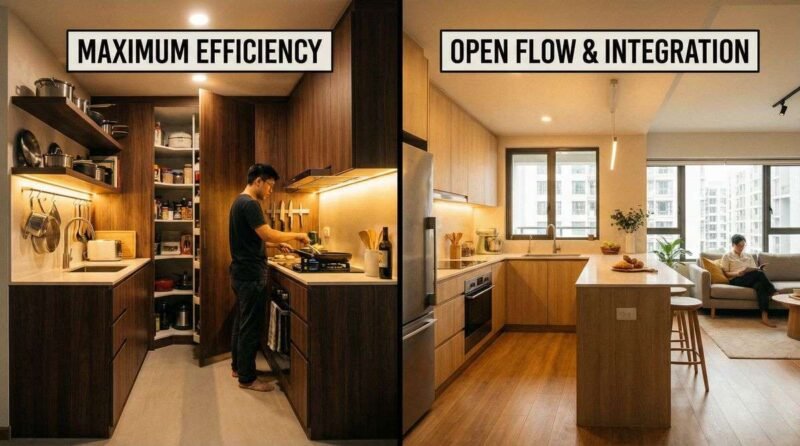
Small kitchens demand smart design. Every square foot must earn its place, and the layout decision — more than any appliance upgrade or cabinet finish — determines how well the kitchen actually functions. The two most debated options for compact spaces are the U-shape and the L-shape, and the right choice depends on factors most homeowners never consider before committing to a renovation.
This guide compares U-shape vs L-shape kitchen layouts for small spaces across the dimensions that matter most: workflow efficiency, storage capacity, social openness, and minimum space requirements. The analysis draws on kitchen design standards from the National Kitchen and Bath Association (NKBA) to provide concrete, actionable guidance.
1. The U-Shape Kitchen Layout
Answer Capsule: A U-shape kitchen uses three walls of cabinetry and countertop, forming a horseshoe configuration. It maximizes storage and counter space in a small footprint and creates an efficient work triangle. The minimum recommended space is 8×8 feet (with at least 48 inches between opposing counters), making it unsuitable for very narrow kitchens.
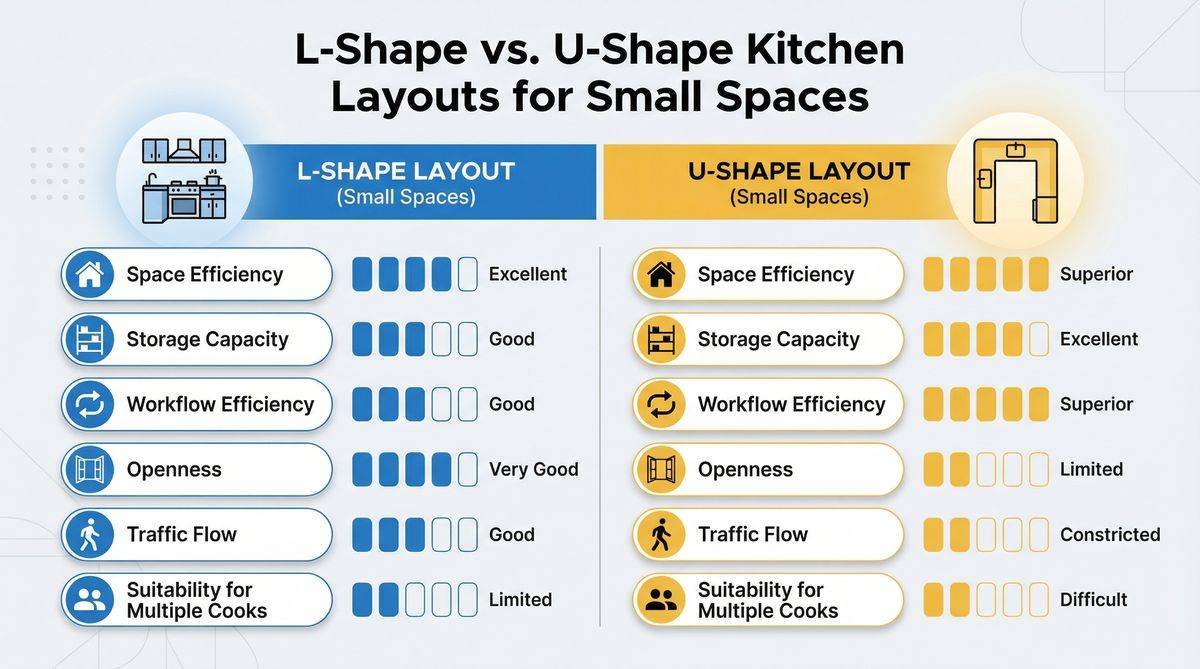
The U-shape is the most storage-efficient layout for small kitchens. Three walls of upper and lower cabinets provide significantly more storage than any two-wall configuration. The work triangle — the path between the refrigerator, sink, and stove — is naturally compact and efficient, reducing the steps required during meal preparation.
The primary limitation is the closed nature of the layout. A U-shape kitchen with walls on three sides is inherently separated from adjacent living or dining areas. In open-plan homes, this can feel isolating. In dedicated kitchen rooms, it creates a focused, distraction-free cooking environment that many cooks prefer.
2. The L-Shape Kitchen Layout
Answer Capsule: An L-shape kitchen uses two adjacent walls, leaving the remaining two sides open. This configuration suits open-plan living spaces, allows for a kitchen island or dining table in the open area, and requires a minimum of approximately 10×10 feet to function well. It trades some storage capacity for social openness and flexibility.
The L-shape is the most popular kitchen layout in open-plan homes precisely because it integrates naturally with living and dining areas. The cook faces the open room rather than a wall, enabling conversation with guests or supervision of children while preparing meals.
Storage is the L-shape’s relative weakness compared to the U-shape. With only two walls of cabinetry, total storage volume is lower. This is often compensated by adding a kitchen island, which provides additional counter space, storage, and a casual dining surface — though the island requires adequate clearance (at least 42–48 inches on all sides).
3. U-Shape vs L-Shape: Head-to-Head Comparison
| Factor | U-Shape | L-Shape | Winner |
|---|---|---|---|
| Storage capacity | High (3 walls of cabinets) | Moderate (2 walls) | U-Shape |
| Counter space | High | Moderate (island optional) | U-Shape |
| Work triangle efficiency | Excellent (compact) | Good | U-Shape |
| Social openness | Low (enclosed) | High (open to living area) | L-Shape |
| Minimum space needed | 8×8 ft (48″ clearance) | 10×10 ft recommended | U-Shape (smaller footprint) |
| Island compatibility | Rarely (too tight) | Yes (with adequate clearance) | L-Shape |
| Multiple cooks | Difficult (single corridor) | Better (open end) | L-Shape |
4. Which Layout Is Right for a Specific Space?
Answer Capsule: Choose a U-shape if the kitchen is a dedicated room (not open-plan), storage is the top priority, and the space is at least 8×8 feet with 48 inches of clearance between counters. Choose an L-shape if the kitchen opens to a living or dining area, social interaction while cooking matters, or a kitchen island is desired.
The decision often comes down to one question: is the kitchen a separate room or part of an open-plan living space? In a dedicated kitchen room, the U-shape’s superior storage and workflow efficiency make it the stronger choice. In an open-plan home, the L-shape’s social openness and compatibility with islands align better with how modern families actually use their kitchens.
Room proportions also matter. A very narrow kitchen (under 8 feet wide) cannot accommodate a U-shape with the required 48-inch clearance between opposing counters. The NKBA recommends a minimum of 48 inches for single-cook kitchens and 60 inches for multi-cook households. In these narrow spaces, an L-shape or galley layout is the only viable option.
5. NKBA Design Standards for Small Kitchens
Answer Capsule: The National Kitchen and Bath Association recommends a minimum 42-inch aisle width for single-cook kitchens and 48 inches for households with multiple cooks. The work triangle perimeter should total 13–26 feet, with no single leg shorter than 4 feet or longer than 9 feet. These standards apply equally to U-shape and L-shape configurations.
Many small kitchen renovations fail not because of the layout choice but because clearance requirements are violated. Cabinets that extend too far into the aisle, islands that are too large for the available space, and appliance doors that conflict with each other are the most common design errors in compact kitchens.
Frequently Asked Questions
What is the smallest space that can accommodate a U-shape kitchen?
The minimum practical size for a U-shape kitchen is approximately 8×8 feet, which provides 48 inches of clearance between opposing counters — the NKBA minimum for a single-cook household. Anything smaller creates a corridor that feels cramped and limits appliance door clearance. In spaces under 8 feet wide, an L-shape or galley layout is more appropriate.
Can an island be added to an L-shape kitchen in a small space?
Yes, but only with adequate clearance. An island requires at least 42 inches of clearance on all working sides (48 inches is preferred). In a 10×12-foot kitchen, a small island of approximately 24×36 inches can be incorporated without violating clearance requirements. Larger islands in small L-shape kitchens typically compromise traffic flow.
Which kitchen layout adds more resale value?
Neither layout has a universally higher resale value — execution quality matters far more than configuration. However, open-plan L-shape kitchens with islands tend to appeal to a broader range of buyers in the current market, where open-plan living is strongly preferred. A well-executed U-shape in a dedicated kitchen room is equally valued by buyers who prioritize cooking functionality.
Conclusion
The U-shape vs L-shape debate for small kitchens has no universal winner — only the right choice for a specific space and lifestyle. The U-shape delivers superior storage, counter space, and workflow efficiency in a compact footprint, making it the top performer for dedicated kitchen rooms. The L-shape sacrifices some storage for social openness and island compatibility, making it the natural choice for open-plan homes.
The most important step before committing to either layout is measuring the available space against NKBA clearance standards. A layout that violates minimum aisle widths will frustrate daily use regardless of how well-designed it looks on paper.
References
- National Kitchen and Bath Association (NKBA). Kitchen Planning Guidelines and Access Standards. 2024.
- Houzz. “Kitchen Layout Guide: Which Is Right for Your Home?” 2025.
- Architectural Digest. “The Best Kitchen Layouts for Small Spaces.” Updated 2025.