




Vile means morally reprehensible, despicable, or physically disgusting — an adjective that has carried the full weight of human contempt for centuries, from courtroom accusations to Shakespearean insults to everyday reactions to bad food. When someone calls an act vile, they’re reaching for the strongest available word for wicked or corrupt behavior, something that provokes not just disapproval but visceral revulsion.
The word functions almost exclusively as an adjective in standard English, though its derivatives — vilely and vileness — extend its reach into adverb and noun territory. Its roots run deep: Latin vilis, meaning cheap or worthless, evolved into a term that now covers everything from contemptible character to genuinely nauseating physical experiences.
Across the King James Bible, Shakespeare’s tragedies, modern British slang, and more than 20 languages worldwide, “vile” does consistent work as a marker of the lowest moral or sensory register — a word that brands something as being at the absolute bottom of human standards, whether moral, social, or sensory.
Vile Definition: What Does Vile Mean in English?
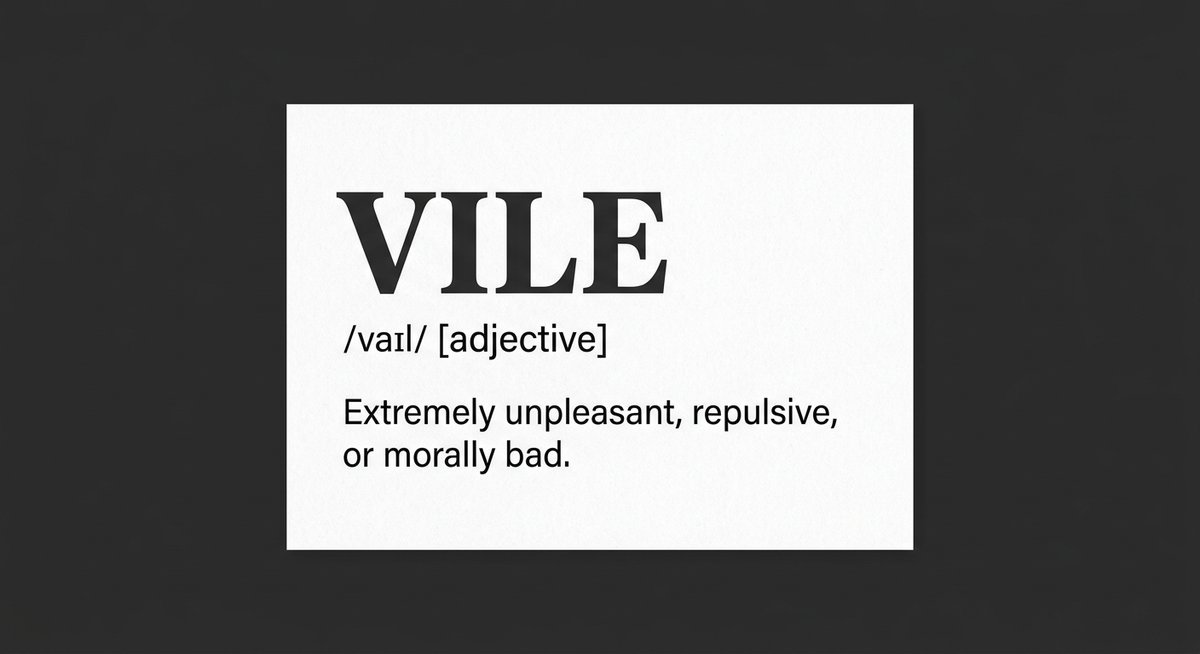
“Vile” is an adjective meaning morally reprehensible, deeply wicked, or physically revolting. It covers two primary senses: the moral (a vile act of cruelty) and the sensory (a vile smell that turns your stomach). Both senses share a core idea — something so low, corrupt, or offensive that it provokes disgust or contempt. According to the Oxford English Dictionary, the word’s earliest recorded use in English dates to the 13th century, derived from the Latin vilis. The Cambridge Dictionary maintains both the moral and sensory definitions as current standard usage.
Core Definition and Pronunciation
“Vile” is pronounced /vaɪl/ — one syllable, rhyming with “mile” and “trial.” The Oxford English Dictionary traces the word’s earliest recorded use in English to the 13th century, derived from the Latin vilis, meaning cheap, base, or worthless. In British English, “vile” is especially common as a strong intensifier for anything deeply unpleasant, whether moral or physical.
Three clear example sentences cover its range: “The warlord committed a vile act against unarmed civilians” (moral); “His vile behavior at the dinner table shocked everyone present” (conduct); “The vile language in that letter was completely unprovoked” (speech). Each instance signals something contemptible — not merely bad, but offensively, disgracefully bad.
Vile as a Noun, Verb, and Adverb
“Vile” functions almost exclusively as an adjective. No standard verb form exists in modern English — you cannot “vile” someone or something. Searchers who ask about “vile meaning noun” or “vile meaning verb” are usually encountering the word in an unfamiliar context, not a different grammatical role.
The adverb form is vilely — as in, “He vilely betrayed every person who trusted him.” The noun form is vileness, used to describe the quality or state of being despicable or morally degraded. Neither form is common in everyday speech, but both appear regularly in formal writing and classical literature.
Vile Synonyms and Antonyms
English offers a rich cluster of synonyms for “vile,” each with a slightly different emphasis, as catalogued by Thesaurus.com. “Odious” stresses the hatred something provokes; “loathsome” emphasizes physical revulsion; “heinous” is reserved for crimes of exceptional severity. “Depraved” and “corrupt” lean toward moral degradation, while “contemptible” highlights how little respect the subject deserves.
| Type | Word | Nuance |
|---|---|---|
| Synonym | Despicable | Deserving strong moral contempt |
| Synonym | Abhorrent | Causing intense disgust or hatred |
| Synonym | Contemptible | Worthy of scorn or disrespect |
| Synonym | Reprehensible | Deserving censure or blame |
| Synonym | Odious | Extremely unpleasant; arousing hatred |
| Synonym | Loathsome | Physically or morally revolting |
| Synonym | Heinous | Shockingly wicked; atrocious |
| Synonym | Depraved | Morally corrupt to an extreme degree |
| Antonym | Noble | High moral character; honorable |
| Antonym | Virtuous | Morally excellent; righteous |
| Antonym | Admirable | Deserving respect and approval |
| Antonym | Decent | Conforming to accepted moral standards |
Choosing between these synonyms matters. Calling someone “vile” is broader and more visceral than calling someone “reprehensible” — the word carries both moral judgment and a sense of physical disgust that most synonyms lack on their own.
Vile in Context: Common Phrases and Usage Examples
“Vile” pairs with nouns across three distinct domains: people and character (vile person, vile creature), actions and speech (vile act, vile rhetoric), and physical disgust (vile disease, vile food). Each pairing intensifies the noun beyond ordinary negativity into territory that signals genuine contempt or revulsion. Merriam-Webster lists both the moral and sensory definitions as standard usage.
Vile Describing People and Character
When “vile” modifies a person or character, the word signals moral depravity so complete that ordinary terms like “bad” or “wrong” feel inadequate. These phrases appear in courtrooms, literature, and everyday condemnation alike.
| Phrase | Meaning | Example Sentence |
|---|---|---|
| Vile person / vile human | Someone morally reprehensible beyond redemption | “No vile person should hold public office.” |
| Vile woman | A woman judged as wicked or corrupt in conduct | “The tabloid called her a vile woman for betraying her own family.” |
| Vile character | A personality defined by despicable traits | “The novel’s antagonist is a vile character who manipulates everyone around him.” |
| Vile creature | A being — human or animal — regarded as loathsome | “He dismissed his rival as a vile creature unfit for decent company.” |
| Vile fiend | A diabolical, wicked individual; often archaic or literary | “The preacher condemned the killer as a vile fiend.” |
| Vile knave | Elizabethan/Shakespearean: a contemptible, dishonest man of low standing | “Thou vile knave — you have stolen from your own master.” |
| Vile villain | A villain whose wickedness is especially pronounced | “Audiences loved to hiss at the vile villain twisting his moustache.” |
| Vile one | Biblical/prophetic usage: a person of base or worthless character | “The psalm warns that the vile one shall be no more honored.” |
Vile Describing Actions, Speech, and Ideas
Paired with conduct or language, “vile” emphasizes that the action crosses a moral threshold — not merely rude or wrong, but morally reprehensible in a way that provokes genuine disgust.
Vile act / vile deeds: Actions so wicked that they shock the conscience. “The tribunal documented vile acts committed against civilians.”
Vile behavior: A sustained pattern of wicked or corrupt behavior, rather than a single incident. “His vile behavior toward subordinates eventually ended his career.”
Vile language / vile words / vile remarks: Speech that is abusive, obscene, or deeply offensive. “She walked out after enduring his vile remarks for the third time.”
Vile accusations: Charges that are both serious and contemptible in their nature. “He called the allegations vile accusations designed to destroy his reputation.”
Vile rhetoric: Politically or ideologically charged language that is despicable in its aims. “Journalists condemned the campaign’s vile rhetoric targeting minority communities.”
Vile vitriol: A compound phrase doubling down on bitterness — vitriol already means corrosive speech, and “vile” intensifies the contemptible quality further. “Her speech was full of vile vitriol aimed at former allies.”
Vile Describing Physical Disgust and Nature
“Vile” also covers sensory revulsion — smells, tastes, textures, and physical conditions that provoke an almost instinctive recoil. This dimension of the word is older than its moral use and remains vivid in everyday speech.
Vile disease: An illness regarded as both horrific and degrading. “Medieval chroniclers described the plague as a vile disease sent as divine punishment.”
Vile food: Food that tastes or smells revolting. “He pushed the bowl away — whatever was in it was vile food by any measure.”
Vile vermin: Creatures considered disgusting and harmful. “The landlord refused to acknowledge the vile vermin infesting the building.”
Vile wind / vile dust: Natural phenomena described as foul or oppressive — common in classical and biblical poetry. “The travelers wrapped their faces against the vile dust of the desert road.”
Vile raiment: Archaic for filthy or degrading clothing; appears in biblical contexts meaning rags or shameful dress. “He stood before the court in vile raiment, stripped of all dignity.”
Vile body: Drawn directly from Philippians 3:21 in the King James Bible, where Paul describes the mortal human body as a “vile body” to be transformed at resurrection — meaning lowly or corrupt in its earthly state, not physically ugly.
Vile passions: From Romans 1:26 (KJV), meaning shameful or degrading desires. “The sermon warned against surrendering to vile passions that corrupt the soul.”
Vile nature: An inherently contemptible disposition — either in a person or in a physical substance. “Critics pointed to the vile nature of the compound as grounds for banning it.”
Vile in the Bible, Shakespeare, and Classical Literature
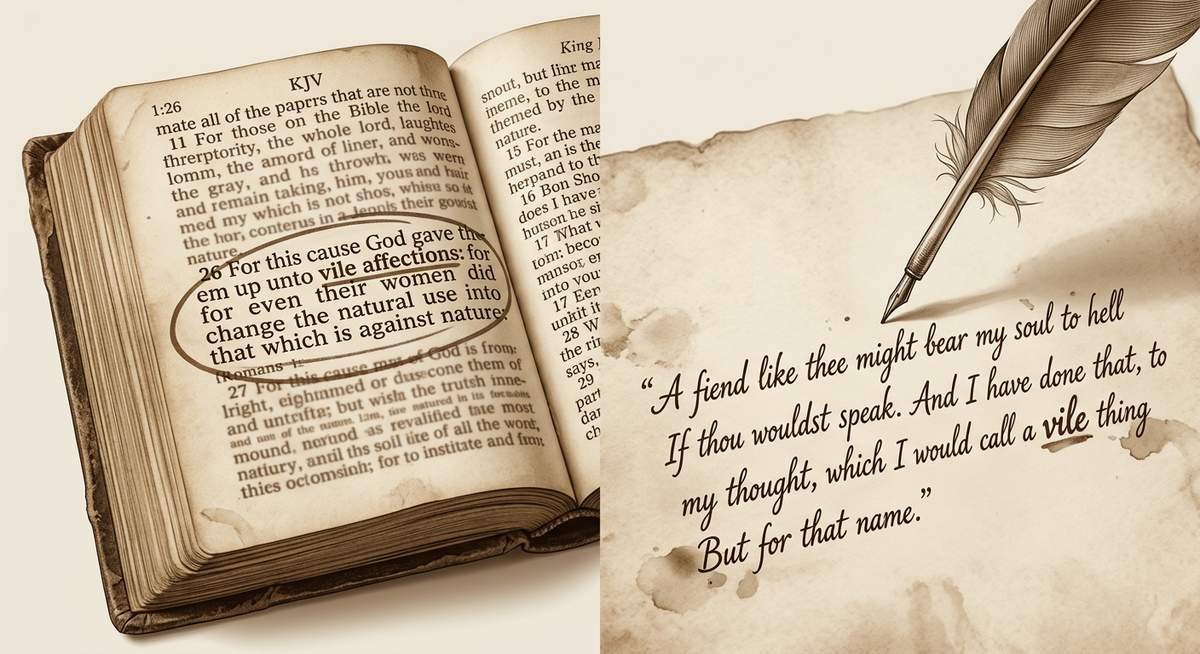
In the King James Bible (1611), “vile” means morally debased or spiritually worthless — appearing in Romans 1:26, Philippians 3:21, and Job 40:4 to describe shameful passions, the mortal body, and human insignificance before God. Shakespeare used the same word across Romeo and Juliet, King Lear, and Hamlet to fuse moral judgment with visceral disgust. According to the Oxford English Dictionary, the moral sense was already established in English by the 14th century, predating both the KJV and the Elizabethan stage.
Vile Meaning in the Bible (KJV)
The King James Version uses “vile” across both Old and New Testaments to signal moral corruption, worthlessness, or spiritual debasement. Three passages define its biblical range most sharply.
| KJV Verse | Exact Phrase | Plain-English Meaning |
|---|---|---|
| Romans 1:26 | “vile affections” | Passions or desires judged morally reprehensible and contrary to natural order |
| Philippians 3:21 | “vile body” | The mortal, lowly human body — subject to decay — contrasted with a glorified resurrection form |
| Job 40:4 | “I am vile” | Job’s declaration of his own insignificance and unworthiness before God |
In prophetic and wisdom literature, “the vile one” or “vile person” (as in Isaiah 32:5–6) denotes someone whose depravity is publicly recognized — a figure whose contemptible character disqualifies the person from social or moral standing. The biblical sense is never casual; the word marks a serious rupture from righteousness.
Vile in Shakespeare
Shakespeare deployed “vile” with precision across his plays, exploiting its double meaning: morally low and socially base. According to the Open Source Shakespeare concordance, the word appears across histories, comedies, and tragedies alike. In Elizabethan English, calling someone vile implied both despicable character and low rank — the two were often treated as inseparable.
In Romeo and Juliet, Romeo uses “vile” to frame his enemies and his own cursed fate as something odious and beneath dignity — the word amplifies his sense of helplessness against forces he finds loathsome. The phrase “vile dust” appears in Hamlet and other works to underscore human mortality and the humbling return of the body to earth.
King Lear’s most viscerally shocking use comes in Act 3, Scene 7, when Cornwall gouges out Gloucester’s eyes and a servant refers to the act in terms of horror — prompting the now-famous phrase “vile jelly.” The “vile jelly” meaning is literal and grotesque: Gloucester’s eyes, once instruments of sight and dignity, are reduced to contemptible, worthless matter. The image remains one of the most disturbing in the entire Shakespearean canon.
“Vile knave” appears across multiple comedies and histories as a stock insult combining moral and class contempt — a despicable, untrustworthy servant or schemer. Shakespeare used the word’s flexibility to move between physical disgust and moral condemnation within a single scene.
Vile in Modern Slang and Informal English
British slang uses “vile” as a casual intensifier for anything disgusting or deeply unpleasant — no moral judgment required. A cup of cold instant coffee is vile. A joke that makes people groan is a vile joke. The word has drifted far from its Latin roots in informal usage, functioning more like “gross” or “nasty” than its formal cousin “abhorrent.”
Urban Dictionary entries reflect this shift: contributors define vile as “something absolutely disgusting” or “a person who is repulsive in character,” collapsing the centuries-old moral-versus-sensory distinction into a single blunt instrument of disapproval. In UK English especially, calling weather “vile” or food “vile” is so routine that the word barely registers as strong language anymore.
The slang meaning also extends to people. Calling someone a “vile person” in casual speech usually means they behave in a way that is morally gross rather than truly evil — a gossipy colleague, a dishonest friend, someone whose vile behavior at a party embarrassed everyone present. The word retains its sting but sheds its formal gravity.
Pop culture reinforced the name through Carmen Sandiego, where the criminal organization V.I.L.E. (Villains’ International League of Evil) turned the adjective into an acronym. For a generation of viewers, “vile” became permanently associated with scheming cartoon villainy — a lighter shade of the word’s original contempt.
Vile Translations: Meaning in 20+ Languages
“Vile” translates across languages with consistent force — every major language has at least one word carrying the same blend of moral contempt and physical revulsion. The translations below cover the most frequently searched language pairs, organized by region. Pronunciation guides use simplified phonetics.
Vile Meaning in South Asian Languages
| Language | Translation | Script | Notes |
|---|---|---|---|
| Hindi | घिनौना (ghinauna) / नीच (neech) | Devanagari | “Ghinauna” = disgusting; “neech” = morally low |
| Tamil | கேவலமான (kevalamaana) | Tamil | Combines moral contempt with social degradation |
| Telugu | నీచమైన (neechamaina) | Telugu | Directly maps to morally contemptible |
| Bengali | জঘন্য (joghonno) | Bengali | Strong connotation of heinous or atrocious |
| Marathi | नीच (neech) / घृणास्पद (ghrunaaspad) | Devanagari | Similar to Hindi; “ghrunaaspad” = loathsome |
| Urdu | ذلیل (zaleel) / گھناؤنا (ghinauna) | Nastaliq | “Zaleel” emphasizes degradation and humiliation |
| Malayalam | നീചമായ (neechamaaya) | Malayalam | Morally base or despicable |
| Punjabi | ਘਟੀਆ (ghateea) / ਨੀਚ (neech) | Gurmukhi | “Ghateea” = inferior/vile in quality |
| Nepali | घृणित (ghrinit) | Devanagari | Hateful, arousing disgust |
Vile Meaning in European and Middle Eastern Languages
| Language | Translation | Notes |
|---|---|---|
| French | vil / ignoble | “Vil” shares the same Latin root (vilis); “ignoble” adds social dimension |
| Spanish | vil / despreciable | “Vil” is a direct cognate; used in legal and literary contexts |
| German | abscheulich / niederträchtig | “Abscheulich” = abhorrent; “niederträchtig” = base, treacherous |
| Greek | ποταπός (potapos) / αχρείος (achreios) | Biblical Greek uses both for morally worthless |
| Hebrew | נבזה (nivzeh) / שפל (shafel) | “Nivzeh” = despised; “shafel” = low, base |
| Arabic | حقير (haqeer) / دنيء (danee) | “Haqeer” = contemptible; “danee” = morally low |
| Farsi/Persian | پست (past) / رذل (razl) | “Past” = base, low; “razl” = morally vile |
| Polish | podły / nikczemny | “Podły” = base, mean; “nikczemny” = despicable |
Vile Meaning in African and Asian Languages
| Language | Translation | Notes |
|---|---|---|
| Chinese (Mandarin) | 卑鄙 (bēibǐ) / 恶劣 (èliè) | “Bēibǐ” = morally base; “èliè” = vile in quality |
| Japanese | 卑劣 (hiretsu) / 下劣 (geretsu) | Both convey moral baseness and contemptibility |
| Malay | keji / hina | “Keji” = vile, abominable; “hina” = despised |
| Tagalog | kasuklam-suklam / masama | “Kasuklam-suklam” = loathsome; “masama” = bad/evil |
| Swahili | -baya sana / -chafu | “-baya sana” = very bad; “-chafu” = dirty/foul |
| Zulu | -nyanyekayo / -bi kakhulu | Conveys extreme moral or physical repulsiveness |
| Xhosa | -bi kakhulu / -nyanyekayo | Closely related to Zulu equivalents |
A consistent pattern emerges across these translations: most languages maintain the split between moral vileness (contemptible character) and sensory vileness (physically disgusting), though the balance varies. South Asian languages tend to emphasize social hierarchy and moral standing, while European cognates of vilis preserve the Latin root’s original sense of cheapness or worthlessness.
Frequently Asked Questions About Vile
What does vile mean in English?
“Vile” is an adjective meaning morally reprehensible, deeply offensive, or physically revolting. The word describes anything — a person, act, or substance — considered contemptible or beneath basic standards of decency. Example: “The judge condemned the vile behavior of the defendant.”
What is the difference between vile and evil?
“Evil” implies active, often profound moral wrongness — sometimes with supernatural connotations — while “vile” emphasizes disgust and contemptibility: something despicable or foul rather than necessarily powerful. Deeply contemptible conduct can be vile without carrying the dramatic weight “evil” implies. Think of “vile” as evil’s more visceral, stomach-turning counterpart.
Can “vile” be used as a noun or verb?
“Vile” functions almost exclusively as an adjective in standard English. No verb form exists. The noun form is “vileness” and the adverb form is “vilely.” Searchers sometimes confuse “vile” with “vial” — a small laboratory or medical container — but the two words share only their pronunciation, not their meaning or origin.
How is “vile” used in the Bible?
The King James Version uses “vile” to mean morally debased or spiritually worthless. The word appears in Romans 1:26 (“vile affections”), Philippians 3:21 (“vile body”), and Job 40:4 (“I am vile”). Across all three passages, “vile” consistently signals unworthiness or moral corruption rather than simple unpleasantness.
What are the best synonyms for vile?
The closest synonyms are despicable, contemptible, abhorrent, and loathsome — all conveying moral or sensory disgust. “Heinous” and “depraved” skew toward serious criminal wrongdoing, while “odious” carries a more formal, literary tone. None of these synonyms fully replicate “vile,” which uniquely combines moral judgment with visceral physical revulsion.
What does “vile” mean in medical terms?
“Vile” has no formal medical definition — it is not a clinical term. When doctors or patients describe a wound, discharge, or symptom as “vile,” they are using the common English meaning of physically disgusting or extremely unpleasant. The word sometimes appears in older medical literature to describe diseases considered both physically and morally degrading, but modern clinical language avoids subjective adjectives like vile.
Is “vile” the same as “vial”?
“Vile” and “vial” are homophones — they sound identical (/vaɪl/) but share no meaning or origin. “Vile” is an adjective meaning morally despicable or physically disgusting, from Latin vilis. “Vial” is a noun meaning a small glass or plastic container used in laboratories and pharmacies, from Greek phiale. Searches for “vile meaning container,” “vile meaning chemistry,” or “vile meaning tube” almost always intend “vial.”
What does “vile” mean for kids?
“Vile” means really, really disgusting or really, really mean — something so bad it makes you feel sick or angry. A simpler way to explain it: if “bad” is a 3 out of 10 and “terrible” is a 7, then “vile” is a 9 or 10. It describes the worst kind of behavior or the most revolting taste or smell.
What does “vile” mean in Romeo and Juliet?
In Romeo and Juliet, Shakespeare uses “vile” to mean hateful, loathsome, or beneath contempt. Romeo applies the word to his cursed circumstances and his enemies, expressing not just anger but disgust at forces he finds morally and personally repulsive. The Elizabethan usage carried both moral and social weight — calling something vile implied it was both wicked and low-born.
Conclusion
Few English words do as much work as “vile.” Job used it to confess his insignificance before God. Shakespeare weaponized it to strip Gloucester’s eyes of their dignity. A teenager in Manchester uses it to describe yesterday’s school lunch. The word has survived seven centuries precisely because it fills a gap no synonym quite covers — that intersection of moral revulsion and physical disgust where “bad” feels weak and “evil” feels overwrought.
The grammar is simple (adjective only, with “vilely” and “vileness” as derivatives), and the vile-versus-vial confusion is easy to clear up once you know they share nothing but a sound. What makes “vile” genuinely interesting is how it has migrated from Latin cheapness (vilis) through biblical condemnation and Elizabethan insult into the kind of word that works equally well in a courtroom and a kitchen.