




The English word “bass” appears in two radically different sentences — “she plays bass guitar” and “he caught a bass in the lake” — yet these two uses share zero phonetic overlap: /beɪs/ for the instrument, /bæs/ for the fish. Same five letters, completely different sounds, completely different meanings. Words like these are called heteronyms, and English has over 300 documented pairs of them.
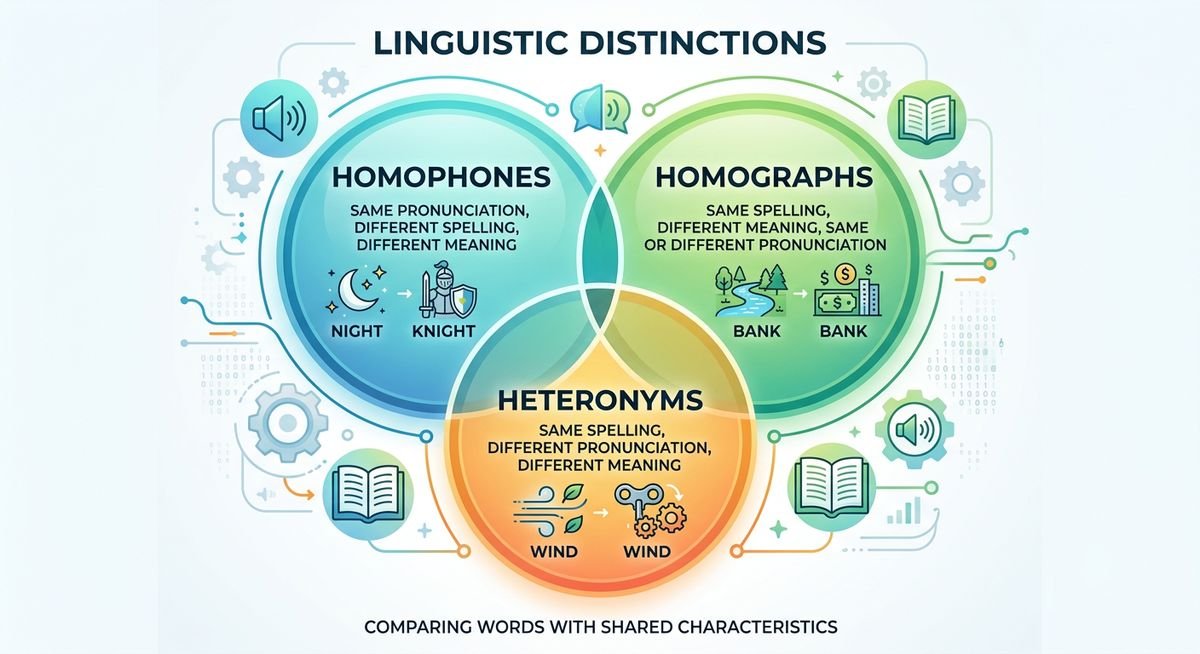
Grasping heteronyms meaning matters because these words sit at the intersection of spelling, pronunciation, and meaning in a way that no other word category does. Homophones sound alike but look different on the page. Homographs look alike but may or may not sound different. Heteronyms demand all three conditions simultaneously: identical spelling, divergent pronunciation, and unrelated meaning. That triple requirement makes them uniquely challenging for second-language learners, text-to-speech engines, and anyone who has ever paused mid-sentence to wonder whether “read” rhymes with “red” or “reed.”
What follows covers the precise heteronym definition, a side-by-side comparison with homophones and homographs, a reference table of common heteronym pairs with IPA pronunciation guides, the role of heteronyms in literature — including Fernando Pessoa’s famous literary alter egos — and the real-world impact these words have on learners, accessibility technology, and standardized testing.
What Does Heteronym Mean? The Core Definition
A heteronym is a word spelled identically to another word but pronounced differently and carrying a completely different meaning. The Cambridge Dictionary defines heteronym as “a word that is spelled the same as another word but has a different meaning and is pronounced differently.” Merriam-Webster’s entry echoes this: “one of two or more homographs that differ in pronunciation and meaning.”
Heteronym Etymology and Definition
The term derives from two Greek roots: hetero (different) and onyma (name). Literally translated, a heteronym is a “different name” disguised behind identical spelling. The Merriam-Webster dictionary entry on heteronym traces the word’s first recorded English usage to 1889, placing it firmly in the era when systematic phonetic classification of English vocabulary was gaining academic traction.
According to a comprehensive analysis published in the journal Lingua (Cutler, 2015), English contains approximately 334 heteronym pairs in common usage — far more than most speakers realize. The concentration is heaviest among short, high-frequency words (one and two syllables), which explains why heteronyms cause disproportionate disruption in everyday reading rather than appearing only in technical or obscure vocabulary.
The One Rule That Separates Heteronyms From Homographs
Pronunciation must change alongside meaning. Consider “bark” — whether it refers to a dog’s sound or the outer layer of a tree, the pronunciation stays identical (/bɑːrk/). That makes “bark” a homograph, not a heteronym. Now consider “does”: /dʌz/ means “performs an action” while /dəʊz/ refers to female deer. Spelling identical. Pronunciation diverges. Meaning diverges. That qualifies as a heteronym.

Heteronyms vs. Homophones vs. Homographs: Are Homographs and Heteronyms the Same?
Heteronyms are a strict subset of homographs — all heteronyms are homographs, but not all homographs are heteronyms. The dividing line is pronunciation: homographs that share the same sound (like “bark”) stay in the homograph-only category, while homographs whose pronunciation splits (like “tear”) qualify as heteronyms.
Definitions at a Glance
A heteronym shares identical spelling with another word but differs in both pronunciation and meaning — “tear” /tɪr/ (a drop from the eye) versus “tear” /tɛr/ (to rip). A homophone sounds identical to another word but is spelled differently, like “to,” “two,” and “too.” A homograph shares spelling and may or may not change pronunciation. “Homonym” is the broadest umbrella: according to the Cambridge Dictionary grammar reference, it covers words that are either spelled the same, sound the same, or both.
Side-by-Side Comparison Table
| Term | Same Spelling? | Same Pronunciation? | Same Meaning? | Example |
|---|---|---|---|---|
| Heteronym | Yes | No | No | tear /tɪr/ vs. /tɛr/ |
| Homophone | No | Yes | No | knight / night |
| Homograph | Yes | Yes or No | Yes or No | bark (tree / dog sound) |
| Homonym | Yes | Yes | No | bat (animal / sports equipment) |
Same spelling, different sound, different sense — all three conditions required, no exceptions. Understanding these connections between spelling, pronunciation, and meaning is what defines heteronyms and separates them from every adjacent category in linguistics.
Common Heteronyms Examples With Meaning and Pronunciation
English contains over 300 heteronym pairs, yet most learners encounter them without phonetic guidance — just a word on a page and a guess. The pairs below include the most frequently tested heteronyms in ESL curricula and standardized exams, each with International Phonetic Alphabet transcriptions and contrasting sentences.
How to Say Heteronyms: Reading the IPA Guide
IPA notation uses standardized symbols to represent sounds across all languages. The mark /ˈ/ before a syllable signals primary stress — so /ˈriːkɔːrd/ means the first syllable carries emphasis. Vowel length is shown with /ː/: /iː/ sounds like the “ee” in “feet,” while /ɪ/ is the shorter “i” in “fit.”
Heteronyms List With Examples
| Word | Pronunciation 1 (with example) | Pronunciation 2 (with example) |
|---|---|---|
| BASS | /bæs/ (a freshwater fish): He caught a largemouth bass on his first cast. | /beɪs/ (low musical register): The bass line drives the entire rhythm section. |
| LEAD | /liːd/ (to guide): She will lead the expedition through the valley. | /lɛd/ (a heavy metal): Old pipes made of lead contaminated the water supply. |
| TEAR | /tɪər/ (a drop from the eye): A single tear rolled down her cheek. | /tɛər/ (to rip): Be careful not to tear the wrapping paper. |
| WIND | /wɪnd/ (moving air): The wind knocked the fence down overnight. | /waɪnd/ (to coil): Wind the cable around the spool before storing it. |
| BOW | /bəʊ/ (a weapon or ribbon): She tied a bow on top of the gift. | /baʊ/ (to bend forward): The actors bow after every performance. |
| DOVE | /dʌv/ (a bird): A white dove landed on the windowsill at dawn. | /dəʊv/ (past tense of dive, American English): He dove into the pool headfirst. |
| DOES | /dʌz/ (performs an action): She does the grocery shopping every Saturday. | /dəʊz/ (plural of doe, female deer): Three does grazed at the edge of the meadow. |
| AXES | /ˈæksɪz/ (plural of axe): The firefighters carried axes to clear the debris. | /ˈæksiːz/ (plural of axis): The graph plots data along two perpendicular axes. |
| WOUND | /wuːnd/ (an injury): The wound required three stitches to close. | /waʊnd/ (past tense of wind): She wound the thread tightly around the bobbin. |
| DESERT | /ˈdɛzərt/ (an arid landscape): The Sahara is the world’s largest hot desert. | /dɪˈzɜːrt/ (to abandon): He would never desert his colleagues under pressure. |
| PRESENT | /ˈprɛzənt/ (a gift): She unwrapped the present on her birthday. | /prɪˈzɛnt/ (to formally show): He will present his findings to the board on Friday. |
| REFUSE | /ˈrɛfjuːs/ (garbage, waste): The refuse collectors arrive every Tuesday morning. | /rɪˈfjuːz/ (to decline): She chose to refuse the offer without explanation. |
| COORDINATE | /kəʊˈɔːrdɪneɪt/ (to organize): The team leader will coordinate the entire rescue effort. | /kəʊˈɔːrdɪnət/ (a position value): Enter the GPS coordinate to find the exact location. |
| MINUTE | /ˈmɪnɪt/ (60 seconds): The train leaves in exactly one minute. | /maɪˈnjuːt/ (extremely small): The difference between the two samples was minute. |
| OBJECT | /ˈɒbdʒɪkt/ (a physical thing): A small metallic object was found at the scene. | /əbˈdʒɛkt/ (to express opposition): The defense attorney will object to that line of questioning. |
| RECORD | /ˈrɛkɔːrd/ (stored information): She broke the world record by half a second. | /rɪˈkɔːrd/ (to capture audio): The studio will record the album over three days. |
| CONTENT | /ˈkɒntɛnt/ (material within something): The content of the report surprised the committee. | /kənˈtɛnt/ (satisfied): After a long hike and a good meal, he felt genuinely content. |
| ROW | /rəʊ/ (a line): They sat in the front row of the theater. | /raʊ/ (a noisy argument, British English): The neighbors had a terrible row last night. |
| CLOSE | /kləʊz/ (to shut): Please close the window before it rains. | /kləʊs/ (near): The finish was incredibly close — only a tenth of a second separated them. |
A pattern connects many of these pairs. Noun-verb heteronyms like record, present, object, refuse, and coordinate follow a consistent stress-shift rule: nouns carry stress on the first syllable, verbs shift it to the second. Research published in the Journal of Phonetics (Kelly, 1992) documented this noun-verb stress alternation across 149 English word pairs, confirming it as one of the most reliable pronunciation shortcuts available to learners — rather than memorizing each pair in isolation, recognizing the grammatical role predicts the correct stress placement.
Heteronyms in Literature: Fernando Pessoa and the Literary Meaning
The word “heteronym” carries a second, entirely distinct meaning in literary studies — one that has nothing to do with pronunciation. Portuguese poet Fernando Pessoa (1888-1935) coined the literary use of the term to describe fully developed fictional identities under which he wrote, each with a distinct biography, writing style, and philosophical worldview.
Pessoa created over 70 heteronyms during his career, but three dominate scholarly study: Alberto Caeiro (a pastoral poet who rejected metaphysics), Ricardo Reis (a classicist influenced by Horace and Latin odes), and Alvaro de Campos (a Futurist and Modernist who wrote sprawling, emotion-driven verse). According to research compiled by the Casa Fernando Pessoa museum in Lisbon, Pessoa published more work under his heteronyms than under his own name.
The distinction between Pessoa’s heteronyms and ordinary pen names is deliberate. A pseudonym is a false name attached to the real author’s voice. A Pessoan heteronym is a complete fictional author — with an independent biography, aesthetic philosophy, and literary output that may contradict the views of the “real” Pessoa. This literary definition of heteronym persists in Portuguese, Spanish, and comparative literature scholarship worldwide, and occasionally causes confusion when linguistics students encounter the same word used in an entirely different disciplinary context.
Why Heteronyms Cause Real-World Reading and Learning Challenges
Heteronyms force readers to resolve pronunciation from context alone — no visual marker, no accent, no spelling variation signals which meaning is active. That ambiguity creates measurable consequences across education, technology, and accessibility.
Challenges for ESL and EFL Learners
English spelling notoriously fails to reflect pronunciation, and heteronyms sit at the sharpest edge of that failure. Unlike homophones — where spelling at least differs — heteronyms offer no orthographic clue that a pronunciation shift is coming. Learners must decode the correct reading entirely from sentence context, placing heavy cognitive load on working memory during real-time reading.
A 2018 study in Applied Psycholinguistics (Gollan et al.) found that bilingual readers required an average of 200 milliseconds longer to process heteronym-containing sentences than matched control sentences — a delay the researchers attributed to lexical ambiguity processing, the mental cost of holding two competing word interpretations simultaneously until context resolves the conflict. For intermediate-level ESL learners, that delay doubles, according to data from Studies in Second Language Acquisition (Libben & Titone, 2009).
Heteronyms and Text-to-Speech Technology
Text-to-speech (TTS) systems — used in screen readers, voice assistants, and audiobook platforms — must predict correct pronunciation from surrounding context using natural language processing. A 2020 analysis by Google’s TTS research team found that heteronyms accounted for roughly 18% of all pronunciation errors in their English synthesis model, making them the single largest category of context-dependent mispronunciation.
A screen reader mispronouncing “wound” in a medical document, or “invalid” in a legal form, can invert a sentence’s meaning for blind users or readers with severe dyslexia who depend entirely on audio output. The Web Content Accessibility Guidelines (WCAG) 2.2 specifically address pronunciation disambiguation as a Level AAA success criterion (SC 3.1.6), recognizing that heteronyms represent a structural accessibility barrier in digital content.
Heteronyms on Standardized Tests
Heteronyms appear in vocabulary-in-context sections of the SAT, TOEFL, and GRE. A misidentified heteronym can cascade into a wrong answer on a question the reader otherwise understood. Consider: “The city council voted to refuse the refuse collection contract.” Processing both instances of “refuse” identically — rather than distinguishing /rɪˈfjuːz/ (to decline) from /ˈrɛfjuːs/ (waste) — collapses the sentence’s logic entirely.
Heteronyms Meaning in Other Languages
Heteronyms are not unique to English — any language whose spelling system does not perfectly map to pronunciation can produce them, though English generates more heteronyms than most because of its unusually inconsistent orthography.
| Language | Heteronym | Pronunciation 1 | Pronunciation 2 |
|---|---|---|---|
| French | fils | /fis/ (son) | /fil/ (threads) |
| French | os | /ɔs/ (bone, singular) | /o/ (bones, plural) |
| Dutch | voorkomen | /ˈvoːrkɔmə(n)/ (to occur) | /voːrˈkɔmə(n)/ (to prevent) |
| Italian | ancora | /ˈaŋkora/ (anchor) | /aŋˈkora/ (again, still) |
Languages with highly phonemic spelling systems — Finnish, Turkish, Korean hangul — produce virtually zero heteronyms because their orthography maps sounds with near-perfect consistency. English, by contrast, absorbed vocabulary from Latin, French, Norse, and Germanic sources over centuries without standardizing pronunciation, which is why it generates heteronyms as a structural byproduct of its multilingual inheritance.
Frequently Asked Questions
What is the meaning of heteronym with examples?
A heteronym is a word spelled identically to another word but pronounced differently and carrying a different meaning. “Desert” (/ˈdɛzərt/, an arid landscape) and “desert” (/dɪˈzɜːrt/, to abandon) are a classic example — same letters, completely different sound and sense. Other common examples include “lead” (/liːd/ to guide vs. /lɛd/ a metal) and “wind” (/wɪnd/ moving air vs. /waɪnd/ to coil).
Are homographs and heteronyms the same?
Homographs and heteronyms are not the same, though they overlap. Homographs are words with identical spelling regardless of pronunciation — “bark” (tree covering) and “bark” (dog sound) are homographs that sound alike. Heteronyms are the subset of homographs where pronunciation must differ, like “bass” (/bæs/ fish vs. /beɪs/ music). Every heteronym is a homograph, but not every homograph qualifies as a heteronym.
What is the difference between heteronyms and homophones?
Homophones sound identical but are spelled differently — “knight” and “night” are the textbook case. Heteronyms are the structural opposite: identical spelling, different sounds. The two concepts are mirror images — homophones diverge on spelling, heteronyms diverge on pronunciation.
What does the heteronym bass mean?
Bass is one of the most frequently cited heteronyms in English. Pronounced /bæs/, it refers to a type of freshwater fish (largemouth bass, smallmouth bass). Pronounced /beɪs/, it refers to the lowest pitch range in music or a bass guitar. The spelling is identical in both cases, but the vowel sound shifts completely depending on whether the context is aquatic or musical.
What does the heteronym axes mean?
Axes functions as a heteronym with two distinct pronunciations. As /ˈæksɪz/, it is the plural of “axe” (a cutting tool). As /ˈæksiːz/, it is the plural of “axis” (a reference line in mathematics or the central line around which something rotates). The spelling is identical, but the final syllable changes from a short /ɪz/ to a long /iːz/.
What does the heteronym dove mean?
Dove splits into two pronunciations. As /dʌv/, it names a bird associated with peace and symbolism. As /dəʊv/ (primarily in American English), it is the past tense of “dive” — “he dove into the water.” British English typically uses “dived” instead, making the heteronym dove more common in American usage.
What does heteronym mean in the context of Fernando Pessoa?
In literary studies, a heteronym refers to a fully developed fictional author identity — not a pen name, but a complete alter ego with an independent biography, writing style, and worldview. Portuguese poet Fernando Pessoa (1888-1935) created over 70 such identities, each producing distinct literary work. This literary usage is entirely separate from the linguistic definition involving pronunciation.
How do you pronounce the word heteronyms?
Heteronyms is pronounced /ˈhɛtərənɪmz/ — stress falls on the first syllable, “HET-er-uh-nimz.” The singular form, heteronym, follows the same stress pattern: /ˈhɛtərənɪm/. The word rhymes roughly with “veteran hymns” if spoken quickly.
What is the meaning of heteronyms in Hindi?
In Hindi, heteronyms can be translated as “विषमनाम” (vishamnaam) or described as “एक ही वर्तनी वाले लेकिन अलग उच्चारण और अर्थ वाले शब्द” (words with the same spelling but different pronunciation and meaning). Hindi itself produces very few heteronyms because Devanagari script maps sounds more consistently than the Latin alphabet used in English.
What is the meaning of heteronyms in Chinese (heteronyms 中文)?
In Chinese, heteronyms are called “多音词” (duōyīncí), meaning “multi-pronunciation words.” Chinese actually has its own rich tradition of heteronyms — characters like 了 (le/liǎo), 行 (xíng/háng), and 长 (cháng/zhǎng) change both pronunciation and meaning depending on context, making heteronyms a familiar concept to Chinese-speaking English learners.
Conclusion
Heteronyms are words sharing identical spelling but carrying different meanings and different pronunciations — that single shift in sound separates them from ordinary homographs and places them in a category of their own. English contains over 300 documented pairs, concentrated among high-frequency short words like “lead,” “bass,” “wind,” “axes,” and “dove.”
The pattern repeats across French, Dutch, Italian, and Chinese, though English produces heteronyms at an unusually high rate because of its chaotic multilingual spelling history. Once you understand heteronyms meaning — same spelling, different sound, different sense — you start spotting them everywhere. Whether the context is ESL education, text-to-speech engineering, literary studies, or a standardized test question, the core challenge remains the same: identical letters, divergent sounds, no visual warning.