


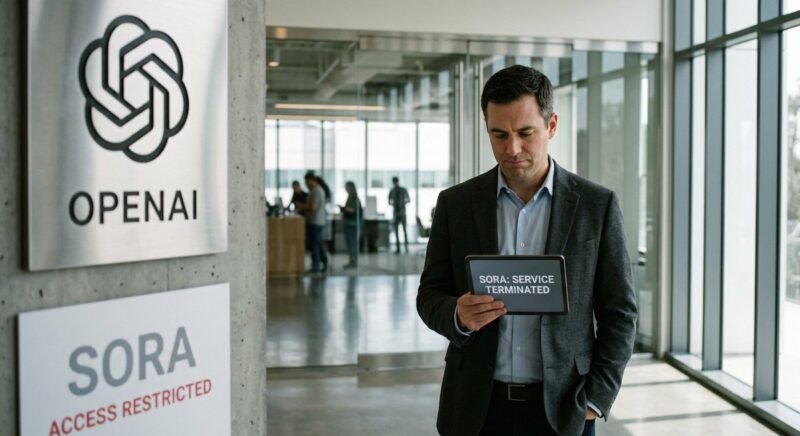
OpenAI confirmed on March 24, 2026 that it is permanently shutting down Sora, the AI video generation platform that launched as a standalone app barely six months ago. “We’re saying goodbye to Sora,” the company wrote on X, promising to share timelines for when the app and its related API would go fully offline. The announcement killed a $1 billion Disney licensing deal in the process.
The news of OpenAI shutting down Sora blindsided an industry that had watched the company pour resources into the platform since its first public demonstration in February 2024. Six months after the standalone app hit the top of Apple’s App Store charts, OpenAI is walking away from consumer AI video entirely — pivoting hard toward enterprise products, robotics research, and what executives have described as a “super app” integrating ChatGPT, Codex, and other core tools.
Why OpenAI Is Shutting Down Sora
OpenAI is discontinuing Sora to redirect compute resources toward enterprise AI and robotics research, areas the company now considers higher-priority than consumer video generation. According to Reuters (2026), the shutdown reflects a strategic sharpening ahead of a potential public market debut later in the year.
Every major outlet covering sora openai news landed on the same conclusion: three forces converged to make the openai shutdown of Sora inevitable. Rising compute costs made running a consumer video app economically painful at scale. User engagement cratered after the initial viral launch — analytics showed a 32% drop in new downloads in December 2025 alone. And competitive pressure from Runway, Luma AI, and Google’s Veo 3 meant Sora was fighting for market share in an increasingly crowded field without a clear path to profitability.
| Factor | Details | Impact on Decision |
|---|---|---|
| Compute costs | Video generation requires 10-50x more GPU hours than text or image tasks | Unsustainable unit economics at consumer scale |
| User retention | 32% download decline in Dec 2025; engagement dropped after initial viral wave | Consumer demand did not justify ongoing investment |
| Competitive landscape | Runway Gen-3 Alpha, Luma Dream Machine, Google Veo 3 all shipping features faster | No defensible moat in consumer AI video |
| Strategic pivot | Enterprise clients, robotics, world simulation, “super app” integration | Management chose to consolidate around core strengths |
According to Business Insider (2026), internal discussions about sunsetting Sora had been underway since early February, well before the public announcement. The decision reportedly accelerated after OpenAI’s $110 billion funding round, which valued the company at approximately $730 billion and came with investor expectations to focus on revenue-generating enterprise products rather than experimental consumer tools.
The Disney Deal That Collapsed
Disney’s planned $1 billion equity investment in OpenAI is dead, a direct casualty of OpenAI shutting down Sora. The deal, announced on December 11, 2025, would have licensed more than 200 characters from Disney, Marvel, Pixar, and Star Wars for use in Sora-generated short videos — a partnership that the entertainment industry had viewed as a watershed moment for AI-powered content creation.
Under the original agreement, users could have prompted Sora to generate videos featuring Mickey Mouse, Iron Man, Darth Vader, Simba, and Groot, among others. A selection of user-generated clips was to be streamed on Disney+. Disney also planned to deploy ChatGPT internally for employee workflows, making the company one of OpenAI’s largest enterprise customers. According to Reuters (2025), the deal included warrants for Disney to purchase additional OpenAI equity beyond the initial $1 billion commitment.
No actual money changed hands. According to Deadline (2026), the investment was never finalized despite the public announcement. Disney confirmed it is ending the partnership, releasing a statement expressing respect for OpenAI’s strategic decision while emphasizing its commitment to “engaging with AI platforms responsibly and protecting intellectual property and creators’ rights.”
Sora Whitepaper and Technical Architecture
The open ai sora whitepaper, titled “Video generation models as world simulators,” described Sora’s architecture as a diffusion transformer (DiT) trained on large-scale video-text datasets to generate temporally consistent video from text prompts. OpenAI published the technical report alongside Sora’s first demonstration in February 2024, framing the model as a step toward AI systems capable of understanding and simulating real-world physics.
Sora’s architecture operates through a multi-stage pipeline. A T5 text encoder first parses the input prompt into dense semantic embeddings. These embeddings then condition a latent diffusion model that generates video by iteratively denoising random noise into coherent frame sequences within a compressed latent space. The model uses a spatiotemporal transformer network to maintain visual consistency — spatial transformers handle within-frame relationships like object placement and lighting, while temporal transformers track motion and object permanence across frames.
| Technical Component | Function | Why It Matters |
|---|---|---|
| T5 Text Encoder | Converts text prompts to dense semantic vectors | Enables nuanced understanding of complex scene descriptions |
| Latent Diffusion Model | Generates video in compressed latent space via iterative denoising | Balances computational efficiency with visual fidelity |
| Spatial Transformer | Models within-frame relationships (objects, lighting, depth) | Produces physically plausible scene compositions |
| Temporal Transformer | Tracks motion and continuity across frames | Prevents flickering and maintains object permanence |
| PixArt-alpha initialization | Pre-trained image model fine-tuned with temporal attention layers | Jumpstarts video generation from proven image capabilities |
Sora 2, released in late September 2025, expanded capabilities to include synchronized dialogue and sound effects, multiple resolution outputs (720×1280 portrait, 1280×720 landscape), and durations of 4, 8, or 12 seconds. The Sora 2 System Card (2025) detailed additional features including character assets that maintained consistent appearance across multiple generations and image-to-video mode where a reference frame could anchor the visual style.
How Sora AI Setup and Usage Worked
The openai sora ai setup required a ChatGPT Plus or Pro subscription, access through sora.com or the dedicated Sora app, and a text prompt describing the desired video. Users who followed any openai sora使用教程 (usage tutorial) would have encountered a straightforward workflow: type a prompt, select resolution and duration, and wait for the model to generate the clip — typically within one to three minutes for a standard request.
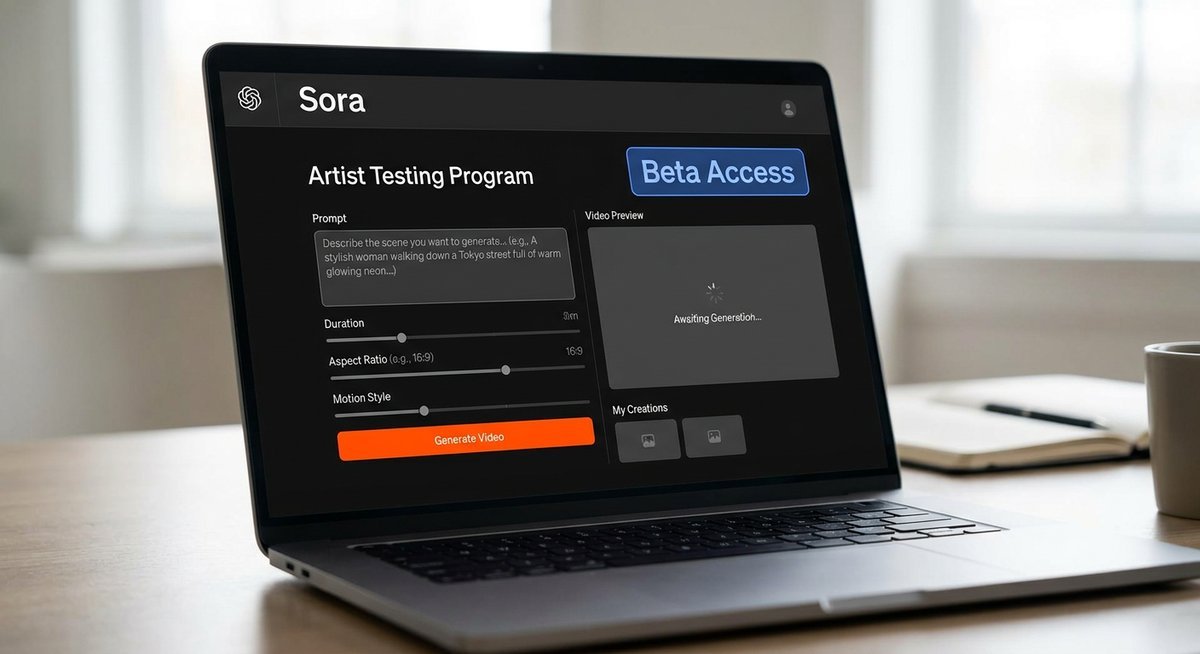
- Account access — Subscribe to ChatGPT Plus ($20/month) or ChatGPT Pro ($200/month) for higher generation limits
- Navigate to Sora — Open sora.com or the standalone Sora app (iOS and web)
- Write a prompt — Describe the scene, camera movement, lighting, and subject in natural language
- Set parameters — Choose resolution (landscape, portrait, or square) and duration (4, 8, or 12 seconds)
- Optional: upload reference — Provide an input image to anchor the first frame or a character asset for consistent subjects
- Generate and download — Wait for processing, preview the result, and download the MP4 file
Creating Music Videos with Sora
The openai sora mv (music video) use case was one of Sora’s most popular creative applications. Creators discovered that by chaining multiple short clips with consistent character assets and stylistic prompts, they could assemble full music video sequences. The workflow typically involved generating 8-12 individual clips of 8-12 seconds each, then editing them together with synchronized audio in a standard video editor like DaVinci Resolve or Adobe Premiere Pro.
Sora’s ability to maintain visual consistency across separately generated clips — same character appearance, same lighting mood, same camera style — made it uniquely suited to this workflow. Several viral music videos generated with Sora accumulated millions of views on YouTube and TikTok during the app’s brief run. With the shutdown now confirmed, creators using Sora for music video production will need to migrate to alternatives like Runway Gen-3 Alpha or Google Veo 3.
OpenAI Blocking Hong Kong and Regional Restrictions
OpenAI has blocked direct API and consumer access from Hong Kong since July 2024, a corporate decision driven by internal risk assessments rather than Hong Kong government censorship. The restriction means users in Hong Kong cannot sign up for or directly access ChatGPT, Sora, or any OpenAI API service — a policy that predates the Sora shutdown and will outlast it.
According to South China Morning Post (2024), OpenAI tightened enforcement against “unsupported countries and territories” including mainland China and Hong Kong, citing national security concerns linked to the 2020 National Security Law and potential data disclosure obligations toward mainland Chinese authorities. Hong Kong maintains an open and uncensored internet — the openai block hong kong policy is entirely a corporate restriction, not a government mandate.
Hong Kong businesses still have a workaround. Microsoft Azure OpenAI Service remains fully available in Hong Kong, providing enterprise customers with access to GPT-4 class models through cloud infrastructure deployed outside the territory. Microsoft confirmed in 2024 that there has been no change to its Azure OpenAI service offerings for Hong Kong customers. Individual consumers, however, have no officially supported access path — VPN workarounds exist but violate OpenAI’s terms of service and carry data privacy risks.
What Happens Next — Competitors and Alternatives
Sora’s exit leaves a vacuum that competitors are already racing to fill. Runway, Luma AI, and Google’s Veo represent the most viable alternatives for creators and developers who built workflows around OpenAI’s video generation capabilities.
| Platform | Key Strengths | Pricing Model | API Available |
|---|---|---|---|
| Runway Gen-3 Alpha | Strong motion consistency, established creative community | Subscription + per-generation credits | Yes |
| Luma Dream Machine | Fast generation speed, free tier available | Freemium + paid plans | Yes |
| Google Veo 3 | Integrated with Google Cloud, high resolution output | Cloud API pricing | Yes (via Vertex AI) |
| Kling AI | Long-form video up to 2 minutes, strong physics simulation | Credit-based | Limited |
For enterprise customers, the pivot signals that OpenAI sees its future in text, code, and reasoning models — not media generation. The company’s planned “super app” integrating ChatGPT and Codex suggests a consolidation around productivity-focused AI rather than creative tools. According to CNBC (2026), internal resources previously allocated to Sora are being redirected to robotics and world simulation research — capabilities OpenAI views as critical for advancing toward artificial general intelligence.
Frequently Asked Questions
Why is OpenAI shutting down Sora?
OpenAI is shutting down Sora to redirect compute resources and engineering focus toward enterprise AI products, robotics research, and its planned “super app” integration. Rising compute costs, a 32% decline in user downloads, and intense competition from Runway, Luma, and Google Veo made the consumer video business economically unsustainable ahead of OpenAI’s potential IPO.
What happened to the Disney-Sora deal?
Disney’s planned $1 billion equity investment in OpenAI collapsed immediately after the Sora shutdown announcement. The deal, announced December 11, 2025, was never finalized — no money changed hands. Disney confirmed it is ending the partnership, which would have licensed 200+ characters from Disney, Marvel, Pixar, and Star Wars for AI-generated video content.
Can I still use Sora after the shutdown?
OpenAI has not yet provided exact shutdown dates for the Sora app and API. The company stated it will share timelines and instructions for users to preserve their AI-generated videos. Until the cutoff date is announced, existing subscribers may still have access, but no new features or updates are expected.
What are the best alternatives to Sora for AI video generation?
Runway Gen-3 Alpha, Luma Dream Machine, Google Veo 3, and Kling AI are the leading alternatives. Runway offers the most mature creative ecosystem and API access. Google Veo 3 integrates with Vertex AI for enterprise deployments. Luma provides a free tier for experimentation. Each platform has distinct strengths depending on whether the priority is creative quality, speed, or API integration.
Does the Sora shutdown affect ChatGPT or other OpenAI products?
No. OpenAI has confirmed that ChatGPT, DALL-E, the GPT API, and Codex are unaffected by the Sora discontinuation. The shutdown is specific to the Sora video generation app, the sora.com experience, and the related video generation API endpoints.
Why is OpenAI blocked in Hong Kong?
OpenAI blocked direct access from Hong Kong in July 2024 due to internal risk assessments related to the 2020 National Security Law, not because of Hong Kong government censorship. Hong Kong maintains an open internet. Enterprise users can still access OpenAI models through Microsoft Azure OpenAI Service, which remains fully available in the territory.
Conclusion
OpenAI shutting down Sora marks the end of the company’s most ambitious consumer creative product. From its first demonstration in February 2024 to the standalone app launch in September 2025 to the Disney mega-deal in December — and now to discontinuation barely three months later — Sora’s trajectory compresses an entire product lifecycle into two years.
The strategic calculus is clear. OpenAI has decided that its path to sustained revenue and eventual public offering runs through enterprise AI, code generation, and robotics — not through competing with Runway and Google in a capital-intensive consumer video market. The $730 billion valuation and investor expectations demand focus, not diversification.
For the creative professionals, developers, and businesses that built workflows around Sora, the lesson is uncomfortable but familiar in the AI space: platform risk is real, and no product is safe from a strategic pivot. Preserving video assets and migrating to alternative platforms should start now, before OpenAI announces its final shutdown dates.