



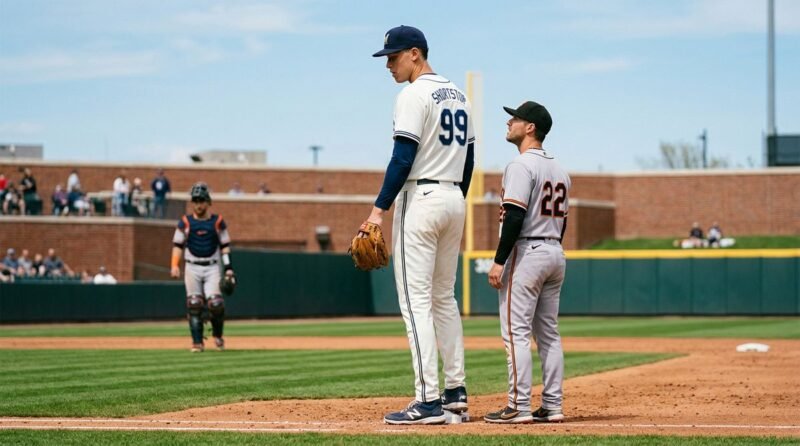
Oneil Cruz of the Pittsburgh Pirates stands 6 feet 7 inches tall, making him the tallest shortstop in MLB history by a margin of three full inches over the next closest player. No one at the position has ever reached that height in the major leagues — Cruz is a genuine statistical outlier in a sport where positional norms run deep. According to Baseball Reference player records, his listed height clears every verified shortstop in the game’s 150-year history.
Shortstop is traditionally the domain of smaller, quicker athletes. The average MLB shortstop stands around 6’1″, and the position’s demands — explosive lateral range, low-center-of-gravity footwork, and rapid double-play pivots — have historically favored compact builds. A 6’7″ shortstop shouldn’t work. Cruz made it work anyway, logging multiple seasons at the position before the Pirates shifted him to center field in 2024.
Below is a ranked breakdown of the tallest shortstops in MLB history, with positional context on why height is so rare at the six-hole, a contrast with the shortest players ever to man the position, and the biomechanics behind Cruz’s anomalous success.
Who Is the Tallest Shortstop in MLB History?
Oneil Cruz of the Pittsburgh Pirates stands 6’7″ tall, making him the tallest shortstop in MLB history by a clear margin. No other player to log significant time at the position has matched that height — not in the Dead Ball Era, not in the steroid era, not ever. Cruz sits six inches above the MLB positional height average for shortstops, which clusters around 6’1″ according to Baseball Reference player records.
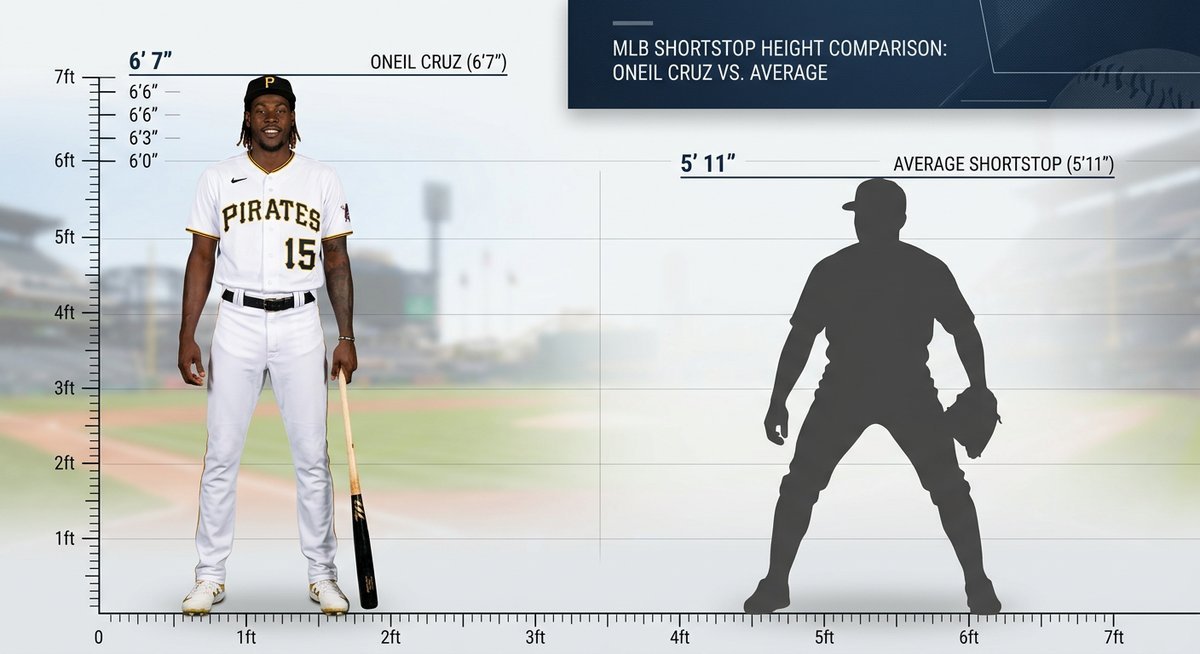
Oneil Cruz: The Record-Holder at 6’7″
Born in Palenque, Dominican Republic, Cruz was signed as an international amateur prospect and made his MLB debut with the Pittsburgh Pirates in 2021. Cruz stands 6’7″ and weighs approximately 220 pounds — a frame that looks more like a power-hitting outfielder than a middle infielder. The combination of that size and genuine shortstop athleticism is what makes Cruz historically unprecedented at the position.
MLB Statcast tracking data backs up what the eye test suggests. Cruz recorded a peak exit velocity of 122.4 mph during his time in Pittsburgh — among the hardest-hit balls ever tracked. His sprint speed clocked above 29 feet per second, placing him in the top tier of baserunners league-wide. Those numbers explain why Cruz could play a position that, by conventional wisdom, his body has no business occupying.
Defensive range at shortstop typically demands explosive lateral movement and a low center of gravity — physical traits that shorter players develop more naturally. Cruz compensates with an extraordinary wingspan that vacuums up ground balls outside a normal shortstop’s reach, and an arm that generates throws most shortstops simply cannot make from deep in the hole.
Has Any Shortstop Ever Been This Tall Before Cruz?
No MLB shortstop in the modern era has a verified listed height of 6’7″. The closest predecessors — players like Cal Ripken Jr. at 6’4″ and Alex Rodriguez at 6’3″ — were themselves considered unusually large for the position when they played. Cruz clears even those towering benchmarks by two to three full inches.
That gap matters more than it sounds. MLB positional height averages place shortstops around 6’1″, meaning Cruz stands six inches above the norm. Ripken and Rodriguez were outliers; Cruz is in a category with no historical precedent. The ranked list below shows exactly how wide that gap is across all of MLB history.
| Player | Height | Primary Team(s) | Inches Above SS Average (6’1″) |
|---|---|---|---|
| Oneil Cruz | 6’7″ | Pittsburgh Pirates | +6″ |
| Cal Ripken Jr. | 6’4″ | Baltimore Orioles | +3″ |
| Alex Rodriguez | 6’3″ | Seattle Mariners / Texas Rangers / NY Yankees | +2″ |
Top 10 Tallest Shortstops in MLB History
The top 10 tallest shortstops in MLB history range from Oneil Cruz at 6’7″ down to Robin Yount and Nomar Garciaparra at 6’0″, based on verified listed heights from Baseball Reference. Every player on this list logged at least 50 career games at shortstop, filtering out token appearances. The full ranking reveals just how rare it is for any shortstop to clear 6’2″.
How We Ranked This List
Every height on this list comes from Baseball Reference’s official player records, which reflect listed heights at the time of MLB registration. Ties in height are broken by total career games played at shortstop — the player who logged more innings at the position ranks higher. Players who split significant time between shortstop and another position are noted, because positional versatility matters when evaluating whether a tall player truly “counts” as a shortstop by trade.
#1–5: The Five Tallest Shortstops Ever
| Rank | Player | Height | Team(s) | Active Years | Career Highlight | Notable Stat |
|---|---|---|---|---|---|---|
| 1 | Oneil Cruz | 6’7″ | Pittsburgh Pirates | 2021–present | First 6’7″ shortstop in MLB history | Peak exit velocity of 122.4 mph; sprint speed above 29 ft/s (top 5% league-wide) |
| 2 | Cal Ripken Jr. | 6’4″ | Baltimore Orioles | 1981–2001 | 2,632 consecutive games played; 2× AL MVP | 19× All-Star; 431 career home runs as a shortstop/third baseman |
| 3 | Alex Rodriguez | 6’3″ | Mariners, Rangers, Yankees | 1994–2016 | 3× AL MVP; 696 career home runs | Led AL in home runs five times while playing shortstop in Seattle and Texas |
| 4 | Derek Jeter | 6’3″ | New York Yankees | 1995–2014 | 5× World Series champion; 2000 World Series MVP | 3,465 career hits, the most by any shortstop in MLB history |
| 5 | Ernie Banks | 6’1″ | Chicago Cubs | 1953–1971 | 2× NL MVP (1958–59); Baseball Hall of Fame inductee | 47 home runs in 1958, a single-season record for shortstops at the time |
Cruz stands entirely alone at the top. The jump from 6’7″ to 6’4″ — Ripken’s listed height — represents a full three inches, which in positional terms is a chasm. Ripken himself was considered freakishly large for a shortstop when he debuted in Baltimore, and he helped redefine what defensive range at shortstop could look like for a taller player.
#6–10: The Next Five Tallest MLB Shortstops
| Rank | Player | Height | Team(s) | Active Years | Career Highlight | Notable Stat / Note |
|---|---|---|---|---|---|---|
| 6 | Fernando Tatis Jr. | 6’3″ | San Diego Padres | 2019–present | 2× NL All-Star; $340 million contract extension signed in 2021 | 42 home runs in 2021; later transitioned to right field, but logged 200+ career games at SS |
| 7 | Tony Fernandez | 6’2″ | Blue Jays, Padres, Mets, Yankees, others | 1983–2001 | 4× Gold Glove Award winner at shortstop | Career .288 batting average across 2,158 games, primarily at shortstop |
| 8 | Troy Tulowitzki | 6’3″ | Colorado Rockies, Toronto Blue Jays | 2006–2019 | 5x All-Star; 2x Gold Glove Award winner at shortstop | Career .290 batting average; 225 home runs, primarily as a full-time shortstop in Colorado |
| 9 | Nomar Garciaparra | 6’0″ | Red Sox, Cubs, Dodgers, Athletics | 1996–2009 | 6× All-Star; 2× AL batting champion | Batted .357 in 1999, one of the highest single-season averages for a shortstop in the modern era |
| 10 | Robin Yount | 6’0″ | Milwaukee Brewers | 1974–1993 | 2× AL MVP; Hall of Fame inductee 1999 | Played 1,479 games at shortstop before moving to center field; won MVP at both positions |
Tony Fernandez deserves a closer look here. At 6’2″, Fernandez was considered unusually tall for a shortstop during his era, yet his four Gold Gloves prove that height alone never defines defensive range at shortstop — footwork and anticipation do. Troy Tulowitzki at 6’3″ brought a different flavor: elite power from the shortstop position in Colorado, with two Gold Gloves of his own despite a frame that scouts initially questioned for the position.
Several players in the 6–10 range spent meaningful time at positions other than shortstop. Tatis Jr. has shifted to right field, and Yount famously reinvented himself as a center fielder in his later years. Their shortstop credentials are real, but their careers weren’t defined by the position alone — unlike Cruz, whose entire MLB identity at this stage is built around playing the most demanding infield spot at a height no one has ever attempted before.
Average MLB Shortstop Height — And Why Cruz Is So Anomalous
The average MLB shortstop height is approximately 6’1″, making Oneil Cruz’s 6’7″ frame a full six inches above the positional mean — the largest deviation from any positional average in MLB’s modern era. That six-inch gap explains why Cruz’s success at shortstop defied a century of conventional wisdom about the position’s physical requirements.
What Is the Average Height of an MLB Shortstop?
Shortstop is one of the shorter positions in professional baseball, with MLB positional height averages clustering around 6’1″ for the role. Compare that to first basemen, who average closer to 6’3″, and corner outfielders, who frequently exceed 6’2″. Even catchers — a position defined by squatting endurance rather than range — average roughly 6’1″, putting them on par with shortstops.
| Position | Approximate Average Height |
|---|---|
| First Baseman | 6’3″ |
| Corner Outfielder | 6’2″ |
| Shortstop | 6’1″ |
| Catcher | 6’1″ |
| Second Baseman | 5’11” |
Cruz’s 6’7″ frame doesn’t just exceed the shortstop average — it clears the average by half a foot. Among all MLB positional height averages, Cruz would be an outlier at any position. At shortstop, the statistical anomaly is in a class of its own.
Why Shortstop Is Traditionally a Smaller Player’s Position
Shortstop favors shorter players because the position’s three core demands — explosive lateral movement, low-stance fielding, and rapid double-play pivots — all benefit from a lower center of gravity. Compact athletes generate quicker first-step bursts, drop into fielding positions faster, and rotate through the pivot throw more efficiently than taller counterparts carrying extra mass through the hips and shoulders.
The double-play pivot adds another layer. Middle infielder athleticism — the kind that lets a player receive a throw, spin, and release to first base in under a second — is easier to generate from a shorter, tighter frame. Research from the American Sports Medicine Institute (ASMI) on throwing biomechanics confirms that taller players carry more mass through the hips and shoulders, which can slow rotational mechanics at exactly the moment speed is critical.
Throwing angles compound the challenge. Shortstops field balls at varied depths and arm angles, often firing across the diamond from awkward stances. A 6’7″ player has more limb to coordinate through those movements, leaving less margin for mechanical error on off-balance throws.
How Tall Shortstops Like Cruz Overcome the Height Disadvantage
Tall shortstops like Cruz compensate for reduced lateral quickness through superior wingspan, arm strength, and raw athleticism. Cruz’s wingspan — estimated at roughly 6’9″ — turns one traditional liability into an asset. Ground balls that require a shorter player to take an extra step are sometimes reachable for Cruz with a single extension of his left arm, effectively widening his fielding radius without the additional footwork.
Statcast data from Cruz’s Pittsburgh Pirates seasons recorded sprint speed above 29 feet per second, placing Cruz in the 80th percentile or higher among all MLB players — elite athleticism that partially offsets the mechanical disadvantages of his frame. Cruz’s Outs Above Average (OAA) numbers were mixed during his MLB tenure, reflecting the genuine defensive tradeoffs his size creates rather than a clean positional fit. Defensive Runs Saved (DRS) and Ultimate Zone Rating (UZR) metrics told a similar story: raw tools that grade well in flashes, with inconsistency that reflects the real cost of playing the most demanding infield position six inches taller than almost anyone who has ever held it.
The Shortest Shortstop in MLB History — The Other End of the Spectrum
Rabbit Maranville stands as the shortest shortstop in MLB history at just 5’5″, a full 14 inches shorter than Oneil Cruz. Maranville played 23 seasons from 1912 to 1935, primarily with the Boston Braves, and earned induction into the Baseball Hall of Fame in 1954 — proof that elite defense at shortstop has never been about a single body type.
The gap between the tallest shortstop in major league baseball and the shortest tells a story about how dramatically the position’s physical profile has evolved. Maranville thrived in the Dead Ball Era, when shortstops were valued almost exclusively for glove work and base-running instincts. His 5’5″ frame gave him a naturally low fielding stance and the quick lateral burst that the position rewarded. Maranville logged 2,153 career games, the vast majority at shortstop, with a defensive reputation so strong that his offensive limitations barely mattered to the teams that employed him.
| Measurement | Shortest SS (Maranville) | Average MLB SS | Tallest SS (Cruz) |
|---|---|---|---|
| Height | 5’5″ | ~6’1″ | 6’7″ |
| Era | 1912–1935 | — | 2021–present |
| Defensive Style | Low center of gravity, range-first | Balanced athleticism | Wingspan-driven, arm strength |
Other notably short shortstops include Freddie Patek at 5’5″ (Kansas City Royals, 1971–1979) and Phil Rizzuto at 5’6″ (New York Yankees, 1941–1956). Rizzuto, like Maranville, earned Hall of Fame recognition, reinforcing that the position historically rewarded agility and instinct over size.
Corey Seager, and Tall Shortstop Prospects Who Could Challenge the Record
Corey Seager of the Texas Rangers currently stands 6’4″, making him one of the tallest active shortstops in Major League Baseball alongside a wave of prospects challenging traditional height limits at the position. The trend toward taller shortstops accelerated after Cruz proved a 6’7″ frame could survive at the six-hole, and front offices are now less likely to move tall athletes off the position purely because of their size.
Among minor league systems, several shortstop prospects listed at 6’3″ or above are advancing through development pipelines without being forced to third base or the outfield — a move that would have been automatic a decade ago. According to a 2023 MLB.com analysis of the tallest players by position, positional height boundaries across baseball are softening as athletic testing (sprint speed, lateral agility, reaction time) replaces visual scouting assumptions.
The Cruz precedent matters. If a 6’7″ shortstop can post competitive Outs Above Average numbers and elite sprint speed, the argument for rejecting a 6’4″ shortstop prospect on height alone collapses. Seager’s sustained success at the position — including a World Series MVP and multiple All-Star appearances — reinforces the case.
Frequently Asked Questions
Who is the tallest shortstop in MLB history?
Oneil Cruz of the Pittsburgh Pirates is the tallest shortstop in MLB history at 6’7″ and 220 pounds. No verified MLB shortstop before Cruz reached that height, making Cruz a genuine statistical outlier at a position where the average stands around 6’1″ according to Baseball Reference.
How tall is Oneil Cruz?
Cruz stands 6’7″ — six inches taller than the typical MLB shortstop and three inches taller than Cal Ripken Jr., the previous benchmark for a large shortstop. No other player to log significant games at the position in MLB history has matched that listed height.
What is the average height of an MLB shortstop?
The average MLB shortstop measures approximately 6’1″, placing shortstop among the shorter positional averages on the field compared to first basemen (6’3″) and corner outfielders (6’2″). Cruz clears that positional average by six full inches, a margin with no precedent at the shortstop position.
Who is the shortest shortstop in MLB history?
Rabbit Maranville, a Hall of Fame shortstop who played primarily from 1912 to 1935, stood just 5’5″. Maranville’s career spanned over two decades with teams including the Boston Braves and Pittsburgh Pirates, and his compact size was considered a genuine defensive asset given the range demands of the position in that era.
Does height hurt defensive range at shortstop?
Historically, a higher center of gravity was considered a disadvantage for lateral quickness and double-play pivot mechanics at shortstop. Statcast data on Cruz, however, shows elite sprint speed above 29 feet per second and competitive Outs Above Average figures, suggesting exceptional athleticism can offset the traditional height penalty at the position.
Conclusion
Oneil Cruz stands alone as the tallest shortstop in MLB history at 6’7″ — a full six inches above the positional average of roughly 6’1″. No player before Cruz reached that height while logging meaningful time at shortstop, and the top-10 list makes clear just how steep the drop-off is once you move past Cruz to Ripken at 6’4″.
The positional context matters. Shortstop’s demands — defensive range, quick-twitch footwork, double-play pivot mechanics — have historically favored compact athletes. Cruz doesn’t just survive those demands at his size; Statcast data shows Cruz actively excels in sprint speed and arm strength, rewriting assumptions about what a viable shortstop body looks like.
Whether the next generation of tall shortstop prospects eventually normalizes 6’4″ or above at the position remains an open question. Cruz has already shifted what scouts and front offices believe is physically possible there — and the data from Baseball Savant’s Statcast database suggests his athletic profile was never the liability that traditional scouting assumed.