




The dumbbell Romanian deadlift is the single closest alternative to the barbell RDL, preserving the hip hinge pattern and hamstring eccentric loading that make the original movement effective. But depending on whether the goal is working around back pain, training at home without equipment, or targeting the glutes more aggressively than the standard version allows, the best substitute changes entirely.
Fifteen exercises below cover every scenario — gym machines, cables, dumbbells, kettlebells, bodyweight-only setups, and options designed specifically for lifters managing lower back injuries. Each one is evaluated against the two criteria that separate a real RDL replacement from a generic leg exercise.
What Separates a Real RDL Alternative From a Generic Leg Exercise
A legitimate RDL substitute must replicate two mechanical stimuli: a hip hinge movement pattern and hamstring eccentric loading under tension. Skip either one, and the exercise trains the posterior chain in a general sense without delivering the specific adaptation the Romanian deadlift produces.
The hip hinge is a movement where the hips travel backward while the torso inclines forward, spine neutral, knees holding a soft bend. According to the National Strength and Conditioning Association (NSCA), the hip hinge is a foundational movement pattern for posterior chain development because it loads the hamstrings as hip extensors rather than knee flexors — a fundamentally different stimulus from a squat or leg press.
The second criterion is eccentric hamstring loading. During the RDL’s lowering phase, the hamstrings lengthen under resistance, generating the mechanical tension that drives hypertrophy and tendon adaptation. A 2023 systematic review published in the Journal of Sports Science and Medicine found that exercises emphasizing the eccentric phase at longer muscle lengths produced significantly greater hamstring growth compared to concentric-dominant alternatives.
| Criterion | What It Requires | Why It Matters |
|---|---|---|
| Hip hinge pattern | Hips drive back, spine neutral, knees soft | Loads hamstrings as hip extensors under stretch |
| Eccentric hamstring loading | Hamstrings lengthen against resistance during descent | Primary driver of hypertrophy and structural tendon adaptation |
| Full hip extension finish | Glute-hamstring co-contraction at lockout | Trains terminal hip extension strength the RDL is known for |
“Whatever alternative has to be a hip hinge movement too — which can also easily mess up your back with bad form.”
— Fitness community discussion, March 2026
That warning captures the core tension. Swapping exercises does not fix bad mechanics. Any hip hinge alternative carries similar injury risk if the lifter hyperextends at the top or rounds the lower back under load — the two most common RDL form errors flagged repeatedly in coaching communities.
Best Romanian Deadlift Alternatives With Gym Equipment
Cable machines, barbells, dumbbells, kettlebells, and specialty stations each offer a distinct loading profile that addresses different weaknesses in a lifter’s posterior chain. The seven exercises below cover every major equipment category found in a standard gym.
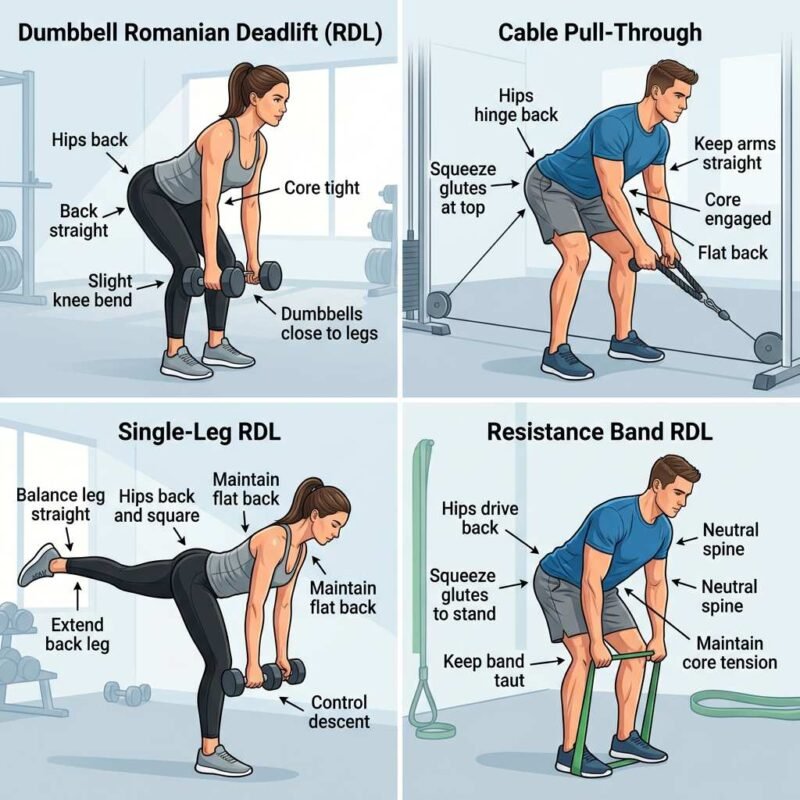
Dumbbell Romanian Deadlift
The dumbbell RDL is the closest 1:1 barbell replacement — same hip hinge, same hamstring stretch, same posterior chain demand. Holding dumbbells at the sides rather than a barbell in front allows a more natural hand path and reduces wrist strain. This variation works well as an RDL swap with dumbbells for home gyms, hotel fitness centers, and lifters returning from shoulder injuries that limit barbell grip width.
Keep a neutral spine, push the hips back, and lower the weights along the thighs until a strong hamstring stretch hits around mid-shin depth. For anyone seeking a Romanian deadlift alternative with dumbbells, three to four sets of 8-12 reps matches the loading pattern of a standard barbell RDL.
Cable Pull-Through
The cable pull-through replicates the hip hinge with a horizontal resistance vector, which dramatically reduces compressive spinal load. That makes it the top RDL substitute for back pain — the cable’s constant tension keeps the hamstrings and glutes loaded without stacking weight on the spine.
Stand facing away from a low pulley, reach back between the legs for the rope attachment, and drive the hips forward to standing. This cable RDL substitute is beginner-friendly and works as a teaching tool for the hinge pattern before progressing to heavier barbell work.
Trap Bar Deadlift
The trap bar (hex bar) deadlift shifts the center of gravity closer to the body, reducing the moment arm on the lumbar spine by roughly 20% compared to a straight barbell. That mechanical advantage makes it a strong RDL replacement for bad backs without sacrificing heavy posterior chain loading.
The trade-off is a slightly more quad-dominant movement pattern compared to a pure RDL. Compensate by keeping the hips higher and initiating the lift with a hip-dominant push rather than a knee-drive squat pattern.
Kettlebell Romanian Deadlift
A kettlebell held between the legs with both hands naturally encourages a deeper hip hinge than dumbbells at the sides. The kettlebell RDL variation is particularly effective for glute emphasis because the loading angle pulls the center of mass slightly forward, increasing glute demand at the bottom of the range.
Single-arm kettlebell RDLs add an anti-rotation challenge that no bilateral variation provides. Use them to expose and correct left-right asymmetries.
Smith Machine Romanian Deadlift
The smith machine locks the bar path to a fixed vertical track, removing the balance demand and allowing lifters to focus purely on hip hinge mechanics. Performing a Romanian deadlift alternative on a machine like the Smith works well for beginners learning the movement pattern and for experienced lifters chasing high-volume hypertrophy sets where fatigue-related form breakdown is a concern.
Set the bar at hip height, step under, and hinge. The fixed path is both the advantage and the limitation — it removes stabilizer demand, which means it builds less functional strength than a free-weight version.
Landmine Romanian Deadlift
Inserting a barbell into a landmine attachment creates an arc-shaped resistance path that naturally guides the hinge pattern. The landmine RDL variation is one of the most underused options in commercial gyms — zero competitors in the top-ranking SERP articles mention it despite its effectiveness for lifters who struggle with barbell balance.
Stand over the loaded end of the bar, grip it with both hands at hip level, and hinge back. The arc path makes the bottom position slightly easier and the lockout harder, which is a useful loading variation for glute-dominant training.
Leg Curl Machine (Seated and Lying)
Leg curls isolate the hamstrings through knee flexion rather than hip extension, making them a complement to — not a direct replacement for — the RDL. However, research from Maeo et al. (2021) found that seated leg curls produced 14% hamstring growth over 12 weeks compared to 9% for the lying variation, likely because the seated position stretches the hamstrings at a longer muscle length during the eccentric phase.
The RDL-to-leg-curl substitution approach works best as a pairing: use a hip hinge exercise (cable pull-through, kettlebell RDL) for the hinge stimulus, then add seated leg curls to maximize hamstring volume through a different loading angle.
Romanian Deadlift Alternatives at Home With No Equipment
Training the posterior chain without a barbell, dumbbells, or gym membership requires exercises that create hamstring tension through bodyweight leverage, single-leg balance demands, or resistance band accommodating resistance. Four options cover the Romanian deadlift alternative at home and no-equipment scenarios.
Resistance Band Romanian Deadlift
Stand on the center of a looped band, hold the ends at hip height, and hinge exactly as with a barbell. The band provides accommodating resistance — tension increases as the band stretches at the top, loading the glutes hardest at full hip extension where the barbell version provides the least challenge.
A medium-weight band generates roughly 30-50 pounds of tension at full stretch. The banded RDL is the highest-value no-barbell option because it preserves the full hinge pattern with scalable resistance.
Single-Leg Romanian Deadlift
The single-leg RDL is the most frequently recommended RDL substitute on Reddit, and for good reason — it preserves the hip hinge, delivers unilateral hamstring loading, and demands balance that exposes left-right strength gaps. One dumbbell or even bodyweight alone provides enough stimulus for intermediate lifters.
“Single leg RDLs are one of the most humbling exercises for runners… But dont rely on these alone for hamstring strength. The stability demand limits how much weight you can use. You need heavy deadlift-pattern loading too.”
— Strength coach, March 2026 (142 likes)
That limitation is real. The single-leg version works as an RDL swap for hamstrings and glutes in unilateral capacity, but bilateral loading (dumbbell RDL, banded RDL) should remain in the program for raw strength development.
Glute Bridge and Bodyweight Hip Thrust
Glute bridges train hip extension without any spinal loading, making them the safest Romanian deadlift bodyweight alternative for anyone recovering from a back injury. The movement is simple: lie face-up, plant feet flat, drive hips toward the ceiling, squeeze glutes at the top.
Progress to single-leg bridges or elevate the shoulders on a bench (hip thrust position) to increase range of motion and difficulty. The glute bridge emphasizes the glutes more than the hamstrings, so pair it with a Nordic curl or stability ball hamstring curl to cover both muscle groups.
Nordic Hamstring Curl
The Nordic curl produces the highest eccentric hamstring force of any exercise on this list. A 2023 meta-analysis in the Journal of Sports Science and Medicine confirmed that Nordic curl protocols significantly reduce hamstring injury rates in athletes, with the eccentric lowering phase generating peak forces that exceed those measured during RDLs. This calisthenics-friendly RDL replacement requires nothing more than an anchor point for the feet.
Kneel, anchor the feet, lower the torso toward the floor under control, and push back up. Most untrained individuals cannot complete a single clean rep — this is firmly an advanced exercise. Build toward it with eccentric-only partials (lower as slowly as possible, use hands to push back up).
Romanian Deadlift Alternatives for Back Pain, Bad Backs, and Bad Knees
Lower back pain is the single most common reason lifters search for an RDL replacement. Community discussions consistently confirm this — the majority of people looking for an RDL replacement for bad back situations are dealing with disc issues, chronic tightness, or post-injury recovery, not programming boredom.
Cable Pull-Through (Top Pick for Lower Back)
The horizontal resistance vector of the cable pull-through eliminates compressive spinal loading while preserving the hip hinge. This is the single best Romanian deadlift safe alternative for herniated discs, bulging discs, and general lumbar sensitivity. Start light and focus on a full hip lockout at the top.
Trap Bar Deadlift (Moderate Back Issues)
For lifters with moderate back sensitivity rather than acute injury, the trap bar keeps heavy posterior chain loading accessible. The neutral grip handles and centered load position reduce shear force on the lumbar spine compared to a conventional or Romanian deadlift.
Stability Ball Hamstring Curl (Rehab-Friendly)
Lie face-up, place heels on the ball, lift hips into a bridge, and curl the ball toward the glutes. The eccentric phase as the legs extend back out delivers hamstring loading without any spinal involvement. The stability ball hamstring curl is the most conservative RDL swap without weights and works well during early-stage rehabilitation.
Seated Good Morning (Bad Knees)
An RDL substitute for bad knees needs to minimize patellar load. Seated good mornings achieve this by removing the standing component entirely — sit on a bench with a light barbell across the upper back and hinge forward. The hamstrings and erectors work through a shortened range while knee flexion stays near zero.
Romanian Deadlift Alternatives by Target Muscle
The standard RDL hits hamstrings, glutes, and erector spinae roughly equally. Isolating one muscle group over the others requires choosing alternatives that bias the loading angle toward the target.
| Target Muscle | Best RDL Alternative | Why It Biases That Muscle |
|---|---|---|
| Hamstrings (eccentric) | Nordic hamstring curl | Highest eccentric force at long muscle length |
| Glutes (peak contraction) | Barbell hip thrust | Maximum glute activation at full hip extension |
| Hamstrings (stretch) | Stiff-leg deadlift | Greater range of motion than RDL, deeper hamstring stretch |
| Erector spinae | Good mornings | Barbell on upper back increases spinal erector moment arm |
| Glutes + hamstrings combined | Glute-ham raise (GHR) | Trains both knee flexion and hip extension simultaneously |
For Glutes: Hip Thrust and Kettlebell Swing
The barbell hip thrust is the strongest RDL replacement for glutes because it loads the glute at peak contraction — the shortened position where the RDL provides the least tension. Combine hip thrusts with a hinge movement (banded RDL, cable pull-through) to cover both the stretched and contracted ranges.
Kettlebell swings add an explosive component, training the glutes through rapid hip extension. They work particularly well as an RDL swap for legs in conditioning-focused programs where metabolic demand matters as much as raw strength.
For Hamstrings: Stiff-Leg Deadlift and Seated Leg Curl
The stiff-leg deadlift extends the range of motion beyond the standard RDL by keeping the knees nearly locked, increasing the hamstring stretch at the bottom. An effective RDL substitute for hamstrings should pair a lengthened-position exercise (stiff-leg deadlift) with a shortened-position exercise (seated leg curl) for complete development.
Single-Leg, Stance, and Grip Variations Worth Knowing
Several RDL “alternatives” are actually stance or grip modifications of the original movement. They deserve separate mention because they solve specific problems without abandoning the exercise entirely.
- B-stance Romanian deadlift — one foot slightly behind the other, biasing load toward the front leg. Bridges the gap between bilateral and single-leg work. The b-stance variation is ideal for lifters who find single-leg RDLs too unstable but want some unilateral emphasis.
- Split stance Romanian deadlift — a wider stagger than b-stance, increasing the single-leg demand while keeping both feet on the ground for stability.
- Sumo Romanian deadlift — wide stance with toes pointed out, shifting emphasis toward the adductors and inner hamstrings. The sumo RDL variation works for lifters with hip anatomy that limits conventional stance comfort.
- Deficit Romanian deadlift — standing on a 2-4 inch platform increases the range of motion, deepening the hamstring stretch at the bottom. Advanced variation only; requires established hip hinge competency.
- Romanian deadlift alternate grip — mixed grip (one overhand, one underhand) or hook grip for heavier loads where grip fails before the posterior chain does. Not a different exercise, but a grip strategy that extends the loading capacity of the standard movement.
Romanian Deadlift Alternatives for Beginners
Beginners who lack the hip mobility or body awareness for a full barbell RDL should build the pattern through simpler variations before progressing. An effective RDL progression for beginners follows three stages.
- Stage 1 — Pattern learning: Cable pull-throughs or banded good mornings. Both teach the hip hinge without heavy spinal loading and provide constant tension that cues proper movement.
- Stage 2 — Light loading: Dumbbell Romanian deadlift with moderate weight. Focus on controlled eccentric tempo (3-4 seconds down) and full hip extension at the top.
- Stage 3 — Full progression: Barbell Romanian deadlift. The lifter has earned the right to load the pattern heavily.
Skipping straight to the barbell with poor hip mobility is the fastest path to the back pain that drives the “alternative” search in the first place. Build the foundation first.
Sample Romanian Deadlift Alternative Workout
Slot these exercises into a lower-body or pull-focused training day. The workout covers the full posterior chain through three complementary movement patterns.
| Exercise | Sets x Reps | Rest | Notes |
|---|---|---|---|
| Dumbbell Romanian Deadlift | 4 x 8-10 | 90 sec | Primary hinge movement; control the eccentric |
| Single-Leg RDL (each side) | 3 x 10-12 | 60 sec | Unilateral balance and asymmetry correction |
| Seated Leg Curl | 3 x 12-15 | 60 sec | Isolation at long muscle length for max hypertrophy |
| Glute Bridge or Hip Thrust | 3 x 12-15 | 60 sec | Peak contraction glute emphasis |
Total volume: 13 working sets for the posterior chain, hitting the hamstrings from two angles (hip extension + knee flexion) and the glutes through both the stretched and shortened ranges. Adjust weight so the final 2-3 reps of each set are genuinely challenging.
Frequently Asked Questions
What is the best substitute for Romanian deadlifts?
The dumbbell Romanian deadlift is the closest 1:1 substitute, preserving the hip hinge and eccentric hamstring loading. For lifters with back pain, cable pull-throughs are the safest option. For home training with no equipment, the resistance band RDL combined with Nordic curls covers both the hinge and isolation stimulus.
What is the best Romanian deadlift alternative for glutes?
Barbell hip thrusts load the glutes at peak contraction — the shortened position where the RDL provides the least tension. Combine hip thrusts with a hinge movement like the kettlebell RDL to train the glutes through both stretched and contracted ranges for complete development.
What is the difference between a Romanian deadlift and a stiff-leg deadlift?
The RDL keeps a slight knee bend and stops the descent when the hamstrings reach full stretch (typically mid-shin). The stiff-leg deadlift keeps the knees nearly locked and often touches the floor, increasing range of motion but also increasing lower back demand. The stiff-leg version is a viable RDL alternative for lifters with good hamstring flexibility who want a deeper stretch.
Can I do a Romanian deadlift alternative on a machine?
The smith machine Romanian deadlift locks the bar path to a vertical track, removing balance demand while preserving the hip hinge pattern. Seated and lying leg curl machines isolate the hamstrings through knee flexion and work best as accessory exercises paired with a free-weight hinge movement rather than standalone RDL replacements.
What is the best Romanian deadlift alternative with no barbell?
The dumbbell RDL is the first choice when dumbbells are available. Without any weights, the resistance band RDL provides the closest loading profile. Single-leg RDLs with bodyweight alone offer enough stimulus for intermediate lifters focused on balance and unilateral strength.
Why does my back hurt during Romanian deadlifts?
The two most common causes are hyperextending at the top of the movement (squeezing the lower back instead of the glutes at lockout) and rounding the lumbar spine under load during the descent. Fixing these form errors often eliminates the pain without switching exercises. If pain persists after form correction, cable pull-throughs and trap bar deadlifts are the lowest-risk alternatives.
What is the Romanian deadlift alternate grip?
The alternate (mixed) grip uses one overhand and one underhand hand to prevent the bar from rolling out of the hands during heavy sets. It is a grip strategy for the standard RDL, not a separate exercise. Hook grip is the main alternative for lifters who want to avoid the slight rotational torque that mixed grip creates.
What is another name for the Romanian deadlift?
The Romanian deadlift is commonly abbreviated as RDL. It is sometimes called the straight-leg deadlift, though technically the stiff-leg deadlift is a separate variation with a greater range of motion. The movement is named after Romanian weightlifter Nicu Vlad, who popularized it in international competition warm-ups during the 1990s.
Conclusion
The right Romanian deadlift alternative depends entirely on the constraint driving the substitution. For a 1:1 swap, the dumbbell RDL preserves the loading pattern most faithfully. Cable pull-throughs dominate for back pain management. Nordic curls deliver maximum eccentric hamstring force for injury prevention. And resistance band RDLs solve the home gym problem without sacrificing the hip hinge mechanics that make the original exercise effective.
No single alternative replicates every aspect of the barbell RDL. The strongest approach is combining two complementary exercises — one hip hinge movement (dumbbell RDL, cable pull-through, or banded RDL) plus one isolation exercise (Nordic curl, seated leg curl, or glute-ham raise) — to cover both the multi-joint posterior chain demand and the targeted hamstring stimulus. Pick the pair that matches your equipment and physical situation, load it progressively, and the results follow.