



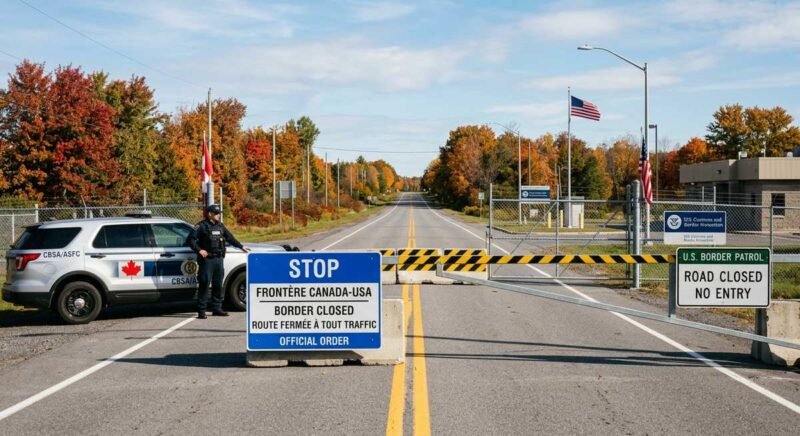
The United States is closing Border Road — a 14-kilometre ribbon of manicured gravel running between Alberta and Montana in the Sweet Grass Hills — to all Canadian traffic starting summer 2026. Alberta has maintained this road for approximately 80 years, and the decision by U.S. Homeland Security to enforce American soil along its path severs one of the last informal cross-border corridors on the northern plains.
The closure affects ranchers, rural families, and communities on both sides of the line who treated this stretch of the Alberta-Montana border as shared infrastructure. Alberta has responded by committing $8 million to build a parallel road entirely on Canadian soil, with construction slated to begin April 2026.
What Is Border Road and Why Does It Matter?
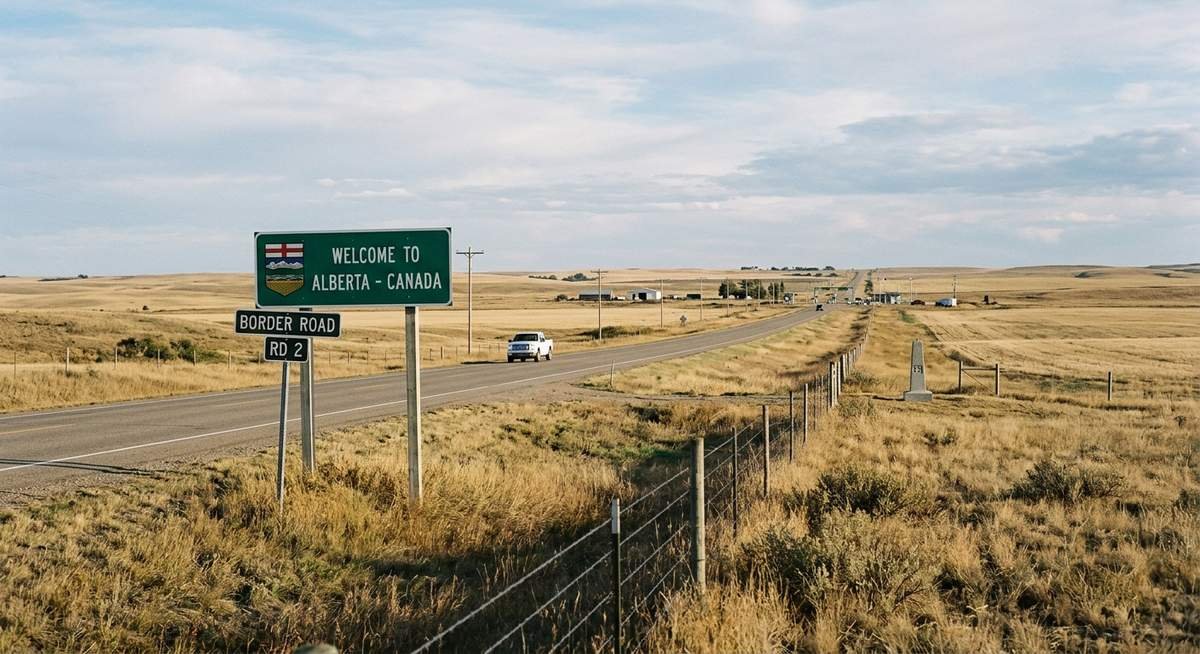
Border Road is a 14-kilometre gravel route that straddles the international boundary near Coutts, Alberta and Sweet Grass, Montana. This US-Canada border road closure eliminates a corridor Alberta’s provincial government maintained for roughly 80 years — one that served as a direct link for ranching families, agricultural operators, and rural residents whose properties and daily routines cross the 49th parallel.
Location and Route Details
The road runs parallel to the boundary in the Sweet Grass Hills area, connecting properties on the Alberta side near Coutts with neighbours on the Montana side near Sweet Grass. National Geographic profiled the farming families living along this stretch — the Fords on the Alberta side and the Horguses on the Montana side — back in 1990, documenting a cross-border relationship that felt more like neighbours sharing a fence line than citizens of different countries.
| Feature | Detail |
|---|---|
| Length | 14 kilometres of maintained gravel |
| Location | Sweet Grass Hills, near Coutts (AB) and Sweet Grass (MT) |
| Maintained by | Province of Alberta (for approximately 80 years) |
| Nearest formal crossing | Coutts-Sweet Grass Port of Entry |
| Closure effective | Summer 2026 (July) |
Generations of Shared Access
Ross Ford, a 64-year-old Alberta farmer who lives along the route, put it simply to The Canadian Press: “We’ve enjoyed free access to the road for I guess about 80 years.” His Montana neighbour Roger Horgus, 68, called the closure “ridiculous,” noting he personally sees no evidence of the illegal activity U.S. Border Patrol claims as justification.
“One more nail in the coffin of Canada’s relationship with the USA. Not that the USA hasn’t already encased that coffin in concrete and dumped it into a burning garbage heap.”
— r/GuardTheLeaf, March 2026 (6 upvotes)
That sentiment — anger laced with resignation — runs through Canadian online communities. On r/GuardTheLeaf, a politically engaged Canadian subreddit known for sharp criticism of U.S. border policy, the announcement drew immediate backlash framing the closure as performative enforcement targeting a road Canadians built and maintained.
Why Is the U.S. Closing Border Road to Canadian Traffic?
U.S. Homeland Security informed Alberta that American soil along Border Road would be “enforced,” citing drug trafficking and unauthorized immigration as justification. No specific threat or incident has been made public to support the claim, and local residents on both sides dispute whether any such activity actually occurs along the corridor.
Official U.S. Justification
U.S. Border Patrol has characterized the closure as part of broader northern border security operations. The agency holds authority under federal law to restrict access to areas adjacent to official ports of entry. According to CTV News reporting (March 2026), Alberta Transportation Minister Devin Dreeshen confirmed that Homeland Security communicated the enforcement decision directly to the province.
The stated rationale — drug trafficking and unauthorized immigration — drew sharp pushback from Montana residents who actually live along the road. Roger Horgus told The Canadian Press he has seen no evidence of illegal activity despite decades of living adjacent to the corridor. The County of Warner, the Alberta municipality responsible for the area, has not publicly corroborated any increase in cross-border criminal activity.
Broader Border Policy Context
The US-Canada border road closure fits a pattern of tightening restrictions under the current federal administration. Millions of Canadians have reduced or stopped cross-border travel entirely, according to federal figures cited by The Daily Beast (March 2026). The economic damage from reduced Canadian tourism and commerce is measurable and growing.
“I would not come here right now if I was a foreigner. Even leaving and re-entering as a citizen is dicey. The administration will detain you indefinitely for completely arbitrary reasons.”
— r/technology, March 2026 (217 upvotes)
That warning came from an American on r/technology — one of Reddit’s largest tech discussion forums — in a thread about international game developers skipping U.S. conferences over border enforcement fears. The thread collected over 6,100 upvotes, signaling how far beyond rural Alberta the chilling effect extends.
Timeline and Canada’s $8 Million Response
Alberta committed $8 million to construct a parallel road on the Canadian side of the boundary, with construction scheduled to begin April 2026 and a target completion by summer 2026. The province moved fast — the replacement route will run just metres from the original Border Road, entirely on Canadian soil.
| Event | Date / Status |
|---|---|
| U.S. Homeland Security informs Alberta of enforcement | March 2026 |
| Border Road closure takes effect | Summer 2026 (July) |
| Canadian parallel road construction begins | April 2026 |
| Parallel road target completion | Summer 2026 |
| Budget for Canadian replacement road | $8 million (Alberta provincial funding) |
| Parallel road distance from original | Metres away, entirely on Canadian side |
Alberta Transportation Minister Devin Dreeshen confirmed the $8 million commitment in public statements reported by The Canadian Press (March 2026). The speed of the provincial response reflects both the political sensitivity of the issue and the practical urgency — ranchers need an alternative before the closure date.
How the Closure Affects Local Communities
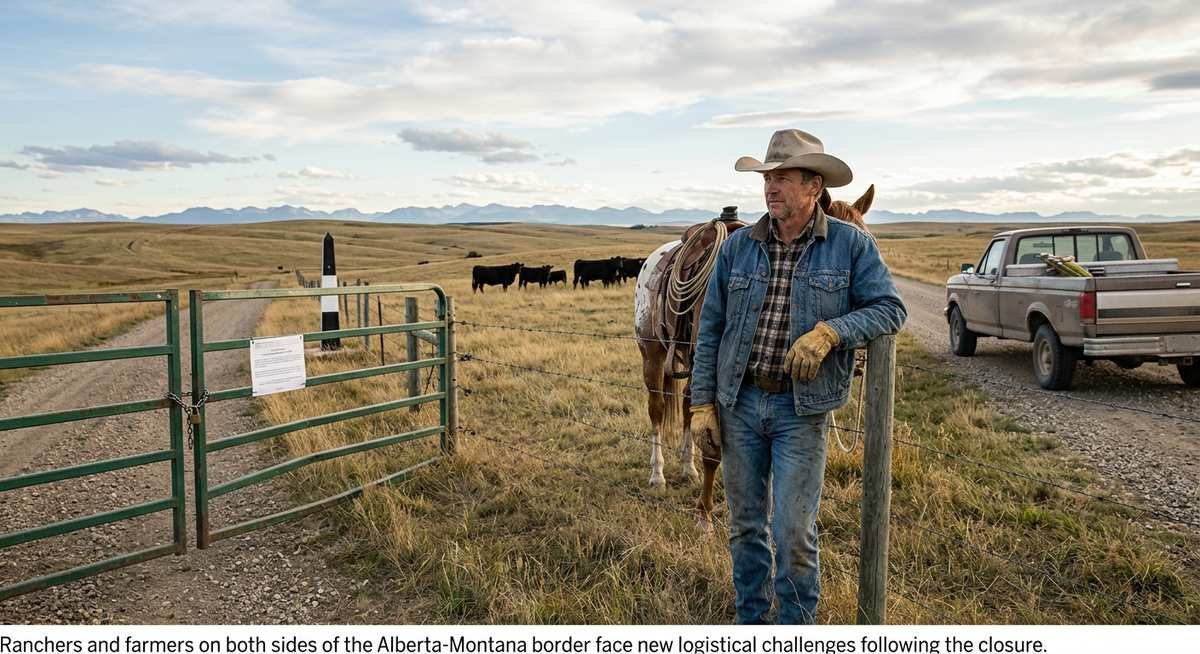
The Border Road closure severs daily routines for ranching families who have managed cross-border operations along this corridor for generations. Livestock movements, equipment transport, supply runs, and simple neighbour visits that once took minutes now require detours through formal ports of entry — adding time, fuel costs, and bureaucratic friction to every trip.
Ranchers and Agricultural Operators
Cross-border ranching in the Sweet Grass Hills depends on direct, low-friction access. Ross Ford and Roger Horgus — the Alberta and Montana farmers profiled by National Geographic in 1990 — represent families whose operations were built around Border Road as working infrastructure, not a recreational shortcut. For cattle operations grazing on both sides of the line, the closure means routing every trip through the Coutts-Sweet Grass Port of Entry, which adds significant distance and wait times during peak crossing hours.
Agricultural suppliers moving equipment seasonally between Alberta and Montana face similar disruptions. In an industry where timing dictates profit — calving, seeding, and harvest wait for no one — every added hour on the road compounds into real cost.
Indigenous Communities and Treaty Rights
A separate but related flashpoint involves First Nations peoples and the Jay Treaty, which historically recognized Indigenous rights to cross the Canada-U.S. border freely. Canada recently advised First Nations travellers to carry passports when entering the United States — a protective measure prompted by unpredictable U.S. enforcement behaviour, not a reversal of treaty recognition.
“The government is providing a warning to them that they should bring a passport because the USA may not let them enter without it. Nothing to do with Canada not upholding anything.”
— r/TourismHell, March 2026 (171 upvotes)
That distinction matters. On r/TourismHell — a community of frustrated travel and policy observers — the top-voted comment defended Canada’s advisory as pragmatic rather than adversarial. Indigenous communities with traditional territorial connections spanning the border face compounding challenges: the Border Road closure restricts one access route, and tighter documentation requirements at formal crossings restrict another.
Alternative Border Crossings for Affected Travelers
The Coutts-Sweet Grass Port of Entry remains fully operational and is the nearest formal crossing for travelers affected by the Border Road closure. Several other Alberta-Montana land crossings exist within driving range, though hours of operation vary and smaller ports may operate on restricted schedules.
| Crossing | Canadian Side | U.S. Side | Distance from Coutts | Notes |
|---|---|---|---|---|
| Coutts-Sweet Grass | Coutts, AB | Sweet Grass, MT | Primary crossing | 24/7 operations |
| Carway-Piegan | Carway, AB | Piegan, MT | ~90 km west | Seasonal/limited hours |
| Del Bonita-Whitlash | Del Bonita, AB | Whitlash, MT | ~60 km east | Limited hours |
| Wild Horse-Turner | Wild Horse, AB | Turner, MT | ~200 km east | Remote; limited hours |
Check current wait times before every trip. Canada Border Services Agency publishes hourly updates for the 29 busiest land crossings at cbsa-asfc.gc.ca. On the U.S. side, CBP’s Border Wait Times tool covers American port conditions. Smaller crossings like Carway-Piegan and Del Bonita-Whitlash do not operate 24 hours — confirm hours directly with CBP before relying on them as alternatives.
Frequently Asked Questions
Why is the U.S. closing Border Road to Canadian traffic?
U.S. Homeland Security cited drug trafficking and unauthorized immigration as justification for enforcing American soil along the 14-kilometre gravel corridor. Local Montana residents, including farmer Roger Horgus who lives adjacent to the road, dispute the claim, stating they have seen no evidence of such activity. No specific incident or threat assessment has been made public.
When does the Border Road closure take effect?
The closure takes effect in summer 2026, with July identified as the target date. Alberta has already begun preparations for a parallel replacement road on Canadian soil, with construction starting April 2026 and a target completion by summer 2026.
Is the US-Canada border road closure permanent?
No permanent designation has been announced for the US-Canada border road closure, and no reinstatement conditions or end date have been published either. The practical reality: Alberta is building a replacement road rather than waiting for a reversal, which suggests the province views the closure as effectively long-term.
What alternative crossings are available near Coutts, Alberta?
The Coutts-Sweet Grass Port of Entry remains operational and is the nearest formal crossing. Carway-Piegan sits approximately 90 km west, and Del Bonita-Whitlash is about 60 km east, though both operate on limited hours. Check CBSA’s border wait times page for real-time updates before travelling.
Does the closure affect the main Coutts-Sweet Grass port of entry?
No. The Coutts-Sweet Grass Port of Entry operates independently and remains fully open for standard cross-border travel. Border Road is a separate secondary corridor. The closure applies specifically to Canadian traffic on the road itself, not to the formal port.
How is Canada responding to the closure?
Alberta committed $8 million to build a parallel road entirely on Canadian soil, running just metres from the original Border Road. Construction begins April 2026, with completion targeted for summer 2026. Alberta Transportation Minister Devin Dreeshen confirmed the funding publicly.
Does the closure affect Indigenous border crossing rights?
The Border Road closure compounds existing concerns for First Nations communities whose traditional territories span the border. Canada has separately advised Indigenous travellers to carry passports when entering the United States, a precaution driven by unpredictable U.S. enforcement rather than any change to Canadian recognition of Jay Treaty rights.
What to Do Now
The US-Canada border road closure near Coutts and Sweet Grass ends roughly 80 years of shared access between Alberta and Montana ranching communities. Alberta’s $8 million replacement road signals that the province expects the closure to stick. For travelers and operators affected by the decision, the practical path forward is clear.
Use the Coutts-Sweet Grass Port of Entry for all cross-border trips. Check CBSA and CBP wait times before every departure. Confirm hours at smaller ports like Carway-Piegan and Del Bonita-Whitlash — they change. And watch for updates on Alberta’s parallel road construction, which could restore local access by late summer 2026.