


FeedBuzzard opens CPC auctions at $0.001 per click and requires just a $50 minimum deposit to launch your first campaign. That entry point undercuts Taboola and MGID by a significant margin, both of which routinely demand hundreds of dollars upfront and impose higher minimum CPCs before you see a single conversion. For affiliate marketers and small businesses testing new traffic sources, the difference is real money. This piece covers the ad formats available on the platform, how much it actually costs to advertise on FeedBuzzard across different geographies, the seven-step campaign setup process, and an honest comparison against the main alternatives.
What FeedBuzzard Actually Is (and Is Not)
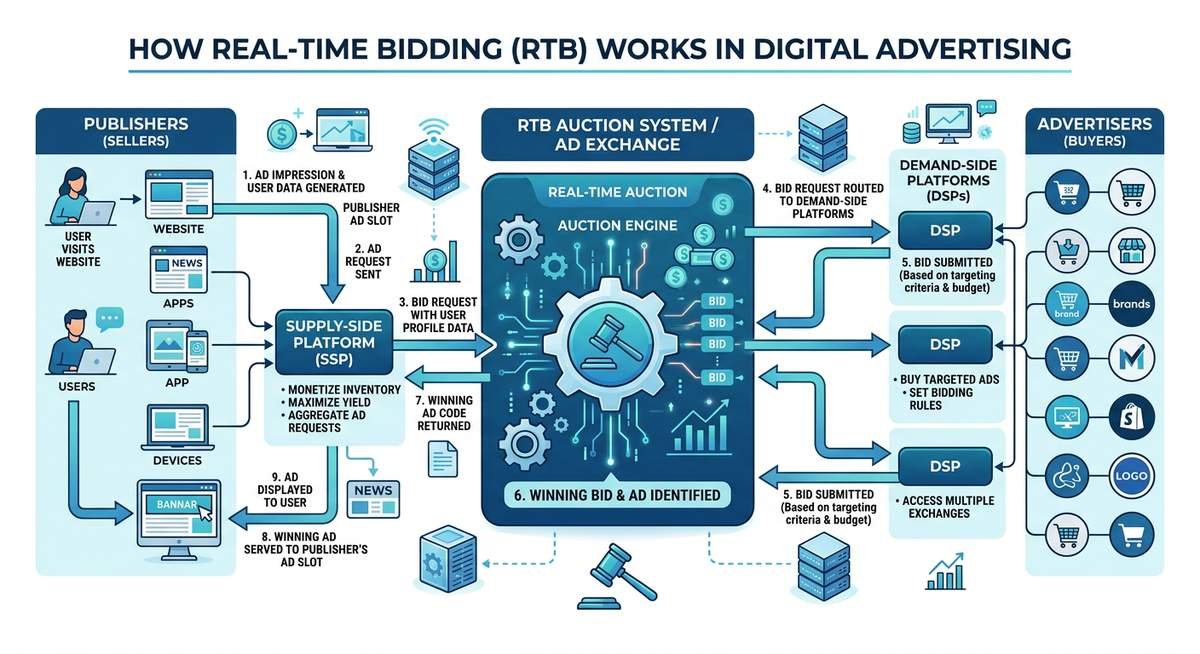
FeedBuzzard is an advertising network that connects advertisers with publisher inventory through real-time bidding. It is not a demand-side platform (DSP) and not a supply-side platform (SSP). It operates as an intermediary network, aggregating publisher inventory and selling it to advertisers through an auction mechanism.
The platform serves affiliate marketers running lead generation offers, small e-commerce businesses looking for direct-response traffic, and digital agencies managing campaigns for clients with modest budgets. It is not built for Fortune 500 brand campaigns or large-scale programmatic buying.
How the Real-Time Bidding System Works
When a user visits a publisher site that carries FeedBuzzard inventory, an auction fires in milliseconds, following the IAB real-time bidding protocol. Every eligible advertiser campaign competes simultaneously based on bid price, targeting match, and ad quality scores. The highest qualified bid wins the impression and pays slightly above the second-highest bid.
This means your $0.001 minimum bid will rarely win premium US desktop inventory, but it can capture high volumes of mobile traffic in lower-cost geographies at efficient rates. Setting your bid is less about hitting a floor and more about understanding what a particular audience segment is worth to your specific offer. Bidding too low wastes no money but delivers no impressions. Bidding accurately against the auction pressure in your target segment is the real skill.
Who Should (and Should Not) Use FeedBuzzard
Affiliate marketers promoting CPA offers, lead gen pages, and sweepstakes campaigns are the natural fit. E-commerce brands with strong direct-response creative and retargeting lists also get good results, since retargeting campaigns on FeedBuzzard outperform cold traffic by 3 to 4 times on conversion rate.
Brand advertisers requiring premium publisher placements and brand-safe editorial environments should look elsewhere. FeedBuzzard’s publisher network skews toward content arbitrage sites and app inventory, not the kind of environment where a luxury brand wants its display ads to appear. The platform is also a poor fit for SaaS companies with long sales cycles that depend on view-through attribution models.
Ad Formats and Performance Benchmarks
FeedBuzzard offers seven ad formats with click-through rates ranging from 1.4% for banner placements up to 4.1% for interactive elements. Format selection matters more than most advertisers realize because each format reaches users at different attention states and commands different inventory prices.
| Format | CTR | Best Use Case | Cost Tier |
|---|---|---|---|
| Interactive elements (polls) | 4.1% | Lead qualification, engagement | Medium-High |
| Native ads | 3.2% | Content marketing, affiliate offers | Medium |
| Sponsored articles | 2.8% | Long-form offers, e-commerce | Medium |
| Push notifications | Variable | Re-engagement, time-sensitive offers | Low-Medium |
| Video ads | Variable | Product demos, brand recall | High |
| Pop-under ads | Variable | High-volume direct response | Low |
| Banner placements | 1.4% | Retargeting, awareness | Low |
Push Notification Ads
Push notifications appear directly on a user’s device screen, bypassing the browser entirely. They feel personal, which drives strong open rates when the copy is relevant. The format works best for time-sensitive offers: flash sales, limited-availability products, or re-engagement sequences for users who visited a landing page but did not convert.
Keep notification copy under 60 characters for the headline and 90 characters for the body text. Anything longer gets truncated on mobile, and most FeedBuzzard push inventory skews mobile. Authentic thumbnail images outperform staged stock photos in this format consistently.
Native and Sponsored Content
Native ads at 3.2% CTR and sponsored articles at 2.8% CTR are the two content-integrated formats. Native ads blend into publisher feeds as recommendation widgets. Sponsored articles sit as paid content within editorial environments.
Both formats require more content investment upfront but generate lower post-click bounce rates than pop-unders or banners. Advertisers running FeedBuzzard campaigns for affiliate review pages or product comparison content tend to see the strongest ROI from these two formats. The longer a user spends reading, the warmer they are when they hit the offer.
Pop-unders load behind the active browser window and surface when the user closes their current tab. They generate high raw impression volume at low CPM rates. The trade-off is user intent: pop-under audiences are not actively seeking information when they encounter the ad.
Banner placements have the lowest benchmark CTR at 1.4%, but they are the lowest-cost format on the platform and suit retargeting applications well. Interactive elements like polls achieve the highest CTR at 4.1% because they require active participation. A poll asking “Which supplement works best for energy?” before revealing a product recommendation is a proven format for supplement and health offers. Video ads should run under 15 seconds to maintain completion rates on mobile inventory.
What FeedBuzzard Advertising Actually Costs
The $50 minimum deposit gets you into the platform, CPC bids start at $0.001, and actual campaign costs vary dramatically based on geography and device type. A click from a US MacBook user can cost five to ten times more than an equivalent click from a Vietnam Android user because advertiser competition for those audiences differs that much.
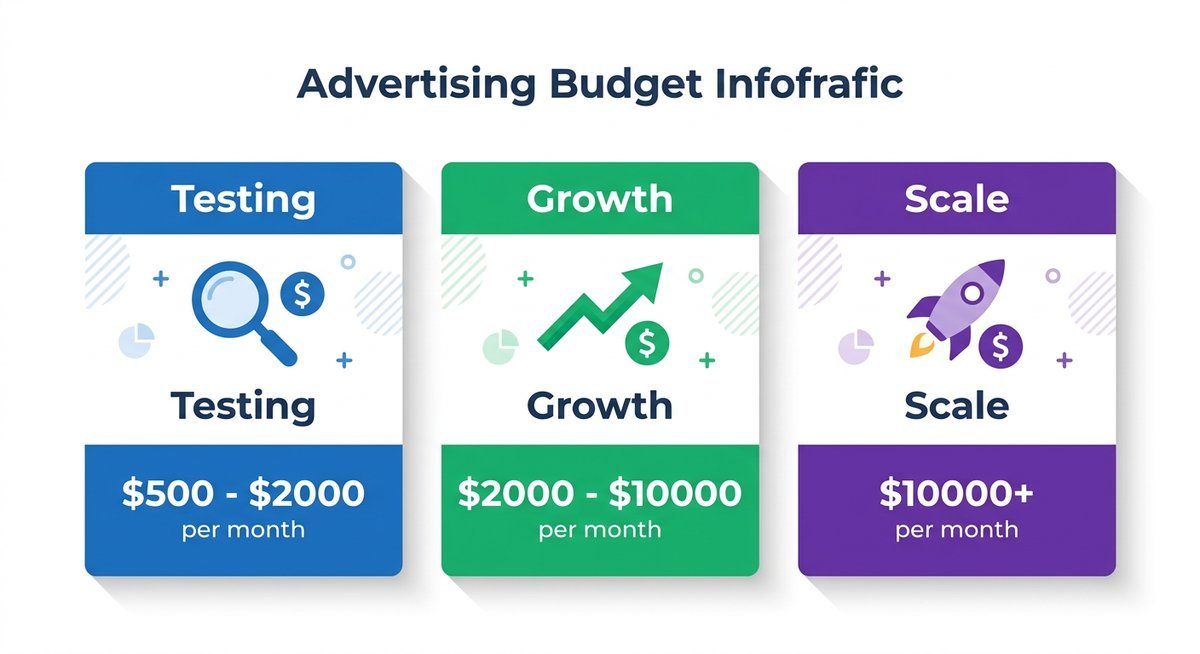
| Budget Tier | Monthly Spend | Expected Clicks (est.) | Strategy Focus |
|---|---|---|---|
| Testing | $50–$150 | 500–5,000+ | Single format, one geo, baseline CPC data |
| Growth | $150–$500 | 5,000–50,000+ | A/B creative testing, expand winning geo segments |
| Scale | $500+ | 50,000+ | Whitelist optimization, retargeting layering, budget scaling ~20% every few days |
CPC vs CPM Bidding
FeedBuzzard supports both CPC and CPM bidding models. CPC (cost-per-click) is lower risk for direct-response advertisers because you pay only when someone actually clicks your ad. CPM (cost-per-thousand impressions) makes more sense when you have a proven creative with a high CTR, since you can drive more total clicks at a lower effective CPC than the CPC auction would yield.
Start with CPC during the testing phase to control spend while you gather data. Once you identify creative and audience combinations that generate consistent CTRs above the format benchmarks, consider switching those specific segments to CPM bidding to reduce per-click cost at scale.
Why Geography and Device Change Everything
Geography is the single largest variable in FeedBuzzard campaign economics. US, UK, Canada, and Australia command the highest CPCs because advertiser demand for those audiences is intense. Southeast Asian and Latin American geographies offer dramatically lower entry costs for the same ad formats.
Device type compounds this effect. Desktop users in Tier 1 countries are the most expensive segment on the platform. Mobile Android users in Tier 3 geographies sit at the opposite extreme. If your offer converts equally well on mobile across geographies, starting in lower-cost regions to generate data before expanding into Tier 1 markets is a sound budget discipline. Run $5 to $10 per day during the testing phase regardless of geography to control burn while you identify what works.
Setting Up Your First Campaign
Seven steps take you from account creation to first meaningful data, with real optimization signals appearing after 50 to 100 clicks on each ad variant. Rushing past that data threshold is how advertisers lose money on FeedBuzzard before they understand what the platform can actually do for their offer.
- Sign up and verify your account. The registration process requires basic business information and email verification. Account approval is typically fast.
- Deposit $50 minimum. Fund your account before creating campaigns. Unspent deposits are refundable through support, subject to terms, so the $50 is not locked away permanently if the platform does not work for your offer.
- Define your conversion goal. Before selecting a format, know what a conversion means: a form submission, a sale, a click to an affiliate link. This drives every subsequent targeting and bidding decision.
- Select your ad format. Match the format to your offer type. Affiliate CPA offers with broad audiences perform well with native ads and push notifications. High-engagement offers benefit from interactive formats. Do not start with pop-unders unless you have experience managing traffic quality filtering.
- Configure targeting. FeedBuzzard targeting options include country, device type, OS, browser type, browser language, interests, demographics, and behavioral signals. Start with 1 to 2 targeting dimensions during testing. Adding too many constraints limits scale before you know which variables matter.
- Set bidding and daily budget. Open with a CPC bid that reflects realistic competition in your target geography. Set a daily budget of $5 to $10 during the testing phase to prevent overspend while you gather click and impression data.
- Monitor and optimize after 50 to 100 clicks. Do not make bidding or targeting changes before this threshold. With fewer data points, any pattern you see is noise. After 100 clicks, evaluate CPCs by device and placement, pause underperformers, and scale budgets on segments showing below-average CPC with above-average engagement.
Tracking Setup With Third-Party Tools
The platform’s native analytics show clicks and impressions but do not provide conversion attribution on their own. Connecting a third-party tracker is not optional for serious campaigns. Voluum, RedTrack, and Binom are the three most widely used options with verified FeedBuzzard integration.
Each tracker works by placing a redirect or postback URL in the campaign flow that captures click data and fires a conversion signal back when a goal completes. Google Analytics can track landing page behavior and goal completions as well, though it lacks the real-time bidding optimization features of dedicated ad trackers. For anyone running multiple simultaneous campaigns, Voluum or RedTrack provides the clearest view of which creative, format, and segment combinations are generating profit.
The 72-Hour Post-Launch Checklist
The first 72 hours after a campaign goes live are the highest-leverage period for avoiding wasted spend. Check impression delivery within the first 6 hours. If delivery is low, your bid is likely below competitive auction pressure for the segment.
At 24 hours, review CTR by ad variant. Anything below half the format benchmark should be paused and replaced. At 48 hours, examine the click-to-conversion gap in your tracker. If clicks are arriving but conversions are not, the issue is usually landing page relevance, not traffic quality. By 72 hours and 100+ clicks, you have enough data to identify your one or two best-performing variants and begin scaling their budgets by approximately 20% every few days.
FeedBuzzard vs Taboola, MGID, and PropellerAds
FeedBuzzard wins on entry cost and interface simplicity. Taboola and MGID have larger, more curated publisher networks with stronger brand-safe editorial inventory. PropellerAds offers comparable volume at similar price points with a different format mix. The right choice depends almost entirely on your budget, offer type, and tolerance for optimization work.
| Platform | Min Deposit | CPC Range | Key Formats | Best For | Learning Curve |
|---|---|---|---|---|---|
| FeedBuzzard | $50 | $0.001+ | Push, Native, Pop, Video, Banner, Interactive | Affiliates, small e-commerce | Low-Medium |
| PropellerAds | $100 | $0.005+ | Push, Pop, Native, Interstitial | Volume-focused affiliate campaigns | Medium |
| Zeropark | $200 | $0.001+ | Pop, Domain redirect, Push | Experienced media buyers | High |
| MGID | $100+ | $0.05+ | Native, Widget | Content publishers, mid-market brands | Medium |
| Taboola | $500+ | $0.20+ | Native, Video | Brand campaigns, large budgets | Steep |
Taboola and MGID both require substantially higher CPCs and deposits because they sit on higher-quality publisher inventory, including major news sites and media properties. That publisher quality commands a price premium that makes sense for brand advertisers but rarely pencils out for direct-response campaigns running at sub-$0.10 CPC targets.
PropellerAds is the most direct competitor in terms of offer type and audience profile. The main difference is that PropellerAds has a more developed self-serve platform with deeper optimization tools, while FeedBuzzard offers a simpler interface that reduces the time-to-launch for new advertisers. Neither is universally superior; the right choice depends on which offer you are running and what CPC your margins support.
Honest Drawbacks and Who Should Skip FeedBuzzard
Traffic quality on FeedBuzzard is uneven and requires active filtering. The platform has anti-fraud systems, but bot traffic and low-quality click sources appear in campaign data regularly enough that daily review of placement-level performance is not optional. Advertisers who set campaigns live and check back weekly will lose money.
- Uneven traffic quality: Publisher inventory varies widely. Without placement-level blacklisting based on tracker data, CPA efficiency degrades over time as low-quality placements absorb budget.
- Slow customer support: Response times from the FeedBuzzard support team are slower than competitors like PropellerAds. Campaign issues that require account-level intervention can sit unresolved for 24 to 48 hours.
- No native conversion tracking: Basic click data is available in the platform dashboard, but conversion attribution requires integrating Voluum, RedTrack, Binom, or Google Analytics. This adds setup time and ongoing cost.
- Not suitable for brand-sensitive products: The publisher network is not curated for brand-safe placements. Advertisers in regulated categories (financial services, pharmaceuticals, alcohol) need to verify compliance independently.
- Daily optimization requirement: FeedBuzzard campaigns do not self-optimize effectively without human review. The 20% budget scaling rule and regular creative testing are not nice-to-have practices; they are required for sustained positive ROI.
Skip FeedBuzzard if your product requires brand-safe editorial placement, if you cannot commit to daily campaign monitoring, or if your offer economics only work at very high-quality traffic sources where verified human engagement is non-negotiable. The platform’s low entry cost is genuinely valuable, but it comes with the responsibility of active management that not every advertiser is set up to provide.
FAQ
What is the minimum deposit for FeedBuzzard?
The minimum deposit to advertise on FeedBuzzard is $50. This amount funds your campaign balance directly, and unspent deposits are refundable through the support team subject to the platform’s terms. There is no additional account fee or monthly subscription required to maintain access to the self-serve platform.
Does FeedBuzzard work for e-commerce?
The platform works for e-commerce advertisers running direct-response campaigns, particularly retargeting sequences where campaign performance is 3 to 4 times higher than cold traffic. Product categories that perform well include impulse-purchase items, digital downloads, and health and wellness products. E-commerce brands requiring brand-safe premium placements will find the inventory mix limiting.
Is FeedBuzzard traffic real human traffic?
The platform operates anti-fraud systems designed to filter bot traffic and deliver real human impressions and clicks. That said, no ad network eliminates invalid traffic entirely. Connecting a third-party tracker like Voluum or RedTrack and monitoring placement-level performance daily is the practical approach to maintaining traffic quality in any campaign you run.
How does FeedBuzzard compare to Taboola?
FeedBuzzard requires a $50 minimum deposit while Taboola typically starts at $500 or more with minimum CPCs well above $0.20. Taboola offers access to premium editorial publisher inventory at a price point the network does not match. For direct-response advertisers and affiliates operating with limited budgets, this platform is the more accessible entry point. For brand campaigns requiring premium context, Taboola justifies its higher cost.
Can I get a refund on unspent deposits?
Unspent deposits are refundable through the support team, subject to the platform’s terms and conditions. The refund process requires contacting support directly rather than initiating it from the dashboard. Processing times vary based on support queue and payment method. Review the current terms before depositing if refund eligibility is a significant factor in your decision to test the platform.
What tracking tools work with FeedBuzzard?
The platform integrates with Voluum, RedTrack, and Binom through standard postback URL configurations. Google Analytics can also track landing page behavior and conversion goals from campaign traffic using UTM parameters. For advertisers running multiple campaigns simultaneously, Voluum and RedTrack provide the most actionable real-time data for optimizing CPC efficiency across formats and geographies.
Conclusion
FeedBuzzard is a low-barrier entry point for advertisers who want real-time bidding traffic without the budget commitments that Taboola or MGID require. The $50 deposit and $0.001 minimum CPC are genuinely accessible, and the seven ad formats cover most direct-response use cases. The platform rewards daily attention and punishes passive management. Affiliate marketers and small e-commerce businesses testing new traffic sources will find it worth the $50 to run a structured 72-hour test. Connect a third-party tracker, start at $5 to $10 per day, and let the first 100 clicks tell you whether the audience quality and cost structure fit your offer economics before scaling.