



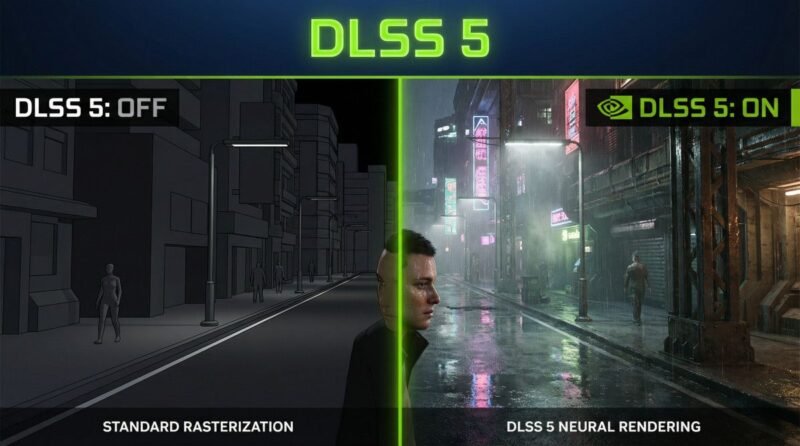
NVIDIA’s announcement of DLSS 5 at GTC 2026 marks a pivotal moment for PC gaming. This isn’t just another incremental update to their popular upscaling technology; it represents a fundamental shift in how game worlds are rendered. Many are calling it the most significant leap in computer graphics since the debut of real-time ray tracing in 2018. But what does that mean for you, the player?
This definitive guide will break down everything you need to know about DLSS 5. We’ll cover the official release date, its controversial hardware requirements, how the new neural rendering technology works, and how it stacks up against previous versions and the competition.
What is DLSS 5, Really? A Shift to Neural Rendering
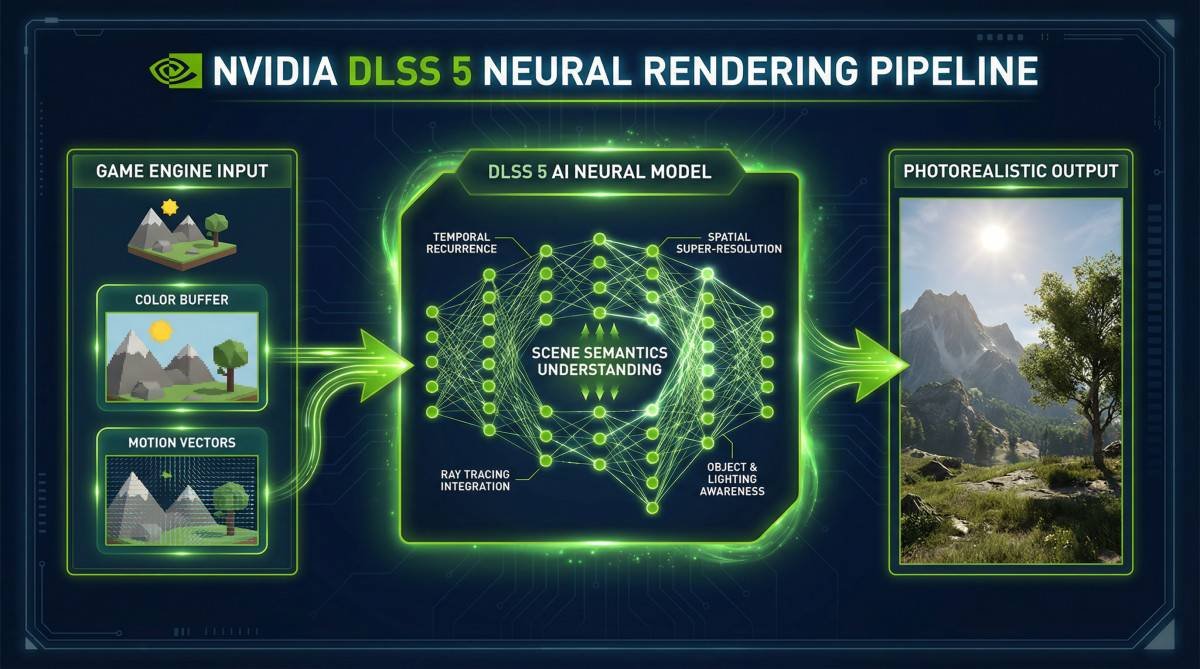
To understand DLSS 5, it’s crucial to move past the idea of simple upscaling. Previous DLSS versions were primarily focused on reconstructing a higher-resolution image from a lower-resolution one to boost performance. DLSS 5 is fundamentally different. It’s a neural rendering engine that uses a powerful AI model to generate photorealistic lighting, shadows, and materials in real-time.
Think of it as having a Hollywood visual effects pipeline running inside your game. The technology takes the game engine’s basic color and motion vector data as input. It then feeds this information into a pre-trained AI model that understands the semantics of a scene—it knows how light should interact with skin, fabric, hair, and metal. The AI then effectively “repaints” the frame with a level of realism previously only seen in pre-rendered cinematic sequences.
This process allows for incredibly complex visual effects that are computationally expensive for traditional rendering, such as accurate subsurface scattering on skin that gives characters a lifelike glow, the delicate sheen on different types of fabric, and the intricate play of light and shadow in a character’s hair.
DLSS 5 Release Date: When Exactly is “Fall 2026”?
NVIDIA has officially stated that DLSS 5 will arrive in “Fall 2026”. While this provides a general window, it’s helpful to add some context. For the Northern Hemisphere, this typically refers to the months of September, October, and November.
The release is widely expected to coincide with the launch of NVIDIA’s next generation of consumer graphics cards, the GeForce RTX 50 series. The final release date within this fall window will likely depend on factors such as the manufacturing timeline for the new GPUs and the readiness of the initial driver and software ecosystem.
Hardware Requirements: Is DLSS 5 an RTX 50 Series Exclusive?
This is the most pressing question for many gamers, and the answer is direct. The core neural rendering features of DLSS 5 are exclusive to the upcoming GeForce RTX 50 series GPUs, such as the anticipated RTX 5090 and RTX 5080.
The reason for this exclusivity lies in the immense computational demands of the new AI model. During its GTC 2026 presentation, NVIDIA revealed that the early demonstration of DLSS 5 was running on a system with two RTX 5090 GPUs—one rendering the game and the other dedicated entirely to the DLSS 5 workload. While the company has assured that the final version will run on a single consumer card, this highlights the need for the advanced Tensor Core architecture and raw power of the new Blackwell GPUs.
Owners of older RTX cards (the 20, 30, and 40 series) will not be left entirely behind. These GPUs will not get the new neural rendering capabilities, but they will continue to be supported with existing DLSS features. This includes DLSS Super Resolution, Ray Reconstruction (part of DLSS 3.5), and, for the RTX 40 series, Frame Generation.
The Evolution of DLSS: A Version-by-Version Comparison
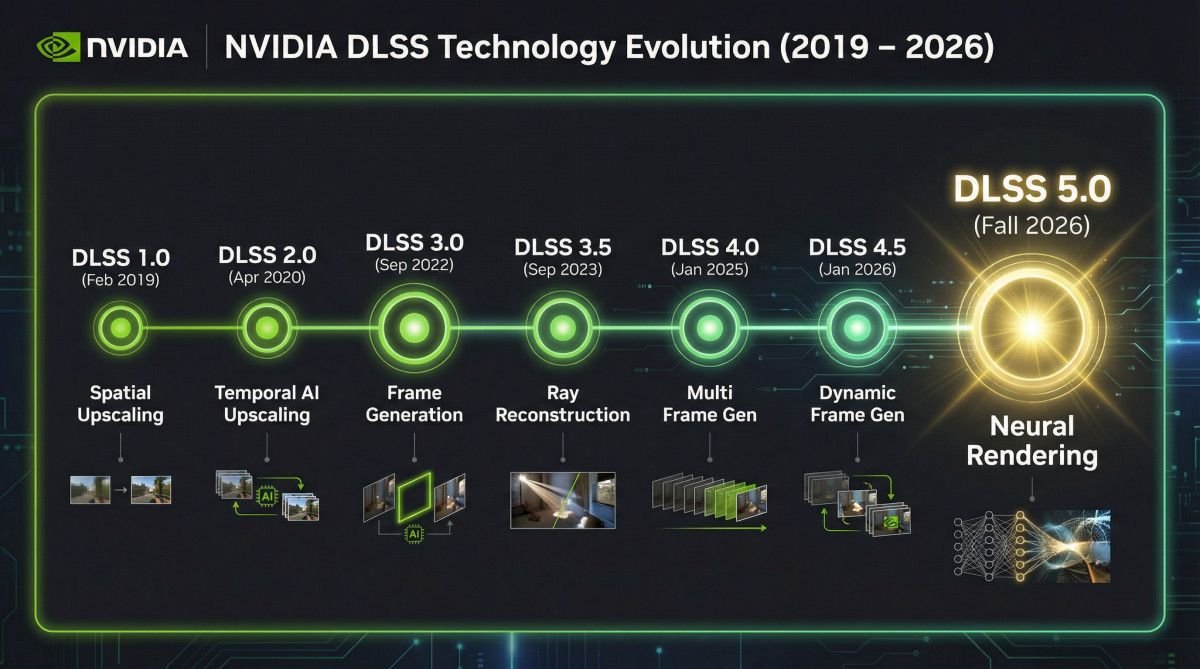
To appreciate the leap that DLSS 5 represents, it’s useful to see its place in the technology’s history. The following table summarizes the journey from a niche feature to a cornerstone of modern gaming, and the infographic below visualizes the full timeline.
| Version | Release Date | Key Technology | Hardware Requirement |
|---|---|---|---|
| DLSS 1.0 | Feb 2019 | Spatial Upscaling (Per-Game Trained) | RTX 20 Series |
| DLSS 2.0 | Apr 2020 | Temporal Upscaling (Generalized AI) | All RTX Series |
| DLSS 3.0 | Sep 2022 | Optical Flow Frame Generation | RTX 40 Series |
| DLSS 3.5 | Sep 2023 | Ray Reconstruction (Denoising) | All RTX Series |
| DLSS 4.0 | Jan 2025 | Transformer-based Multi Frame Generation | RTX 50 Series |
| DLSS 4.5 | Jan 2026 | Dynamic Frame Generation | RTX 50 Series |
| DLSS 5.0 | Fall 2026 | Neural Rendering | RTX 50 Series |
The “AI Filter” Controversy: Artistic Intent vs. AI Enhancement
The announcement of DLSS 5 was met with both excitement and skepticism. On social media and forums, some gamers voiced concerns that the technology could act as an “AI filter” or apply a layer of “AI slop,” potentially overwriting a game’s unique, handcrafted art style with a generic, AI-generated aesthetic.
These concerns are not without merit, as the potential for misuse of any powerful generative technology exists. However, NVIDIA has been proactive in addressing this issue. CEO Jensen Huang emphasized that DLSS 5 is designed to preserve “the control artists need for creative expression.” To this end, the technology provides developers with a suite of granular controls.
Game studios can use intensity sliders, detailed color grading tools, and spatial masking to determine exactly how and where the neural rendering enhancements are applied. For example, they could apply the effect at full strength to water and foliage while dialing it back on character models to preserve a specific stylized look. The positive reception from major developers like Bethesda, Capcom, and Ubisoft suggests that they view DLSS 5 as a tool to better realize their artistic vision, not replace it.
Which Games Will Support DLSS 5?
NVIDIA has already secured an impressive lineup of titles that will support DLSS 5 at or near its launch. The list includes a mix of highly anticipated new releases and updates to existing blockbusters:
- AION 2
- Assassin’s Creed Shadows
- Black State
- CINDER CITY
- Delta Force
- Hogwarts Legacy
- Justice
- NARAKA: BLADEPOINT
- NTE: Neverness to Everness
- Phantom Blade Zero
- Resident Evil Requiem
- Sea of Remnants
- Starfield
- The Elder Scrolls IV: Oblivion Remastered
- Where Winds Meet
DLSS 5 vs. The Competition: How Does It Stack Up to FSR and XeSS?
In the broader landscape of upscaling technologies, NVIDIA’s main competitors are AMD’s FidelityFX Super Resolution (FSR) and Intel’s Xe Super Sampling (XeSS). The key difference with DLSS 5 is its fundamental approach. While FSR and XeSS are primarily advanced spatial upscalers that reconstruct an image, DLSS 5’s neural rendering adds new, AI-generated data to the scene to enhance it.
The primary advantage for AMD and Intel is that their technologies are open-source and compatible with a wide range of GPUs from all manufacturers. DLSS 5, by contrast, is a proprietary technology locked to NVIDIA’s latest and most powerful hardware. While FSR and XeSS provide a valuable performance boost for everyone, DLSS 5 aims to deliver a generational leap in visual fidelity for those with cutting-edge systems. The industry now waits to see how AMD and Intel will respond to this new frontier of real-time neural rendering.
Frequently Asked Questions (FAQ) About NVIDIA DLSS 5
What is the exact release date for DLSS 5?
NVIDIA has announced a release window of “Fall 2026,” which typically means a launch between September and November, likely alongside the new RTX 50 series GPUs.
Will my RTX 3080 or RTX 4090 support DLSS 5?
No, the new neural rendering feature of DLSS 5 requires the architecture of the RTX 50 series GPUs. Older RTX cards will continue to be supported with features like Super Resolution and Ray Reconstruction.
Is DLSS 5 free for gamers?
Yes. DLSS is a feature of NVIDIA’s GeForce GPUs and is available to gamers at no extra cost. The cost is the hardware investment in a compatible graphics card.
Does DLSS 5 replace DLSS 3.5 and 4.5?
It’s more of an evolution. The core upscaling and frame generation technologies will likely continue to exist, while DLSS 5 adds the new, exclusive layer of neural rendering on top for RTX 50 series owners.
How much performance does DLSS 5 cost?
NVIDIA has not released specific performance metrics. Given the technology’s complexity and the two-GPU demo, it is expected to have a significant performance cost, which is why it is tied to the more powerful next-generation hardware.
Can I turn DLSS 5 off if I don’t like the look?
Yes. Like all previous versions of DLSS, DLSS 5 will be a selectable option in a game’s graphics menu, allowing players to toggle it on or off according to their preference.
In conclusion, DLSS 5 represents a bold and exciting step forward for real-time graphics. While its exclusivity to the RTX 50 series will be a point of contention, the promise of photorealistic visuals generated by AI is poised to redefine what we expect from the look and feel of our games. The future of gaming is not just about more frames, but more realistic frames, and DLSS 5 is leading that charge.
Sources: NVIDIA Newsroom (GTC 2026), Digital Foundry (Richard Leadbetter), Ryan Shrout (hands-on impression), PC Gamer, Wikipedia — Deep Learning Super Sampling.