



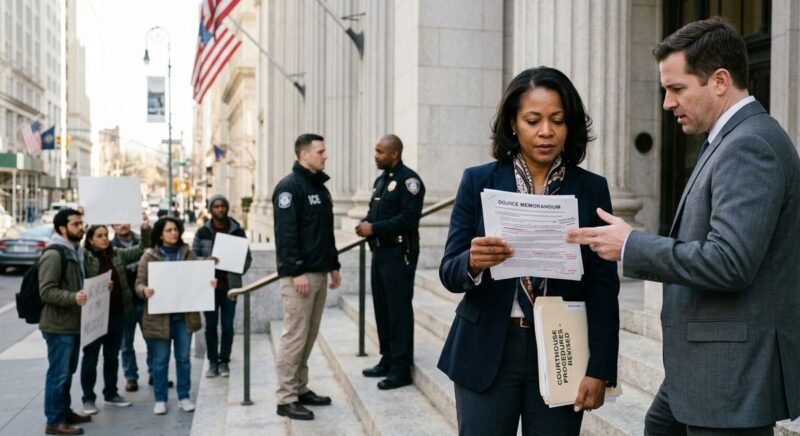
Federal prosecutors admitted in a March 2026 court filing that the Department of Justice had “erroneously relied on” an internal ICE guidance memo to defend courthouse immigration arrests before U.S. District Judge Kevin Castel in the Southern District of New York. The DOJ ICE memo error was not a typo or a clerical slip. It was a substantive misrepresentation of policy authority in active federal litigation, and its consequences now ripple across immigration enforcement, due process protections, and the credibility of every courthouse arrest conducted under that claimed authority.
The May 2025 ICE guidance at the center of the controversy explicitly excluded immigration courts from its scope. DOJ attorneys cited it anyway. When prosecutors finally acknowledged the mistake, they conceded in writing that the court’s prior ruling and both parties’ briefs would “need to be reconsidered and re-briefed.” That language, rare in federal litigation, signals a fundamental collapse of the government’s legal position on a hotly contested enforcement practice.
What the DOJ Admitted About the ICE Memo
The DOJ acknowledged making a “material mistaken statement of fact” based on “agency attorney error” when citing an internal ICE memo to justify courthouse immigration arrests. The memo — a May 27, 2025, operational directive — was never intended to authorize civil immigration enforcement at or near immigration courts. Prosecutors learned of the error when an internal email reminder clarified the memo’s actual scope.
The admission landed in the middle of a lawsuit brought by immigrant rights groups, represented by the New York Civil Liberties Union (NYCLU), challenging ICE’s practice of stationing agents at the Jacob K. Javits Federal Building immigration court in New York City. Attorney Amy Belsher, representing the plaintiffs, had argued that the government’s legal justification was built on a misreading of its own internal documents. The DOJ’s corrective filing proved her right.
Judge Castel had previously denied the plaintiffs’ motion to block courthouse arrests, relying in part on the government’s now-retracted characterization of the ICE memo. With the foundation of that ruling undermined, the case faces a full re-briefing. According to NBC News reporting on the March 2026 admission, the DOJ’s corrective filing stated the memo “does not and has never applied to civil immigration enforcement actions in or near” immigration courts.
| Element | What It Means |
|---|---|
| DOJ’s own language | “Material mistaken statement of fact” and “agency attorney error” |
| Error type | Substantive misrepresentation of policy scope, not a clerical mistake |
| Immediate consequence | Prior court ruling and all briefs must be reconsidered and re-briefed |
| Broader impact | Every courthouse arrest justified by the memo faces potential legal challenge |
What the ICE Memo Actually Said
The May 2025 ICE guidance was an internal operational directive issued by ICE’s Enforcement and Removal Operations (ERO) division — not a federal statute, not an Administrative Procedure Act (APA) regulation, and not a court order. It directed field agents on circumstances for conducting enforcement near courthouses, but explicitly carved out immigration courts from its coverage. DOJ attorneys cited the document as though it authorized exactly what it excluded.
Scope and Limitations of the Memo
The memo addressed where ICE agents could pursue arrests when they had “credible information” that a targeted individual would appear at a specific location. Courthouses were included in this operational guidance. Immigration courts were not. That distinction matters enormously: immigration courts operate under the DOJ’s Executive Office for Immigration Review (EOIR), a separate administrative body within the Department of Justice itself. Arresting people attending their own immigration hearings raises a fundamentally different set of due process concerns than intercepting someone outside a state criminal court.
The memo was never subjected to public notice-and-comment rulemaking under the APA. Internal ICE memos set operational practice. They do not create enforceable legal authority, and they cannot override constitutional protections or supersede judicial authority over courthouse premises.
How DOJ Attorneys Misapplied the Document
DOJ prosecutors cited the ICE memo in federal litigation as independent legal authorization for immigration court arrests. That application exceeded the memo’s actual scope by a wide margin. An internal enforcement directive describing where agents may operate is not the same as a constitutional or statutory grant of arrest authority. Conflating operational guidance with legal authorization is precisely the error the government was forced to concede.
| Document Type | Legal Weight | Subject to Public Comment? | Can Authorize Arrests? |
|---|---|---|---|
| Internal ICE Memo | Operational guidance only | No | No — discretion, not authority |
| Federal Statute (e.g., INA) | Binding law | N/A — passed by Congress | Yes, within constitutional limits |
| APA-Compliant Agency Rule | Binding regulation | Yes | Yes, if constitutionally sound |
ICE delegation of immigration enforcement authority operates through formal statutory mechanisms, not internal memos. The primary vehicle is Section 287(g) of the Immigration and Nationality Act (INA), which authorizes ICE to delegate specific enforcement powers to state and local law enforcement agencies through written agreements. As of March 2026, ICE reports 1,552 signed 287(g) agreements across 39 states and 2 U.S. territories.
The 287(g) program trains participating officers to identify removable individuals in custody, enforce limited immigration authorities during routine duties, and serve administrative warrants. Four operating models exist: Jail Enforcement, Task Force, Tribal Task Force, and Warrant Service Officer. Each model carries specific limitations on what delegated officers can and cannot do.
The DOJ ICE memo error exposed a gap in this chain. Formal ice delegation under 287(g) requires signed agreements, trained officers, and statutory authority. The internal memo that DOJ cited in court had none of those structural safeguards. It was a directive to ICE’s own agents — not a delegation of authority to anyone, and certainly not a source of legal justification for a contested enforcement practice.
ICE Notices, Detainers, and Enforcement Documents
ICE notices come in several legally distinct forms, each carrying different levels of authority and different implications for the people who receive them. Understanding the difference matters, because the DOJ ICE memo error blurred the line between operational guidance and binding legal process.
- Notice to Appear (NTA, Form I-862): The charging document that initiates removal proceedings before an immigration judge. An NTA is the formal starting point of a deportation case.
- Immigration Detainer (Form I-247A): A request — not an order — from ICE to another law enforcement agency asking them to hold a removable individual for up to 48 hours beyond their normal release time so ICE can assume custody.
- Administrative Warrant (Form I-200): A civil arrest warrant authorizing ICE officers to take a noncitizen into custody. These are administrative documents, not criminal warrants signed by a judge.
- Order of Supervision: Issued to noncitizens released from custody under reporting conditions while awaiting removal.
The memo issue at the heart of the DOJ’s error involved none of these formal instruments. It was an internal operational guidance document that lacked the procedural rigor of any of the above. When DOJ attorneys cited it in court as though it carried legal weight comparable to a statute or regulation, the mismatch between the memo’s actual authority and its claimed authority became the central vulnerability in the government’s case.
DOJ Immigration Systems and Key Terminology
The DOJ manages immigration court proceedings through the Executive Office for Immigration Review (EOIR), which operates its own case management infrastructure separate from ICE’s enforcement databases. The DOJ ICMS — the internal case management system used by EOIR — tracks dockets, hearing schedules, filings, and case dispositions across hundreds of immigration courts nationwide. It is the backbone of immigration court administration, distinct from ICE’s Enforcement Alien Removal Module (EARM) and the public-facing Automated Case Information System (ACIS).
A working knowledge of the DOJ e-glossary of immigration terms is essential for following this controversy. Key terms that appear throughout the litigation and policy debate include:
| Term | Definition |
|---|---|
| EOIR | Executive Office for Immigration Review — the DOJ component that adjudicates immigration cases through immigration courts and the Board of Immigration Appeals |
| ERO | Enforcement and Removal Operations — the ICE division responsible for identifying, arresting, and removing individuals from the U.S. |
| NTA | Notice to Appear — the charging document initiating removal proceedings (Form I-862) |
| APA | Administrative Procedure Act — the federal law governing how agencies create binding regulations through notice-and-comment rulemaking |
| Sensitive Locations Policy | Obama-era DHS guidance designating courthouses, schools, hospitals, and churches as spaces where ICE would generally not conduct enforcement |
| 287(g) | Section of the INA authorizing formal ICE delegation of immigration enforcement authority to state and local agencies |
| DOJ Reciprocal Enforcement | Framework under which DOJ prosecutors and ICE mutually support enforcement — DOJ prosecutes criminal immigration offenses ICE refers; ICE pursues removal of individuals DOJ refers |
The concept of doj reciprocal enforcement became particularly relevant after the Trump administration expanded courthouse enforcement. Under this framework, ICE agents arrest individuals at courthouses and simultaneously refer them for potential criminal prosecution by DOJ U.S. Attorneys’ offices. The reciprocal relationship means an arrest at an immigration hearing can trigger both civil removal proceedings and criminal charges — a dual-track enforcement approach that critics argue is fundamentally incompatible with due process when the arrest itself rested on a misapplied memo.
The Broader Policy Collapse and Its Legal Consequences
The DOJ ICE memo error did not occur in isolation. It surfaced inside a deliberate administration-wide policy shift that made courthouses active immigration enforcement zones for the first time in modern federal practice. On January 20, 2025, DHS Secretary Kristi Noem formally rescinded the sensitive locations policy, explicitly permitting ICE enforcement at courthouses, schools, and hospitals. That rescission removed the single most significant restraint on where ICE could operate.
The consequences have been tangible. Dylan Contreras, a 20-year-old New York City public school student from Venezuela with no criminal history, was detained in May 2025 after attending a routine immigration hearing at which he was pursuing a green card. He spent approximately ten months in detention before being released in March 2026 — the same month the DOJ admitted the memo error. Cases like his illustrate the human cost of enforcement built on a flawed legal foundation.
Judges, public defenders, and organizations including the American Civil Liberties Union (ACLU) and the NYCLU have documented a chilling effect: when immigrants fear arrest at courthouses, crime victims stop testifying, witnesses disappear, and defendants facing minor charges fail to appear — converting misdemeanor cases into active warrants. The DOJ’s reliance on a flawed memo to justify this practice deepens those due process vulnerabilities.
At the operational center of this controversy sits ICE’s Enforcement and Removal Operations (ERO) division — the same unit that authored the internal memo DOJ attorneys misapplied in court, and the entity responsible for executing courthouse arrests under the now-discredited legal justification.
Frequently Asked Questions
What error did the DOJ admit regarding the ICE memo?
The DOJ acknowledged making a “material mistaken statement of fact” by citing an internal ICE guidance memo as legal justification for immigration court arrests, when the memo explicitly excluded immigration courts from its scope. The corrective filing stated the document “does not and has never applied to civil immigration enforcement actions in or near” immigration courts. This forced a full re-briefing of the case before Judge Kevin Castel in the Southern District of New York.
What is DOJ reciprocal enforcement in immigration cases?
DOJ reciprocal enforcement is the mutual-support framework between DOJ criminal prosecutors and ICE civil enforcement agents. ICE refers individuals for criminal prosecution by U.S. Attorneys’ offices, and DOJ prosecutors refer convicted individuals back to ICE for removal proceedings. This dual-track system became controversial when courthouse arrests conducted under the erroneous memo simultaneously triggered both civil and criminal enforcement actions.
When was the DOJ OOC opinion no. 1 issued, and does it relate to the ICE memo error?
The DOJ OOC — more precisely, the Office of Legal Counsel (OLC) — issues numbered opinions that serve as binding guidance within the executive branch. Searches for “doj ooc issued doj opinion no 1 on what date” reference the OLC’s formal advisory function. No publicly identified, formally numbered OLC opinion on courthouse immigration enforcement appears in the 2025-2026 published database. OLC opinions from this period address bankruptcy appointments, defense production, and alien eligibility for federal benefits, but none directly confronts the courthouse arrest authority at the center of the DOJ ICE memo error.
What does DOJ I-Day mean in immigration enforcement?
DOJ I-Day — sometimes written as “doj i day” in search queries — refers to the initial hearing date, the first scheduled Master Calendar Hearing when a case is called before an immigration judge after a Notice to Appear is filed with the court. In DHS operational planning, the term has also designated the implementation or initiation day of a coordinated enforcement operation. The term appears in internal DOJ scheduling and EOIR court administration but is not formally defined in the publicly available doj e glossary or EOIR practice manual appendices.
Can people arrested under the erroneous memo challenge their detention?
Individuals detained based on improperly cited legal authority may have grounds to challenge their arrests in federal court. The DOJ’s own admission that it erroneously relied on the ICE memo strengthens arguments for bond hearings, motions to suppress, and potential civil rights claims. Each case depends on its specific facts, but the government’s written concession that its legal justification was wrong creates a meaningful opening for affected individuals to seek relief through immigration judges or federal district courts.
What is DOJ ICMS and how does it relate to immigration courts?
DOJ ICMS is the internal case management system operated by the Executive Office for Immigration Review (EOIR) to track immigration court dockets, hearing schedules, filings, and case dispositions nationwide. It is separate from ICE’s own enforcement databases and from the public-facing ACIS system that allows individuals to check case status online. EOIR’s electronic filing system, ECAS, has been mandatory since February 2022 for attorneys and DHS representatives filing documents with immigration courts.
What the DOJ ICE Memo Error Means Going Forward
The DOJ’s admission that it erroneously relied on an internal ICE memo to defend courthouse immigration arrests is not a procedural footnote. It is a substantive fracture in the legal foundation of one of the most contested federal enforcement practices in recent memory. When the government’s own attorneys concede that their cited authority was wrong, every arrest conducted under that justification becomes legally vulnerable.
The case before Judge Castel in the Southern District of New York will now be re-briefed without the government’s original legal justification intact. Affected individuals, their attorneys, and civil liberties organizations have a documented admission to cite in motions for relief. The broader questions about ice delegation authority, the validity of ice notices issued during these operations, and the role of doj reciprocal enforcement in dual-track prosecution remain unresolved — and they will define courthouse immigration policy for years ahead.