


Living in an apartment often comes with the unspoken agreement that you’ll share walls, and sometimes, more than just a wall. The persistent hum of a neighbor’s television, the rhythmic thud of footsteps, or even muffled conversations can transform a peaceful sanctuary into a source of constant irritation. The quest for quiet is a universal desire, and for many apartment dwellers, soundproofing shared walls is not just a luxury but a necessity for maintaining peace and privacy. This article delves into the world of soundproofing, offering practical insights and material recommendations to help you reclaim your quiet space. We will explore the science behind noise transmission, the core principles of effective soundproofing, and the best materials and strategies available for both existing walls and new constructions.
Understanding Noise Transmission in Shared Walls
Noise transmission through shared apartment walls is a complex phenomenon, primarily categorized into airborne and impact noise. Airborne noise, like voices or music, travels through the air, while impact noise, such as footsteps or slamming doors, transmits vibrations directly through the building structure. Effective soundproofing requires addressing both types of noise, as simple insulation alone is often insufficient to block the full spectrum of sound.
Sound propagates through shared walls as vibrations. Airborne noise (conversations, music) causes walls to vibrate, transmitting sound. Impact noise (footsteps, slamming doors) transmits vibrations directly through the structure. Traditional insulation primarily reduces reverberation within cavities and is ineffective against significant sound transmission or impact noise. True soundproofing demands a multi-faceted approach addressing both mass and structural continuity.
The Core Principles of Effective Soundproofing
Effective soundproofing relies on three fundamental principles: adding mass to block sound waves, damping vibrations to convert sound energy into heat, and decoupling structures to interrupt the path of sound transmission. A combination of these strategies is essential for comprehensive noise reduction in shared apartment walls.
To truly soundproof a shared wall, a strategic combination of acoustic principles must be employed. These principles work synergistically to reduce both airborne and impact noise, providing a more comprehensive solution than any single method alone.
Adding Mass
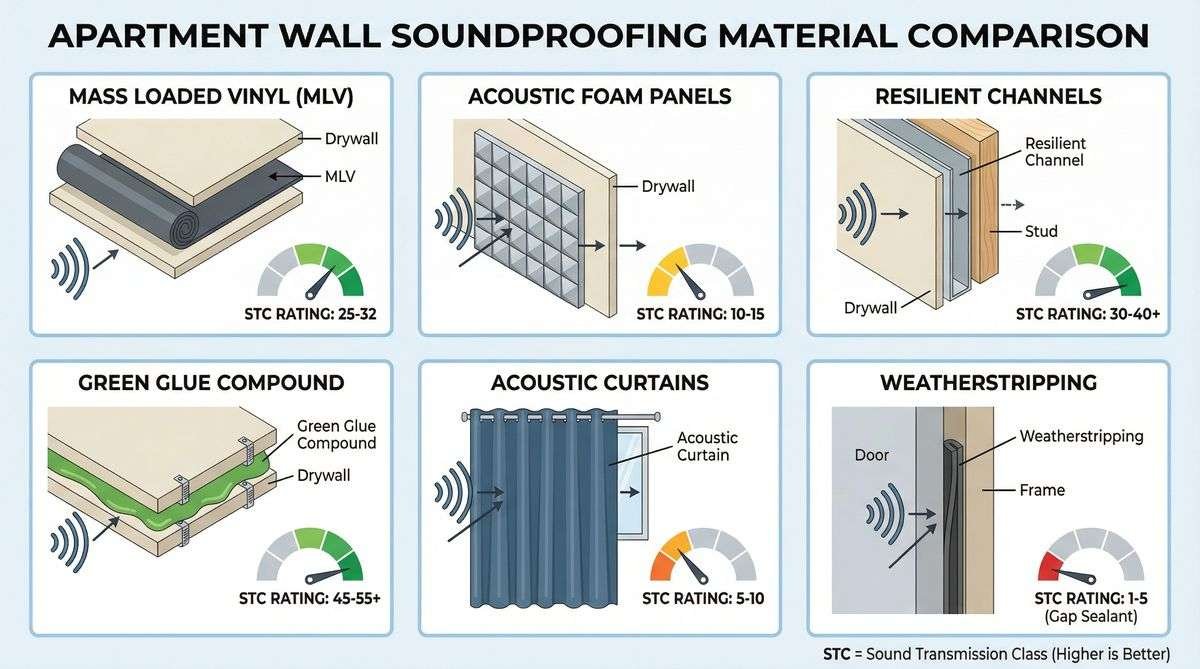
Adding mass to a wall assembly makes it harder for sound waves to cause vibrations, reducing transmission. Materials like additional layers of 5/8-inch drywall and Mass Loaded Vinyl (MLV) are effective. MLV is a flexible, heavy material that significantly increases mass without excessive thickness, often installed before or over drywall.
Damping Vibrations
Damping converts sound energy into heat, dissipating vibrations within wall assemblies. Green Glue Noiseproofing Compound, a viscoelastic material, is applied between rigid layers (typically drywall) to convert vibrational energy into heat, significantly reducing sound transmission. It’s a cost-effective solution for both new and existing constructions.
Decoupling the Structure
Decoupling physically separates wall sides, preventing vibration transfer. Resilient Sound Isolation Clips (RSIC Clips) create a resilient connection between drywall and studs, interrupting the sound transmission path. Used with hat channels, RSIC clips dramatically improve a wall’s STC rating by 15-20 points or more [1].
By combining these three principles—adding mass, damping vibrations, and decoupling the structure—it is possible to create a highly effective soundproof barrier that significantly reduces noise transmission through shared apartment walls.
Top Soundproofing Materials for Shared Apartment Walls
For effective soundproofing of shared apartment walls, a range of specialized materials are available, each serving a distinct purpose in blocking, absorbing, or dampening sound. Key materials include Mass Loaded Vinyl for adding density, Green Glue for vibration damping, RSIC clips for decoupling, acoustic drywall for enhanced mass, and mineral wool or fiberglass for insulation and sound absorption.
Mass Loaded Vinyl (MLV)
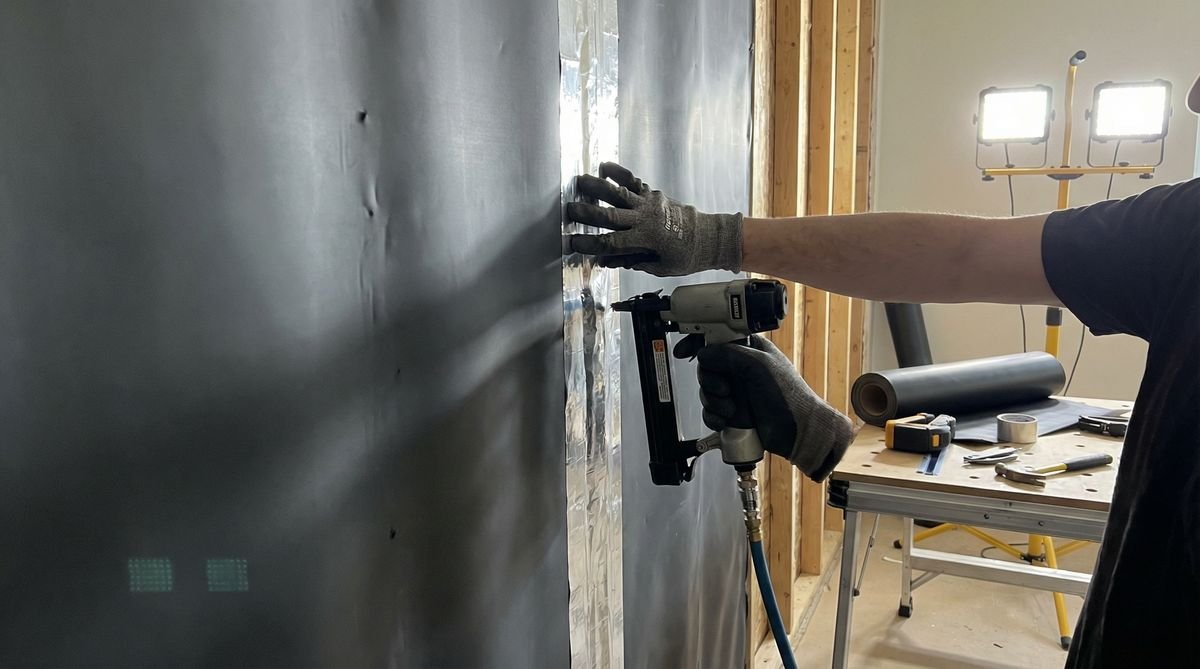
MLV is a flexible, heavy material that adds significant mass to walls, blocking airborne noise. It’s effective against conversations, music, and television sounds, and can be stapled to studs or applied over existing drywall.
Green Glue Noiseproofing Compound
Green Glue is a viscoelastic damping compound applied between rigid layers like drywall. It dissipates sound energy by converting vibrations into heat, reducing sound transmission and improving STC ratings. Ideal for new and retrofit projects.
Resilient Sound Isolation Clips (RSIC Clips)
RSIC clips decouple wall structures, creating a resilient connection between drywall and studs. This prevents direct vibration transfer, significantly improving a wall’s ability to block airborne and impact noise. They are used with hat channels.
Acoustic Drywall
Acoustic drywall, or soundproof drywall, has enhanced sound-blocking properties due to multiple gypsum layers laminated with a viscoelastic polymer. It offers increased mass and damping, providing a convenient all-in-one solution for improving STC ratings.
Mineral Wool and Fiberglass Insulation
These fibrous insulation materials absorb sound within wall cavities, reducing reverberation and echo, particularly for mid to high-frequency sounds. While not primary sound blockers, they are crucial for comprehensive soundproofing.
Here’s a comparison of mineral wool and fiberglass for sound absorption:
| Feature | Mineral Wool | Fiberglass |
|---|---|---|
| Composition | Made from basalt rock and slag | Made from spun glass fibers |
| Density | Generally denser, offering slightly better low-frequency absorption [2] | Less dense than mineral wool |
| Form | Available in semi-rigid boards or batts | Available in rolls, batts, or loose-fill |
| Fire Resistance | Excellent fire resistance | Good fire resistance |
| Moisture | Hydrophobic, resists moisture | Can be affected by moisture |
| Installation | Can be more challenging to cut and install due to density | Easier to cut and install |
| Cost | Typically higher | Generally lower |
| Primary Use | High-performance acoustic and thermal insulation | General thermal and acoustic insulation |
Mineral wool often has a slight edge in sound absorption due to its higher density, particularly for lower frequencies. However, fiberglass is a more common and cost-effective option for general sound absorption within wall cavities [3].
Soundproofing Strategies: Existing Walls vs. New Construction
The approach to soundproofing shared apartment walls varies significantly depending on whether you are working with an existing structure or building new. Existing walls often require retrofit solutions that minimize demolition, focusing on sealing gaps and adding layers, while new construction allows for comprehensive, integrated soundproofing measures within the wall assembly.
Soundproofing an Existing Wall (Minimal Demolition)
For existing walls, focus on surface-level treatments:
- Sealing Gaps: Use acoustical caulk to seal all cracks, gaps, and penetrations around outlets, baseboards, and frames. Sound finds the path of least resistance.
- Adding Layers: Attach an additional layer of 5/8-inch drywall to the existing wall, with Green Glue Noiseproofing Compound applied between layers. This creates a constrained layer damping system.
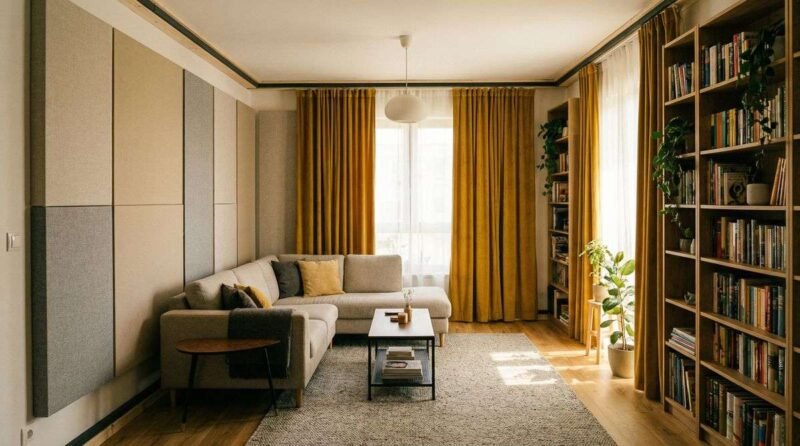
- Surface-Applied Acoustic Panels: For supplementary absorption, use fabric-wrapped or decorative acoustic panels to reduce echo and reverberation within the room.
Soundproofing During New Construction or Renovation (Opening the Wall)
When walls can be opened, implement a robust, integrated system:
- Insulation in Stud Cavities: Fill cavities with mineral wool or fiberglass to absorb sound.
- Mass Loaded Vinyl (MLV) Installation: Staple MLV directly to studs for added mass and airborne noise blocking.
- RSIC Clips and Hat Channel: Install RSIC clips on studs with hat channels to decouple the drywall, preventing vibration transfer.
- Multiple Layers of Drywall with Green Glue: Install two layers of 5/8-inch drywall onto hat channels, with Green Glue between them, maximizing mass and damping. Seal all perimeter gaps with acoustical caulk.
Cost-Effectiveness and Investment Considerations
Investing in soundproofing for shared apartment walls offers significant long-term benefits, including enhanced comfort, privacy, and property value. While initial costs vary based on the chosen methods and materials, balancing budget with performance is key to achieving optimal noise reduction and a favorable return on investment.
Soundproofing costs vary widely. Low-cost DIY options (tapestries, foam panels) offer minimal improvement. Mid-range solutions (sealing, Green Glue + drywall) cost $3-$5 per square foot and provide noticeable improvement. High-performance solutions (RSIC clips, MLV, multiple drywall layers) cost $5-$10+ per square foot, offering superior noise reduction.
Long-Term Benefits and ROI for Homeowners and Landlords
Investing in soundproofing offers tangible long-term benefits:
- Attract Higher-Quality Tenants: Soundproofed units command higher rents and attract stable tenants valuing peace.
- Fewer Noise Complaints, Lower Turnover: Reduces tenant disputes and turnover, saving on vacancy and administrative costs.
- Enhance Property Value and Reputation: Increases market value and appeal, as acoustic comfort is highly desired.
- Compliance & Future-Proofing: Meets stricter STC requirements, potentially qualifying for tax credits or rebates [4].
Ultimately, the enhanced quality of life, increased property value, and reduced operational headaches make effective soundproofing a sound investment.
Frequently Asked Questions
Here are answers to some of the most common questions regarding soundproofing shared apartment walls, covering effective methods, cost considerations, and practical solutions for various scenarios.
What is the best way to soundproof an interior wall?
The most effective way involves adding mass (MLV), damping vibrations (Green Glue between drywall layers), and decoupling (RSIC clips). Sealing all gaps with acoustical caulk is also crucial.
How much does it cost to soundproof a duplex wall?
Costs range from minimal for basic DIY to $3-$5 per square foot for mid-range solutions, and $5-$10+ per square foot for high-performance systems. It’s an investment in comfort and property value.
Can I soundproof a wall without removing drywall?
Yes. Seal gaps with acoustical caulk, then add an additional layer of 5/8-inch drywall with Green Glue between layers. Surface-applied acoustic panels can also help.
Do I need both MLV and RSIC clips?
For highest soundproofing against both airborne and impact noise, using both is highly recommended. MLV adds mass, while RSIC clips decouple the structure; they are complementary.
How can I reduce noise in common areas?
Focus on sound absorption to control reverberation and echo. Use fabric-wrapped acoustic panels, acoustic ceiling tiles, heavy curtains, or carpets to absorb sound waves.
Conclusion
Achieving a peaceful living environment in shared apartment spaces is entirely possible with the right soundproofing strategies and materials. By understanding the principles of mass, damping, and decoupling, and by carefully selecting materials like Mass Loaded Vinyl, Green Glue, and RSIC clips, residents can significantly reduce unwanted noise and enhance their quality of life.
A well-planned soundproofing approach can transform a noisy dwelling into a tranquil sanctuary. The key lies in a comprehensive strategy that addresses the fundamental ways sound travels: through mass (MLV, acoustic drywall), vibration (Green Glue), and structural connections (RSIC clips).
Whether for existing walls or new construction, viable solutions exist. From sealing minor gaps to implementing advanced decoupling systems, each step contributes to a more effective sound barrier. The investment in high-quality soundproofing, while considerable, offers long-term benefits including enhanced privacy, improved sleep, reduced stress, and increased property value.
Reclaiming your quiet space is an investment in your well-being. By applying these proven soundproofing principles and materials, you can create an apartment environment that truly feels like home, free from the disturbances of the outside world.
References
- How to Soundproof a Shared Duplex Wall: Proven Solutions for Noise Reduction. Acoustic Geometry
- How to Soundproof a Shared Wall or Party Wall. Second Skin Audio, https://www.secondskinaudio.com/soundproofing/party-wall-soundproofing/?srsltid=AfmBOorTq6Po7aAEukur6RkfykFm0ja2b1yVXlGdxy6TyZs5n5XPcI2a
- The 7 Best Sound Absorbing Materials. Acoustical Solutions, https://acousticalsolutions.com/best-sound-absorbing-materials?srsltid=AfmBOoqKjkyry49l_9Y0dy_-bUi1t-nodzq2TYy5JrV7JSc9c5LCfuzI
- Why Building Owners Should Invest in Wall Soundproofing for Tenant Spaces. Acoustic Geometry, https://acousticgeometry.com/soundproof-shared-duplex-wall/?srsltid=AfmBOoo4LTgsIhS5_QEOrXbpB-TEANA01h1cYwNYh6vpCKtr-GyGYx1O