



FeedBuzzard advertise options center on three ad formats, push notification, native, and pop-under, running through a real-time bidding (RTB) platform with a minimum deposit reported at $50 by multiple independent advertiser reviews. For marketers in gaming, software, finance, and e-commerce who need measurable direct-response traffic without the cost barriers of major platforms, FeedBuzzard advertise campaigns have become a practical testing ground where small budgets can generate real performance data.
Note: Platform-specific details in this guide are based on published advertiser reviews and third-party analyses as of early 2026. Features, pricing, and policies may change. Verify current terms directly with FeedBuzzard before committing any budget.
What Is FeedBuzzard Advertising?
A FeedBuzzard advertise account connects you to a performance advertising network that uses real-time bidding to match advertiser campaigns with publisher inventory across push, native, and pop-under placements. Advertisers set bids, define audience parameters, and the platform auctions placements in milliseconds every time an eligible impression becomes available.
The platform targets direct-response advertisers who need measurable outcomes: a click, a lead form submission, an app install, or a sale. It does not serve brand-awareness campaigns that run on premium editorial publishers. Traffic flows through content discovery and notification-based channels, which places FeedBuzzard alongside other performance networks like PropellerAds and Zeropark rather than with search-intent platforms like Google Ads.
According to published advertiser analyses, the reported $50 minimum deposit gives FeedBuzzard one of the lowest entry thresholds among comparable RTB networks. This accessibility distinguishes it from Zeropark ($200 minimum) and PropellerAds ($100 minimum), making it particularly relevant for marketers testing a new offer before scaling budget to higher-cost platforms.
FeedBuzzard Ad Formats: Push, Native, and Pop-Under Explained
FeedBuzzard’s three ad formats serve fundamentally different audience interaction patterns: push notifications interrupt users directly in their notification tray, native ads blend with publisher content to reduce ad fatigue, and pop-unders surface after session end for high-volume, low-intent impressions. Choosing the right format before launching determines whether your first campaign generates useful data or simply depletes budget.
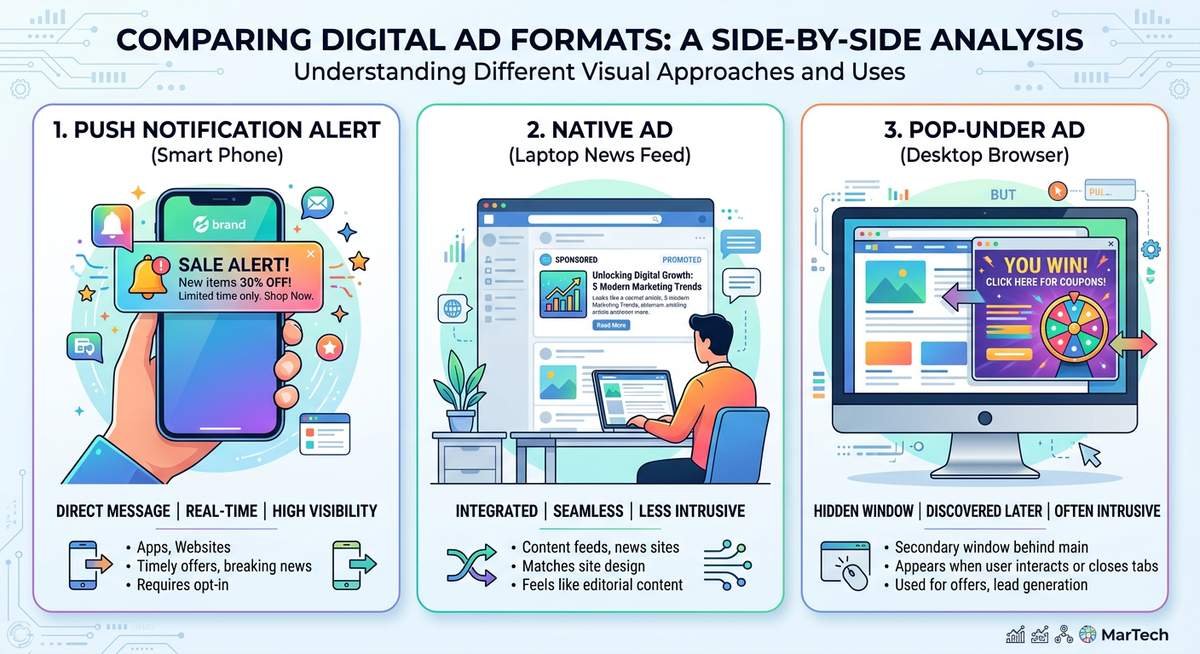
Push notification ads appear as browser or mobile alerts even when the user is not actively browsing a website. According to industry research, push notifications carry higher visibility than passive banner placements because they interrupt the user’s current activity. On FeedBuzzard, push ads consist of a short headline, a small icon image, and descriptive text. They work best for time-sensitive promotions, app installs, and news-driven offers where immediate urgency drives the click decision.
Native ads are designed to blend with surrounding publisher content, typically appearing as “recommended articles” or sponsored product widgets at the bottom of editorial pages. The format reduces banner blindness by mimicking organic content. Native advertising consistently generates higher engagement than standard display because readers are in an information-seeking mindset when they encounter it. According to the Interactive Advertising Bureau’s 2023 Internet Advertising Revenue Report, native advertising accounted for 59% of all U.S. display ad revenue, reflecting the format’s dominance in performance marketing.
Pop-under ads open a new browser window behind the user’s current tab. They become visible only when the user closes their active window. Pop-unders generate high impression volumes at low CPM rates, but user intent is minimal. They are best reserved for broad-appeal offers where brand familiarity already exists or for retargeting audiences who have previously visited your landing page.
A format that delivers volume without intent demands exceptional copy and an extremely frictionless landing page. Push and native ads, by contrast, reach users with a specific context that your creative can match. Starting with native ads is the more defensible first test for most advertisers.
FeedBuzzard vs. Competing Ad Networks: A Direct Comparison
FeedBuzzard’s reported $50 entry point sits well below PropellerAds ($100), Zeropark ($200), and Taboola ($500+), making it the lower-cost option for marketers who want to test RTB performance advertising before committing larger budgets to more sophisticated platforms with steeper optimization requirements.
| Platform | Minimum Deposit | Ad Formats | Best Verticals | Targeting Granularity | Entry Difficulty |
|---|---|---|---|---|---|
| FeedBuzzard | ~$50 (reported) | Push, Native, Pop-under | Gaming, Finance, Software, E-commerce | Geo, Device, OS, Browser | Low — beginner-accessible |
| Google Ads | No minimum (but $300+ recommended for data) | Search, Display, Shopping, Video | All verticals | Keywords, Demographics, Intent | High — steep learning curve |
| PropellerAds | $100 | Push, Interstitial, Pop-under | Gaming, Downloads, Finance | Geo, Device, Browser, Audience Segments | Medium — intermediate |
| MGID | $100 | Native only | Editorial, Health, Finance | Contextual, Geo, Demographics | Medium — curated approval |
| Zeropark | $200 | Push, Domain, Pop | Finance, Nutra, Downloads | Geo, Device, Source URL level | High — advanced optimization |
| Taboola | $500+ (recommended) | Native, Display | Editorial, Finance, Health | Contextual, Demographics, Retargeting | High, premium publisher network |
The entry cost gap between FeedBuzzard and Taboola illustrates the structural difference: FeedBuzzard serves performance marketers testing offers at low cost, while Taboola serves brand advertisers seeking premium publisher placements. Neither is universally superior; they serve different stages of a campaign’s lifecycle.
FeedBuzzard Pricing and Cost Breakdown
FeedBuzzard uses auction-based pricing with no fixed rate cards, supporting both CPC (cost-per-click) and CPM (cost-per-thousand-impressions) bidding models. Every feedbuzzard advertise campaign competes against other advertisers in real time for each eligible impression, so actual costs depend entirely on how contested your target audience is at any given moment.
Practical cost ranges based on published advertiser accounts:
- Tier-1 geos (US, UK, Australia, Canada): CPC bids typically need to exceed $0.05 to win meaningful traffic volume on push and native formats.
- Tier-2 geos (Eastern Europe, Southeast Asia, Latin America): Competitive CPC bids often fall between $0.005 and $0.02, making these regions practical for testing creative performance before scaling budget to higher-value markets.
- Pop-under CPM: Among the lowest-cost inventory in the network, often sub-$1 CPM in many regions.
For beginners, CPC bidding is the safer starting model because you only pay when someone actually clicks through to your landing page. CPM campaigns require experience reading impression-to-click efficiency ratios to avoid overpaying for traffic that never converts. The standard performance marketing rule applies: treat the first $50-100 on any new network as research investment, not revenue generation.
The $50 entry point attracts advertisers who haven’t yet built the optimization discipline the platform demands. Low entry cost does not equal low cost per acquisition. Your margins set the ceiling on what you can afford to spend per conversion, and that ceiling doesn’t change based on the platform’s deposit minimum.
Audience Targeting Options on FeedBuzzard
A feedbuzzard advertise setup provides country-level geo targeting, device type (mobile and desktop), operating system, browser, and browser language filters that apply across all three ad formats. These are demographic and contextual parameters, not intent signals. The platform does not offer keyword, interest, or behavioral audience segments comparable to Google or Meta’s targeting infrastructure.
Key targeting parameters and their strategic implications:
- Geography: Country-level targeting with bid multipliers for regions where your offer converts at higher rates. Starting with a single country and one device type produces cleaner, more actionable data.
- Device: Mobile and desktop should run as separate campaigns. Conversion rates, bounce behavior, and appropriate CPC bids differ significantly between the two environments.
- Operating System: Critical for app-install campaigns that require traffic matched to specific iOS or Android distribution.
- Browser Language: Useful for filtering audiences by probable language comprehension for offers that depend on reading and understanding content.
One practical limitation: FeedBuzzard’s standard campaign interface does not offer site-level publisher whitelisting during initial campaign setup. You are targeting audience segments rather than specific websites. Building a publisher whitelist requires running campaigns first, collecting source-level performance data, and then refining targeting based on which sources actually convert for your offer.
How to Launch Your First FeedBuzzard Campaign
A complete feedbuzzard advertise campaign setup takes approximately 30 minutes if your landing page and conversion tracking are already in place. These seven steps cover the complete process from account creation to first click, with each decision affecting whether your initial budget generates usable data or simply disappears into the platform.
- Create an account and deposit funds. The reported minimum deposit is $50, payable by credit card or e-payment methods. Account verification is standard.
- Define your campaign objective before touching any settings. Know whether you are optimizing for clicks, app installs, or lead form completions. Set up conversion tracking before your first campaign launches, not after.
- Choose your ad format. Native ads work best for content-based or information-driven offers. Push notifications suit direct, time-sensitive promotions. Pop-unders work for broad-appeal products with maximum volume requirements.
- Set geographic and device targeting. Start with one country and one device type. Broad initial targeting spreads budget thin across too many variables to identify what is working.
- Upload your creative. Native ads require an image and headline. Push ads use an icon image and title line. Headlines should create genuine curiosity or state a clear benefit; misleading claims risk account-level issues with the platform’s content review.
- Set your bid and daily budget cap. Start within the platform’s suggested bid range and cap daily spend at $5-10 for initial data collection. This pace allows multiple days of learning before drawing conclusions.
- Launch and observe for at least 50-100 clicks before optimizing. Pause underperforming targeting segments, test new creative variations, and adjust bids based on what the actual click and conversion data reveals. This test-measure-optimize cycle is the real work of performance marketing.
For a deeper walkthrough of FeedBuzzard’s ad format options and bidding mechanics, the complete FeedBuzzard ad format and campaign setup guide covers advanced bid strategy in greater detail.
FeedBuzzard Analytics and ROI Measurement
FeedBuzzard provides an integrated campaign dashboard showing impressions, clicks, spend, and CTR at the campaign level, with a conversion pixel for tracking post-click actions on your landing page. For advertisers running multiple offers or A/B testing, pairing this built-in reporting with a third-party tracker like Voluum, RedTrack, or Binom adds source-level granularity that the native dashboard does not provide on its own.
Third-party tracker advantages:
- Source-level reporting: Identify which publisher sources within FeedBuzzard’s network are actually delivering conversions versus clicks that bounce. This data drives whitelist and blacklist decisions.
- Multi-offer split testing: Test different landing pages against the same traffic source without polluting campaign-level data.
- Attribution modeling: Track the full path from ad impression through to conversion, including time-delay patterns between click and purchase.
According to Statista’s 2024 Digital Advertising Outlook, global digital advertising spending exceeded $600 billion in 2023 and continues its annual growth trajectory. The Interactive Advertising Bureau (IAB, 2023) confirmed in its Internet Advertising Revenue Report that native advertising accounted for 59% of all U.S. display ad revenue, validating the format’s importance in performance marketing. According to eMarketer’s 2024 programmatic advertising analysis, over 90% of all U.S. digital display spending now flows through programmatic channels, which means understanding RTB bidding mechanics is no longer optional for performance marketers at any budget level.
Key performance metrics to establish from campaign launch: CTR by ad format, CPC relative to your vertical’s industry benchmarks, and cost per acquisition (CPA) measured against actual product margin, not gross revenue. A campaign generating profitable CPA with poor CTR is a better business outcome than a high-CTR campaign that fails to convert.
Who Should Use FeedBuzzard (and Who Should Not)
The feedbuzzard advertise platform is a practical fit for performance marketers in gaming, software, finance, cryptocurrency, and e-commerce who need measurable direct-response traffic on a limited testing budget. Beginners with $100-200 who want real-world experience with RTB bidding will find the platform accessible without the catastrophic burn rate that higher-minimum networks risk during the learning phase.
The platform is not suitable for brand-safety-focused campaigns, luxury products requiring controlled editorial placement, or businesses where Google Ads search intent is already performing efficiently. FeedBuzzard’s audience arrives without any expressed intent signal, which requires your landing page and offer to generate purchase motivation from zero context.
The same $50 that feels like a modest test to an experienced performance marketer represents real money to a beginner with no tracking, no optimization process, and no benchmarks for what good data looks like. The platform is accessible in cost but demanding in discipline.
Common Mistakes Advertisers Make on FeedBuzzard
Three recurring errors account for the majority of wasted budget in feedbuzzard advertise campaigns and similar RTB networks: overly broad initial targeting, no conversion tracking before launch, and premature campaign optimization. Recognizing these patterns before launching saves the kind of budget that most advertisers lose during their first two campaigns.
1. Running campaigns without conversion tracking. FeedBuzzard shows clicks, but clicks are not conversions. Launching without a configured tracking pixel or third-party tracker means collecting vanity metrics instead of actionable data. Set up your conversion goal and confirm it fires correctly on a test transaction before depositing anything.
2. Targeting multiple countries at once to “scale faster.” Multi-country campaigns in early stages produce data that is impossible to analyze cleanly. A $50 test split across five countries yields $10 worth of data per country, too little to conclude anything. Start with one country, one device, and one ad format. Broad targeting is a privilege of campaigns that have already identified what works.
3. Optimizing within the first 20 clicks. Pausing placements, changing bids, or swapping creatives before reaching 50-100 clicks per variation creates optimization loops based on statistical noise. The platform’s RTB auctions need time to learn which placements match your audience. Premature changes reset this learning cycle and extend the time to usable data.
4. Using pop-under ads for cold-traffic conversion campaigns. Pop-unders generate impressions cheaply, but user intent on pop-under traffic is minimal. Direct-response campaigns asking for an email signup or a purchase from a cold audience typically perform poorly on this format. Reserve pop-unders for retargeting or brand awareness campaigns where the offer does not require high cognitive commitment from the viewer.
Key Takeaways Before You Start
The feedbuzzard advertise platform offers a lower-cost entry into RTB-based performance advertising than most competing networks, with push, native, and pop-under formats covering the primary direct-response ad placement types. The platform rewards advertisers who bring disciplined testing frameworks, proper conversion tracking, and realistic CPA expectations.
Three things that determine whether a FeedBuzzard campaign succeeds: starting with a narrow target (one country, one device), tracking conversions before spending rather than after, and giving each creative at least 50-100 clicks before drawing conclusions. The marketers who burn through deposit funds quickly are typically those who skip these fundamentals, not those who encountered a platform-specific problem.
For niche verticals where major platforms impose restrictive category policies, FeedBuzzard’s lower barrier to entry and more permissive content categories represent a genuine operational advantage that the larger platforms simply do not offer at comparable cost.
Frequently Asked Questions About FeedBuzzard Advertising
What is the minimum deposit to start advertising on FeedBuzzard?
The minimum deposit on FeedBuzzard is reported at $50 by multiple independent advertiser reviews, payable via credit card or e-payment services such as Skrill. This threshold makes it one of the more accessible entry points in the RTB network space relative to competitors like PropellerAds ($100) and Zeropark ($200). Confirm current minimum requirements directly with FeedBuzzard before depositing.
Should I use CPC or CPM bidding on FeedBuzzard?
For beginners, CPC (cost-per-click) bidding is the safer choice because you only pay when a user actually visits your landing page, giving you direct control over the spend-to-traffic relationship. CPM bidding requires experience interpreting impression-to-click efficiency ratios and works best for campaigns with strong prior CTR data on similar audience segments.
Does FeedBuzzard work for e-commerce stores?
FeedBuzzard can produce results for e-commerce stores running impulse-purchase offers with broad appeal, particularly when discount-driven promotions are paired with native or push ad formats. It is generally less effective for high-consideration purchases or niche products that require a specific purchase-intent audience. Starting with a single best-selling product and a tight geographic target produces the most actionable initial data.
Is FeedBuzzard traffic real human traffic?
FeedBuzzard implements anti-fraud systems, and the majority of traffic on the platform is reported as real by independent advertisers who have tested it. As with any programmatic ad network, low-quality publisher sources exist within the broader inventory. Monitoring post-click behavior (bounce rate, session duration, conversion rate) in a third-party analytics tool alongside FeedBuzzard’s click data helps identify and exclude underperforming sources.
What are the main alternatives to FeedBuzzard?
The closest alternatives to FeedBuzzard are PropellerAds (similar push and pop inventory, $100 minimum), Zeropark (higher $200 minimum with finer source-level targeting control), MGID (curated native-only network for content-driven offers), and Taboola (premium native placements with brand-safe publisher relationships and higher CPCs). The right choice depends on your vertical, available budget, and how much optimization complexity you can manage in parallel with running your business.
How long does it take to see results from FeedBuzzard ads?
When you feedbuzzard advertise with competitive bids targeting a focused geography, traffic typically begins flowing within hours of campaign approval. Meaningful performance data requires at least 50-100 clicks per ad creative before conclusions about offer-audience fit are valid. A realistic first-campaign timeline is one to two weeks from launch before making final decisions about scaling, pausing, or restructuring the campaign.