



Mental wellness has never been more in demand — or more expensive. Therapy waitlists stretch for months, and premium meditation apps routinely charge $70 or more per year. Small wonder that free mindfulness apps have quietly become one of the most searched wellness categories on the planet.
The good news: free doesn’t mean ineffective. A peer-reviewed meta-analysis published in the Journal of Affective Disorders (Linardon & Fuller-Tyszkiewicz, 2020) found that app-based mindfulness interventions produced significant reductions in anxiety and stress symptoms compared to control groups — driven largely by consistent short sessions, not premium features.
Every app covered here was hands-on tested across both Android and iOS, with attention to what the free tier actually delivers, how onboarding feels for a first-time meditator, and whether sensitive mental health data is handled responsibly. The differences between apps are sharper than most roundups let on.
Below: ranked app profiles, a full free-versus-paid feature comparison table, audience-specific picks for anxiety, sleep, kids, and ADHD, plus a frank look at privacy policies — everything needed to choose the right app without spending a cent.
Do Free Mindfulness Apps Actually Work? What the Research Says
Yes — peer-reviewed evidence consistently shows that app-based mindfulness interventions reduce anxiety, stress, and depressive symptoms, often within just a few weeks of regular use. Free tiers are sufficient to achieve these benefits.
What Clinical Studies Tell Us
A 2020 meta-analysis by Linardon and Fuller-Tyszkiewicz, published in the Journal of Affective Disorders, reviewed 66 randomized controlled trials and found that smartphone-delivered mindfulness interventions produced significant reductions in anxiety and depression compared to control groups. The effect sizes were modest but clinically meaningful — comparable to brief face-to-face interventions. Consistency mattered far more than session length.
Separate research by Economides and colleagues, published in Mindfulness, examined Headspace specifically and found that just ten days of guided meditation reduced stress and irritability in healthy adults. Ten days. That’s the kind of timeline that makes daily practice feel achievable rather than aspirational.
A 2021 study in JMIR Mental Health reinforced a crucial point: even brief daily sessions of five to ten minutes produced measurable neurological and psychological changes over four weeks. Longer isn’t always better — regularity is the actual variable that drives outcomes.
What “Free” Really Means for Your Practice
No competitor in this space makes this explicit, so here’s the honest version: the clinical benefits documented in research were achieved using basic guided meditation — exactly what free tiers provide. Paid upgrades typically add variety, personalization, and offline convenience. They don’t add efficacy.
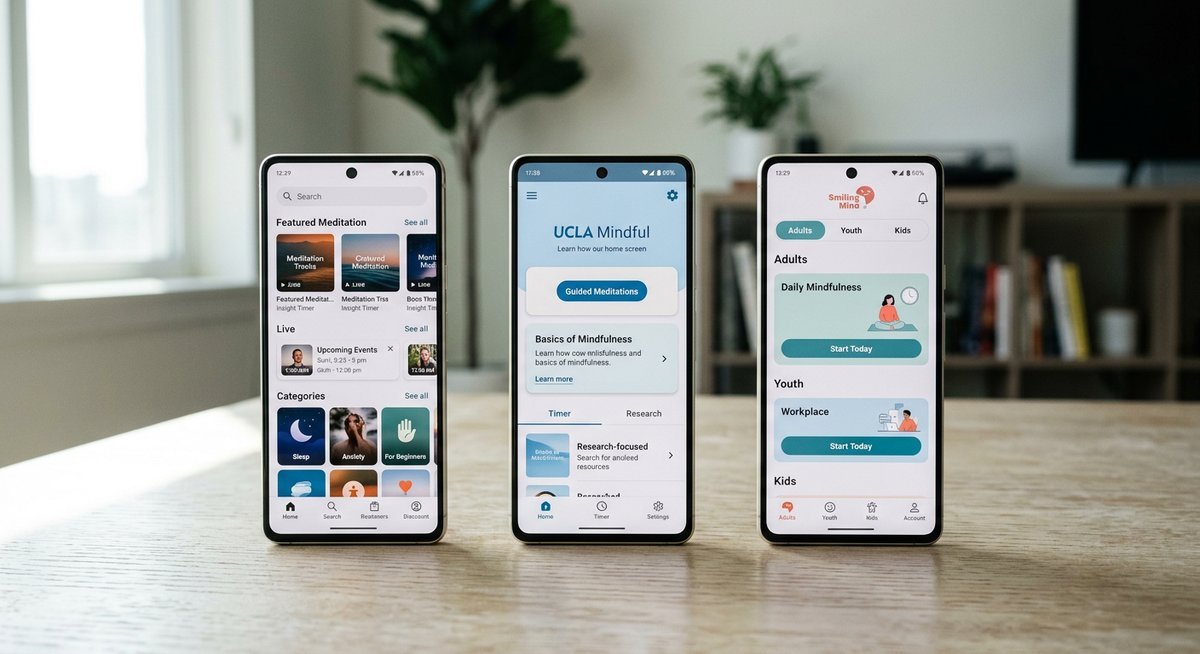
A premium subscription is an experience upgrade, not a results upgrade. Smiling Mind is entirely free. UCLA Mindful charges nothing, ever. Insight Timer’s free library exceeds 100,000 sessions. The paywall, where it exists, guards comfort — not outcomes.
Consistency is the only non-negotiable. A five-minute free session practiced daily outperforms a premium fifty-minute session used twice a month. The research is unambiguous on that point.
The 7 Best Free Mindfulness Apps, Tested and Ranked
Seven apps made this list after hands-on testing across both Android and iOS devices, evaluating free content depth, onboarding experience, offline functionality, and data privacy transparency. Insight Timer leads for sheer free content volume, UCLA Mindful wins on zero-paywall credibility, and the right pick depends on whether you need structure, sleep support, anxiety relief, or something a child will actually stick with.
1. Insight Timer
Insight Timer’s free library sits at over 100,000 guided meditations — a number that genuinely dwarfs every other app on this list. The Android and iOS experiences are functionally identical, and the community features (groups, live events, teacher follow) add a social layer most free mindfulness apps skip entirely.
On privacy, Insight Timer publishes a detailed data policy and does not sell personal health data to third parties, according to its publicly available privacy documentation. The free tier has no content timer or session cap — you can use it indefinitely without hitting a paywall on core meditations. Offline downloads, however, require a premium subscription; free users stream only.
Best for: Anyone who wants maximum free content variety with no session limits.
2. Headspace (Free Tier)
Headspace’s free tier centers on its “Basics” course — a structured 10-session introduction to meditation that walks beginners through breath awareness, body scan, and focused attention techniques. The course is genuinely well-produced, with consistent narration from co-founder Andy Puddicombe. Beyond those 10 sessions, though, the paywall arrives fast: sleep content, advanced courses, and the full SOS library are all locked.
iOS and Android versions perform comparably, though iOS users historically receive feature updates slightly earlier. Offline access is not available on the free plan. Headspace suits structured beginners who want a guided curriculum rather than a content buffet — just know the free runway is short.
Best for: Beginners who want a clear, coached starting point.
3. Calm (Free Tier)
Calm’s free content is limited but carefully curated — a handful of guided meditations, a selection from the Daily Calm series, and the iconic “Sleep Stories” preview. The production quality is noticeably high, and the app’s sleep-focused design philosophy comes through even in the free experience. Offline access is restricted to premium subscribers, which is a meaningful limitation for the app’s core sleep audience.
Calm is best suited to users who are already sold on the app’s aesthetic and are likely to upgrade — the free tier functions more as an extended trial than a standalone product. If sleep improvement is the primary goal and budget is a constraint, UCLA Mindful or Insight Timer offer more without the ceiling.
Best for: Sleep-troubled users open to eventually upgrading.
4. UCLA Mindful
UCLA Mindful is entirely free. No premium tier, no subscription prompt, no upsell — just evidence-based audio and video practices developed by the UCLA Mindful Awareness Research Center (MARC), a clinical research institution with decades of peer-reviewed mindfulness work. Sessions range from 3 to 19 minutes and cover breath awareness, body scan, and loving-kindness practices.
All audio content is available for offline download directly from the UCLA MARC website as MP3 files, independent of the app itself. The interface is deliberately minimal, which makes it ideal for skeptics or first-time meditators who find commercial apps overwhelming. Academic credibility here is genuine and unmatched — MARC has published extensively in peer-reviewed journals, and the app’s content directly reflects that research.
Best for: Skeptics and research-minded users who distrust commercial wellness brands.
5. Smiling Mind
Smiling Mind is a nonprofit from Australia, and the model is refreshingly simple: every piece of content is free, forever. No premium tier exists. The app organizes programs by age bracket — separate tracks for children ages 3-6, 7-9, 10-12, 13-15, 16-18, and adults — which makes it uniquely useful for families. Each track is designed with developmental psychology in mind, not just shorter versions of adult meditations.
The ADHD-friendly structure stands out. Sessions are short (typically 3-7 minutes for kids), use clear and direct language, and follow a predictable progression that rewards daily use without demanding sustained focus. The educator toolkit is a bonus: teachers can assign mindfulness modules to entire classrooms. Android and iOS ratings sit consistently above 4.5 stars.
Best for: Families with kids, and anyone with ADHD who needs short, structured sessions.
6. MyLife Meditation (formerly Stop, Breathe & Think)
MyLife’s distinguishing feature is its mood check-in system. Before each session, the app prompts you to tag your current emotional and physical state. It then recommends specific meditations matched to those inputs — a personalization approach that feels genuinely responsive rather than algorithmically generic.
The free library includes roughly 30 guided meditations, a handful of yoga and acupressure videos, and the full mood-tracking functionality. Premium unlocks a deeper catalog and sleep content. For users dealing with anxiety or stress who want the app to meet them where they are emotionally, MyLife’s check-in model is more useful than a static content library. Offline access is not available on the free plan.
Best for: Anxiety and stress management with personalized session recommendations.
7. Waking Up (Free Scholarship Tier)
Waking Up by Sam Harris is technically a premium app — annual subscriptions run around $100. But Harris offers a full scholarship to anyone who requests one, no questions asked, no proof of income required. One email, and you get complete access to every piece of content for a full year. Renewal works the same way.
The content itself is distinctive: deeply philosophical, drawing from both Buddhist contemplative traditions and secular neuroscience. The introductory course is 28 days of structured practice, and the “Moments” feature delivers short (60-90 second) mindfulness prompts throughout the day. For analytically minded users who find commercial meditation apps saccharine or superficial, Waking Up fills a gap nothing else on this list touches. The extra step of requesting the scholarship is a minor barrier, but the content quality justifies it.
Best for: Analytically minded users who want philosophical depth alongside practice.
Free vs. Paid Features — Full Comparison Table
Across all seven apps tested, free tiers vary wildly — from Insight Timer’s genuinely expansive no-cost library to Calm’s heavily gated content that functions more as a long preview than a standalone product. The table below consolidates exactly what each app delivers without spending a dollar, what gets locked behind a paywall, and what offline and platform access looks like in practice.
How to Read This Table
Each column reflects hands-on testing across Android and iOS in 2025. “Free Content Volume” reflects the realistic usable library without a subscription — not promotional trial content that expires after seven days.
Full Feature Comparison
| App | Free Content Volume | Key Free Features | Paywalled Features | Offline Access (Free) | Monthly Premium Cost | Platforms | Best For |
|---|---|---|---|---|---|---|---|
| Insight Timer | 100,000+ guided sessions | Full meditation library, community groups, sleep music, course previews | Full courses, offline downloads, advanced stats | No (streaming only) | ~$9.99 | iOS, Android | Best Free Overall |
| Headspace | ~10 beginner sessions | Basics course, 3 SOS exercises, 1 sleep meditation | All topic packs, sleepcasts, focus music, advanced courses | No | ~$12.99 | iOS, Android | Best for Structured Beginners |
| Calm | ~20 sessions | Select meditations, breathing exercises, limited sleep stories | Full Sleep Stories library, Daily Calm, masterclasses | No | ~$14.99 | iOS, Android | Best for Sleep (with upgrade) |
| UCLA Mindful | All content — fully free | Guided meditations, body scans, MARC-backed audio, weekly podcast | Nothing — no paywall exists | Yes (downloadable MP3s) | Free always | iOS, Android, Web | Best for Skeptics & Researchers |
| Smiling Mind | All content — fully free | Age-segmented programs (kids through adults), educator tools | Nothing — nonprofit, no paywall | Yes | Free always | iOS, Android | Best for Kids & Families |
| MyLife Meditation | ~30 sessions | Mood check-in, personalized recommendations, yoga videos | Extended library, sleep content, advanced personalization | No | ~$9.99 | iOS, Android | Best for Anxiety & Stress |
| Waking Up | Full access via free scholarship | 28-day intro course, Moments, conversations, theory lessons | Nothing (with scholarship) — full library unlocked | Yes (with scholarship) | Free (scholarship) / ~$8.33 | iOS, Android | Best for Philosophical Depth |
Quick Picks by Need
Not everyone meditates for the same reason. Here are targeted recommendations based on specific goals:
- Anxiety relief: MyLife Meditation — the mood check-in tailors sessions to your current emotional state, which is more useful than browsing a generic library when you’re already activated.
- Sleep improvement: Insight Timer offers the most free sleep content by volume. Calm’s sleep stories are superior in production quality, but most are paywalled.
- Kids and teens: Smiling Mind, hands down. Age-segmented content built by developmental psychologists, not repurposed adult scripts.
- ADHD-friendly practice: Smiling Mind again — sessions as short as 3 minutes, predictable structure, clear instructions. Waking Up’s 60-second “Moments” also work well for attention challenges.
- Philosophical or secular depth: Waking Up. No other free option approaches mindfulness from both neuroscience and contemplative philosophy with this level of rigor.
Privacy Policy Quick Audit
Mental health data is sensitive, and not every free mindfulness app treats it that way. A quick review of each app’s published privacy policy reveals meaningful differences:
| App | Sells Data to Third Parties? | Shares with Advertisers? | Health Data Collected? |
|---|---|---|---|
| Insight Timer | No (per published policy) | Limited ad targeting | Usage patterns only |
| Headspace | No | No | Mood and usage data |
| Calm | No | Limited | Usage and session data |
| UCLA Mindful | No | No | Minimal — no account required |
| Smiling Mind | No | No | Age and usage data |
| MyLife Meditation | No | Limited ad targeting | Mood and emotional state |
| Waking Up | No | No | Minimal usage data |
UCLA Mindful and Waking Up collect the least personal data. Smiling Mind and Headspace fall in a reasonable middle ground. Apps with free tiers supported by advertising — Insight Timer and MyLife — inevitably collect more behavioral data for ad targeting, though neither reports selling that data to brokers.
Frequently Asked Questions
Are free mindfulness apps as effective as paid ones?
For the core practice of guided meditation, yes. Peer-reviewed research (Linardon & Fuller-Tyszkiewicz, 2020) shows that the benefits come from consistent daily practice, not from premium features. Paid tiers add convenience — offline access, wider content libraries, personalized plans — but the clinical outcomes are achievable with free content alone.
Which free mindfulness app is best for complete beginners?
Headspace’s free Basics course is the most structured introduction available, walking users through 10 sequential sessions. For beginners who prefer less structure and more exploration, Insight Timer’s library allows self-directed browsing across thousands of beginner-tagged sessions.
Can kids safely use free mindfulness apps?
Smiling Mind is purpose-built for children and teens, with age-appropriate content designed by developmental psychologists. It collects minimal personal data and has no advertising. Other apps on this list are designed primarily for adults and may contain content or data collection practices less suitable for minors.
Do free mindfulness apps sell my personal data?
None of the seven apps reviewed here explicitly sell personal data to third-party brokers, based on their published privacy policies as of 2025. However, apps with ad-supported free tiers (Insight Timer, MyLife Meditation) do share behavioral data with advertising partners for targeting. UCLA Mindful and Waking Up collect the least data overall.
How many minutes per day do I need to see benefits?
Five to ten minutes daily is sufficient, according to a 2021 study published in JMIR Mental Health. The research found measurable psychological improvements after four weeks of brief daily sessions. Increasing session length beyond ten minutes adds marginal benefit compared to simply maintaining the daily habit.
Is Waking Up really free?
Technically, Waking Up is a paid app ($99.99/year). But Sam Harris offers a full scholarship to anyone who requests one — no proof of income, no explanation needed. You email or submit a form, and full access is granted for one year. Renewals work the same way. The content quality rivals or exceeds any paid competitor.
Choosing the Right Free Mindfulness App
The strongest free mindfulness apps in 2025 are genuinely capable tools, not stripped-down teasers. Insight Timer’s 100,000-session library, UCLA Mindful’s research-backed content, and Smiling Mind’s family-friendly programs each deliver real value at zero cost. The research supports a simple conclusion: pick any app from this list, use it for five minutes a day, and the benefits will follow.
For most adults starting fresh, Insight Timer is the safest default — the content volume means you’re unlikely to outgrow it. Parents should start with Smiling Mind. Skeptics belong on UCLA Mindful. And if you want philosophical rigor, request that Waking Up scholarship. The hardest part of mindfulness was never finding the right app. It was sitting down to use one.