




Joint pain doesn’t announce itself politely. It shows up in the morning stiffness that slows you down before the day even starts, or the knee ache that cuts a workout short. If you’ve been researching natural options, you’ve likely come across Glucosamax — a joint health supplement from Life’s Fortune that combines glucosamine, chondroitin, and MSM in a single formula.
But does it actually work, or is it another bottle of expensive hope?
This review covers exactly what’s in Glucosamax and whether the doses are clinically meaningful, what peer-reviewed evidence actually says, who should take it and who should avoid it, how to use it correctly for the best results, and whether the cost makes sense versus buying ingredients separately.
No filler. No vague promises. Just a clear, evidence-based look at whether Glucosamax deserves a place in your daily routine.
What Is Glucosamax and What Does It Contain?
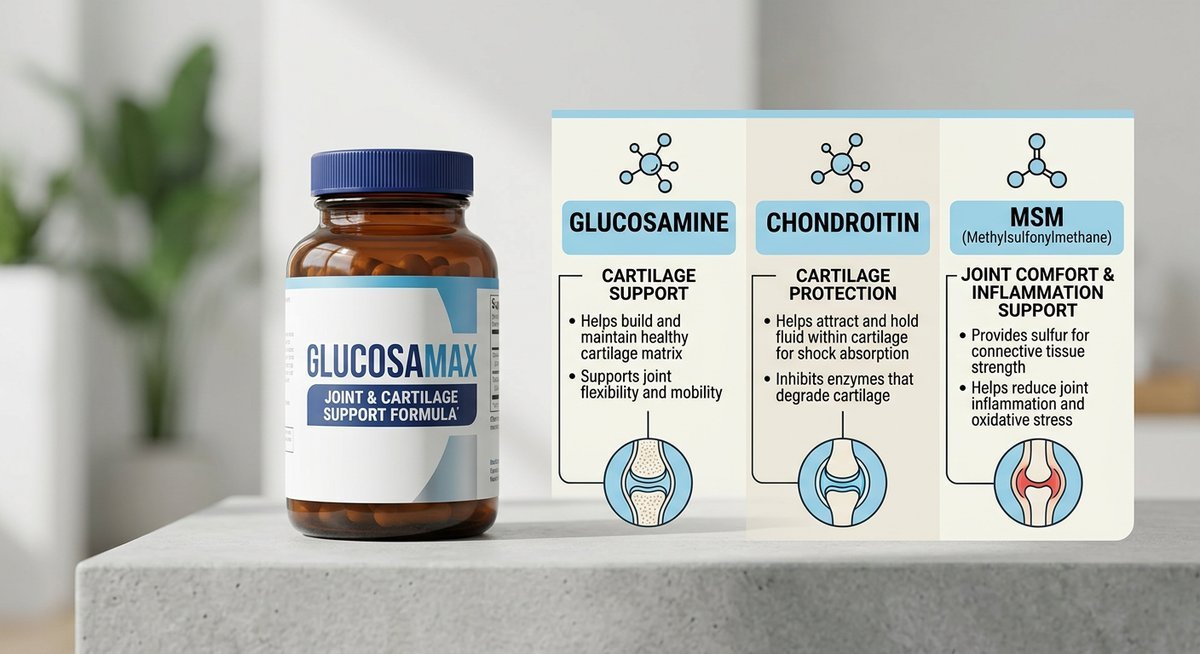
Glucosamax is a joint health supplement manufactured by Life’s Fortune, built around three clinically studied compounds: glucosamine sulfate, chondroitin sulfate, and MSM (methylsulfonylmethane). Each ingredient targets a different mechanism of joint degradation, making this a combination-approach product rather than a single-compound solution.
Glucosamine Sulfate
Glucosamine sulfate is a naturally occurring compound found in the fluid surrounding your joints and in cartilage tissue itself. As the body ages, natural glucosamine production slows — supplementing it supports synovial fluid production, the lubricating liquid that cushions bone-on-bone contact during movement.
The form matters significantly. Glucosamine sulfate has a stronger clinical track record than glucosamine hydrochloride (HCl). The sulfate form provides an additional sulfur group that plays a direct role in cartilage matrix synthesis, whereas the HCl form has shown less consistent results across independent trials. Life’s Fortune’s use of the sulfate form aligns with the formulations studied in the most-cited joint health research.
Chondroitin Sulfate
Chondroitin sulfate works through a complementary but distinct pathway. Its primary mechanism involves inhibiting matrix metalloproteinases — enzymes that actively break down cartilage tissue. By blocking these degrading enzymes, chondroitin helps slow structural joint deterioration rather than simply masking discomfort.
Chondroitin also draws water into cartilage tissue, maintaining the elasticity and shock-absorbing properties that healthy joints depend on. Paired with glucosamine sulfate, the two compounds address both the building and the protection side of cartilage health simultaneously — a synergy that single-ingredient products cannot replicate.
MSM (Methylsulfonylmethane)
MSM is an organic sulfur compound with documented anti-inflammatory properties. Sulfur is a structural component of collagen and connective tissue, and MSM delivers a bioavailable form of it directly to joint structures that need repair. MSM also reduces oxidative stress in joint tissue — a contributing factor to chronic inflammation that glucosamine and chondroitin don’t directly address on their own.
Together, these three ingredients cover three distinct mechanisms. The table below summarizes how each compound functions within the Glucosamax formula.
| Ingredient | Primary Mechanism | Key Benefit | Form Used in Glucosamax |
|---|---|---|---|
| Glucosamine Sulfate | Supports synovial fluid and cartilage matrix production | Joint lubrication and cushioning | Sulfate (stronger evidence than HCl) |
| Chondroitin Sulfate | Inhibits cartilage-degrading enzymes; retains water in joint tissue | Structural cartilage protection | Sulfate form |
| MSM | Reduces inflammatory cytokines; supplies sulfur for collagen repair | Anti-inflammatory support and connective tissue repair | Methylsulfonylmethane |
What Does the Clinical Evidence Say?
The clinical evidence behind Glucosamax’s core ingredients is genuinely promising — but not without caveats. Glucosamine and chondroitin have the strongest research base, showing meaningful pain relief in moderate-to-severe osteoarthritis. MSM adds credible anti-inflammatory support. The combination formula logic is sound, though most long-term structural benefits require consistent use beyond 12 weeks.
Research on Glucosamine and Chondroitin
The most rigorous data comes from the Glucosamine/Chondroitin Arthritis Intervention Trial (GAIT), a landmark study funded by the National Institutes of Health involving 1,583 participants with knee osteoarthritis. The combination of glucosamine and chondroitin sulfate produced statistically significant pain relief in participants with moderate-to-severe knee pain, with roughly 79% of that subgroup responding positively.
The results for mild pain were mixed, however. Participants with lower baseline pain scores showed no significant advantage over placebo. That distinction is critical for honest expectations. Glucosamax is likely to deliver more noticeable results for users who already have measurable joint discomfort, not those taking it purely as a preventive measure.
MSM Study Findings
MSM has its own credible evidence base. A peer-reviewed study published in Osteoarthritis and Cartilage (Kim et al.) found that participants taking MSM experienced approximately a 25% reduction in pain scores over 12 weeks compared to baseline. The mechanism: MSM supplies bioavailable sulfur, which the body uses to synthesize collagen and reduce inflammatory cytokine activity — essentially dampening the chemical signals that trigger joint pain and swelling.
MSM’s anti-inflammatory effect works upstream. Rather than masking pain like an NSAID, it reduces the oxidative stress that accelerates cartilage breakdown in the first place. That’s a meaningful distinction for long-term joint health management.
Combination Formula Advantage
These three ingredients interact in a way that amplifies individual effects. Glucosamine supports cartilage matrix synthesis, chondroitin inhibits the enzymes that degrade that matrix, and MSM reduces the inflammatory environment that would otherwise undermine both. Each ingredient targets a different point in the joint degradation cycle.
| Ingredient | Primary Mechanism | Key Evidence | Realistic Benefit |
|---|---|---|---|
| Glucosamine Sulfate | Stimulates cartilage matrix synthesis; supports synovial fluid | GAIT Trial (NIH, 1,583 participants) | Pain relief in moderate-to-severe OA; mixed results for mild pain |
| Chondroitin Sulfate | Inhibits cartilage-degrading enzymes; retains joint moisture | GAIT Trial (combination arm) | Structural support; slows cartilage loss over time |
| MSM | Reduces inflammatory cytokines; supplies sulfur for collagen repair | Kim et al., Osteoarthritis and Cartilage | ~25% reduction in pain scores at 12 weeks |
Who Should Take Glucosamax — and Who Should Avoid It?
Glucosamax is best suited for adults over 45 with early-to-moderate joint discomfort, active individuals seeking preventive cartilage support, and post-injury recovery users. Several populations should consult a physician before use — or avoid it entirely.
Ideal Candidates
The clearest fit is adults aged 45 and older experiencing early signs of osteoarthritis — morning stiffness, aching knees after activity, or reduced range of motion that’s starting to affect daily life. These users align directly with the populations studied in clinical trials, which means the evidence is most applicable to them.
Active adults and athletes are a second strong candidate group. Runners, cyclists, and gym-goers place repetitive mechanical stress on cartilage, and the glucosamine-chondroitin-MSM combination may help maintain joint integrity before significant wear occurs. Think of it as maintenance, not just repair.
Post-injury recovery users — particularly those recovering from ligament strains or meniscus issues — may also benefit from the connective tissue support MSM and chondroitin provide. The supplement works best as a complement to physical therapy, not a replacement for it.
Who Should Exercise Caution or Avoid It
Glucosamine is derived from shellfish shells — primarily shrimp, crab, and lobster. Anyone with a documented shellfish allergy should treat this as a hard contraindication and consult an allergist before considering any glucosamine-containing supplement.
Chondroitin sulfate has demonstrated anticoagulant properties in research, meaning it may potentiate the effects of warfarin and other blood thinners. According to the National Institutes of Health Office of Dietary Supplements, individuals on anticoagulant therapy should discuss glucosamine and chondroitin use with their prescribing physician before starting supplementation.
Diabetics represent another population requiring caution. Some research suggests glucosamine may affect insulin sensitivity, though findings remain inconsistent. Monitoring blood glucose more closely during the first several weeks of use is a reasonable precaution. Pregnant and breastfeeding individuals should avoid Glucosamax due to insufficient safety data.
| Population | Recommendation | Primary Reason |
|---|---|---|
| Adults 45+ with early osteoarthritis | Strong candidate | Matches clinical trial populations; highest evidence applicability |
| Active adults / athletes | Good candidate (preventive) | Cartilage maintenance under repetitive mechanical stress |
| Post-injury recovery users | Suitable with medical guidance | Connective tissue support; complement to physical therapy |
| Shellfish allergy sufferers | Avoid | Glucosamine is shellfish-derived |
| Warfarin / blood thinner users | Consult physician first | Chondroitin may potentiate anticoagulant effect |
| Diabetics | Caution; monitor blood glucose | Possible effect on insulin sensitivity (inconsistent evidence) |
| Pregnant / breastfeeding | Avoid | Insufficient safety data |
How to Take Glucosamax: Dosage, Timing, and What to Expect
Take Glucosamax with meals, split across two doses daily, and commit to at least 8–12 weeks before evaluating results. Most users won’t feel meaningful changes before week four — and that’s normal, not a product failure.
Recommended Dosage and Timing
The standard serving aligns with clinically studied doses: 1,500 mg of glucosamine sulfate and 1,200 mg of chondroitin sulfate daily — the same amounts used in the NIH-funded GAIT trial. Splitting the dose across two meals reduces the likelihood of GI discomfort, the most commonly reported side effect with glucosamine supplementation.
Taking Glucosamax with food supports absorption. Fat-soluble components in a meal can improve uptake of the active compounds, and pairing doses with breakfast and dinner creates a consistent 10–12 hour interval that maintains steadier serum levels throughout the day.
Cycling is unnecessary. Unlike stimulant-based supplements, glucosamine and chondroitin work through gradual structural mechanisms — stopping and restarting resets the loading process. Long-term continuous use is supported by clinical study durations of up to three years without safety concerns in healthy adults.
Realistic Results Timeline
No credible joint supplement delivers overnight results. The compounds in Glucosamax work at the tissue level, which takes time. A 2016 review published in Therapeutic Advances in Musculoskeletal Disease confirmed that glucosamine and chondroitin require a minimum of 8 weeks to demonstrate statistically significant pain reduction.
| Timeframe | What’s Happening Internally | What You May Notice |
|---|---|---|
| Weeks 1–3 | Loading phase; compounds accumulating in joint tissue | Minimal to no perceptible change |
| Weeks 4–8 | Anti-inflammatory effects of MSM becoming active | Reduced morning stiffness; slight discomfort decrease |
| Weeks 8–12 | Synovial fluid support and cartilage hydration improving | More consistent mobility; less post-activity soreness |
| 12+ weeks | Structural cartilage support phase | Sustained joint comfort; benefits aligned with GAIT trial outcomes |
If you reach week 12 without any noticeable improvement, consult a healthcare provider. Non-response does occur — and in those cases, a different intervention may be more appropriate than continuing supplementation.
Is Glucosamax Worth the Cost?
Glucosamax retails for approximately $20–$25 per 120-tablet bottle, which provides a 30-day supply at the recommended 4-tablet daily dose. That works out to roughly $0.65–$0.83 per serving — competitive for a triple-ingredient joint formula of this type.
For comparison, purchasing glucosamine sulfate, chondroitin sulfate, and MSM as three separate supplements typically costs $35–$55 per month combined, even at budget prices. Glucosamax consolidates all three into a single product, which lowers cost and removes the guesswork of stacking compatible doses. That simplification matters for adherence — and adherence is what determines whether any supplement produces results.
| Factor | Glucosamax (Life’s Fortune) | Three Separate Supplements | Generic Single-Ingredient |
|---|---|---|---|
| Active Ingredients | Glucosamine + Chondroitin + MSM | Same (purchased individually) | Glucosamine only |
| Estimated Monthly Cost | ~$20–$25 | ~$35–$55 | ~$10–$15 |
| Mechanisms Targeted | 3 (structural, enzymatic, anti-inflammatory) | 3 | 1 |
| Dosing Convenience | Single product, two daily doses | Three separate bottles to manage | Simple but incomplete |
| Shellfish Allergy Risk | Yes — glucosamine is shellfish-derived | Depends on sourcing | Depends on sourcing |
The honest answer on value: if you need all three ingredients and want a streamlined routine, Glucosamax makes financial and practical sense. If you have specific needs — a vegan glucosamine source, a higher MSM dose, or third-party certification for competitive sport — building your own stack gives more flexibility. For most users, though, Glucosamax hits the right combination of completeness, dose accuracy, and cost efficiency.
Frequently Asked Questions About Glucosamax
How long does Glucosamax take to work?
Most users notice initial changes — reduced morning stiffness, slightly less post-activity soreness — between weeks 4 and 8. Full structural benefits, particularly cartilage support, require a minimum 12-week commitment. Clinical trials confirming significant pain reduction all used study periods of at least 3 months. Starting Glucosamax and stopping before the 8-week mark is the most common reason people conclude it “doesn’t work.”
Is it safe to take Glucosamax every day long-term?
Yes, for healthy adults without the contraindications listed above. Clinical research has followed participants using glucosamine and chondroitin daily for up to three years without identifying safety concerns. The most common side effects reported are mild GI discomfort — nausea, loose stools — which is typically resolved by taking the supplement with food. Anyone on warfarin, managing diabetes, or with shellfish allergies should consult a physician before starting.
Why does Glucosamax use glucosamine sulfate instead of glucosamine HCl?
The sulfate form has a significantly stronger clinical track record. The major NIH-funded GAIT trial used glucosamine sulfate exclusively. Glucosamine HCl has shown less consistent results in independent studies, partly because the HCl form lacks the additional sulfur group that may contribute to cartilage matrix synthesis. Glucosamax’s use of the sulfate form is a meaningful formulation decision, not just a labeling difference.
Can I get the same results from a glucosamine-only supplement?
Unlikely, especially for moderate-to-severe joint discomfort. Single-ingredient glucosamine addresses synovial fluid support but doesn’t block cartilage-degrading enzymes (chondroitin’s role) or reduce oxidative stress in joint tissue (MSM’s role). The GAIT trial’s most significant results came from the combination arm, not glucosamine alone. If cost is the primary concern, a triple-ingredient formula like Glucosamax is more efficient than a single-ingredient product at a lower price.
What are the most common Glucosamax side effects?
The most commonly reported side effects are gastrointestinal: mild nausea, stomach discomfort, or loose stools — particularly when taken on an empty stomach. Taking Glucosamax with a full meal largely eliminates these issues for most users. Rarer reports include mild headaches during the first week of use. Serious adverse events in clinical literature are extremely rare at standard doses, but anyone experiencing unusual symptoms should discontinue use and consult a healthcare provider.
Final Verdict
Glucosamax delivers a clinically grounded, well-formulated combination of three ingredients that have earned genuine research support for joint health. The use of glucosamine sulfate — not the weaker HCl form — demonstrates that Life’s Fortune paid attention to the clinical literature when building this formula. The ingredient doses align with GAIT trial amounts. The price is competitive for a triple-compound product.
The limitations are real but narrow. Adults with mild or purely preventive joint concerns may see modest results. Users with shellfish allergies or those on blood thinners cannot use it without medical guidance. And anyone expecting relief within a few weeks will be disappointed — this is a minimum 8-to-12-week commitment.
For adults 45 and older managing early-to-moderate joint discomfort who want one product that covers the major biological mechanisms of joint support, Glucosamax is a rational, evidence-aligned choice at a price that undercuts buying the same ingredients separately. That’s not a vague endorsement — it’s what the clinical data and the cost math both support.