




A heteronym is a word that shares its spelling with at least one other word but carries a different meaning and a completely different pronunciation — no shared sound whatsoever. The word lead is a classic example: the metal is pronounced /lɛd/, while the verb meaning “to guide” is pronounced /liːd/. Same letters on the page, two distinct words in speech.
English has hundreds of these pairs, and they cause genuine confusion — for native speakers reading aloud, for ESL learners trying to decode unfamiliar text, and for anyone who has ever stumbled over wound mid-sentence and had to backtrack. Understanding the heteronym meaning matters because mispronunciation here isn’t just an accent issue; it changes what the word actually is.
The term itself comes from Greek: hetero- meaning “different” and -onym meaning “name” or “word.” That etymology is a useful anchor. Unlike homophones or homonyms, heteronyms live in a specific linguistic category — one that sits inside the broader word entry family of look-alike terms — and the distinctions between them are worth knowing precisely.
What Does Heteronym Mean?
A heteronym is a word that shares identical spelling with another word but carries a completely different pronunciation and a completely different meaning — two criteria that must both be met simultaneously. The word lead is a classic case: spelled the same whether you mean the metal (/lɛd/) or the act of guiding (/liːd/), yet pronounced nothing alike.
The Core Definition
Heteronyms sit inside the broader category of homographs — words that share spelling but may or may not sound alike. The distinction matters: every heteronym is a homograph, but not every homograph is a heteronym. A homograph only qualifies as a heteronym when the pronunciation diverges along with the meaning, making heteronyms the more specific, more demanding word entry.
That two-part test — same spelling, different sound, different sense — is what separates heteronyms from lookalike terms that often get confused with them.
Where the Word “Heteronym” Comes From
The term is built from two Greek roots: hetero-, meaning “different” or “other,” and -onym, from onoma, meaning “name” or “word.” Literally, a heteronym is a “different name” — a tidy description of a word that wears one spelling but answers to two distinct phonetic identities.
According to the Oxford English Dictionary (2nd ed., 1989), the term heteronym entered formal English linguistic vocabulary during the 20th century as the study of lexical ambiguity became more systematic. Knowing the etymology is genuinely useful: the moment you recall that hetero- signals difference, the definition locks into place without memorization.
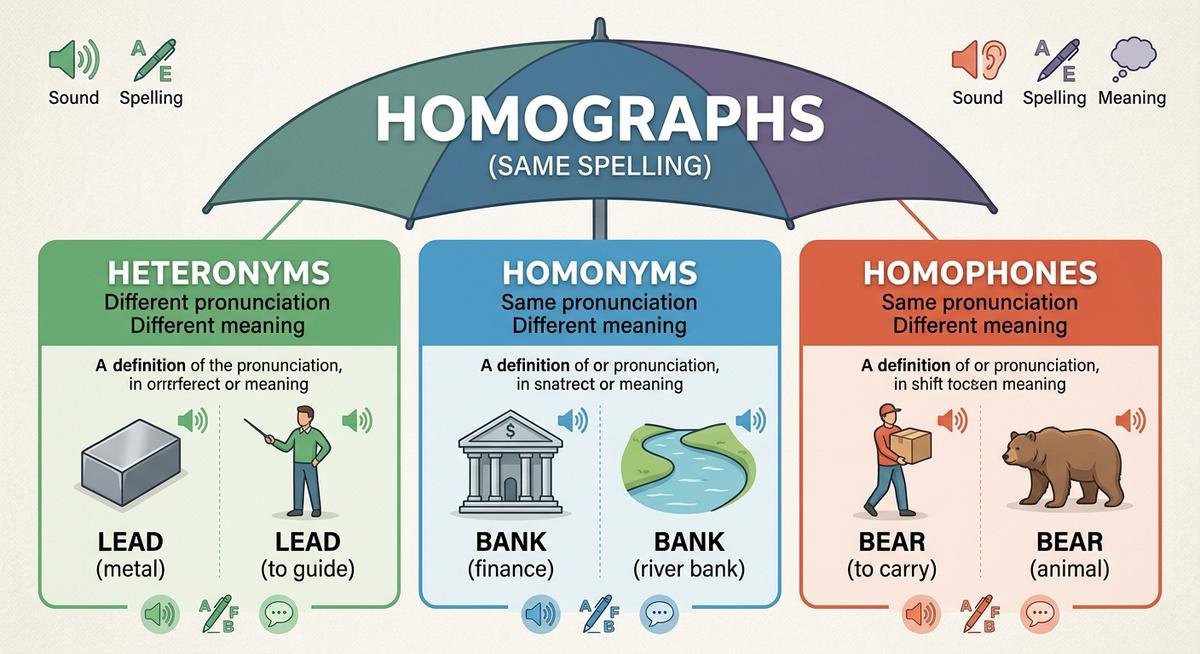
Heteronyms vs. Homonyms vs. Homophones vs. Homographs
A heteronym shares spelling with another word but differs in both pronunciation and meaning; a homonym shares spelling, pronunciation, and only differs in meaning; a homophone sounds identical but is spelled differently; and a homograph is the umbrella term for any words sharing the same spelling. These four categories are distinct — not interchangeable labels for “words that look or sound alike.”

The Key Differences Explained
A homonym shares both spelling and pronunciation with another word — only the meaning differs. Bark (the sound a dog makes) and bark (tree covering) are classic homonyms: identical on the page and out loud, completely unrelated in meaning.
A homophone sounds identical to another word but is spelled differently and means something else. There, their, and they’re are the textbook example — same spoken sound, three separate written forms and meanings.
A homograph is the umbrella category: any two words that share spelling, regardless of whether pronunciation matches. Heteronyms and homonyms both fall under this umbrella. What separates a heteronym from the broader homograph category is the pronunciation split — heteronyms always sound different.
A heteronym, then, is the most specific of the four: same spelling, different pronunciation, different meaning. Bass the freshwater fish (/bæs/) and bass the low musical tone (/beɪs/) share every letter yet sound nothing alike.
Comparison Table: Heteronym vs. Homonym vs. Homophone vs. Homograph
| Feature | Homonym | Homophone | Homograph | Heteronym |
|---|---|---|---|---|
| Definition | Same spelling and pronunciation, different meaning | Same pronunciation, different spelling and meaning | Same spelling; pronunciation and meaning may differ | Same spelling, different pronunciation and meaning |
| Same Spelling? | Yes | No | Yes | Yes |
| Same Pronunciation? | Yes | Yes | Not always | No |
| Same Meaning? | No | No | No | No |
| One Example | bark / bark | there / their | lead (metal) / lead (guide) | bass /bæs/ vs. /beɪs/ |
English contains several hundred documented heteronym pairs across standard dictionaries, making them far more common than most learners realize. Homographs as a whole — the umbrella category — number in the thousands, but heteronyms occupy the most confusing subset because the pronunciation shift is invisible on the page.
Why Do Heteronyms Exist in English?
Heteronyms exist primarily because English spelling was frozen in place before pronunciation finished evolving — locking identical letter sequences onto words that had already begun to sound different across word classes, dialects, and borrowed language systems. Three distinct forces drove this divergence: systematic stress-shifting between grammatical roles, centuries of Latin and French borrowing, and the standardization of spelling conventions that outpaced spoken change.
Stress-Shift Patterns in Noun–Verb Pairs
English has a remarkably consistent rule for two-syllable stress-shift words: when the same spelling functions as a noun, stress lands on the first syllable; as a verb, it moves to the second. PER-mit (noun) becomes per-MIT (verb). RE-cord becomes re-CORD. According to Merriam-Webster’s Dictionary of English Usage, linguists have catalogued over 170 such noun-verb pairs in standard American English, making this one of the most productive heteronym-generating patterns in the language. Learners who internalize this single rule unlock a large portion of common heteronyms immediately.
Latin, French, and Borrowed Vocabulary
English absorbed vocabulary from Old French and Latin across several centuries, and Old French and Latin carried phonological rules that didn’t always align with native Germanic patterns. The word wound illustrates this collision neatly: the noun meaning “an injury” descends from Old English wund and is pronounced /wuːnd/, while the past tense of wind — also spelled wound — follows a different vowel shift entirely, producing /waʊnd/. Two histories, one spelling.
Morphological Derivation and Spelling Conventions
English spelling was largely standardized during the 15th and 16th centuries, well before pronunciation had settled uniformly across dialects or word classes. According to David Crystal’s The Stories of English (2004), printers and early lexicographers fixed spellings to reflect etymology rather than contemporary speech, which meant words that had already diverged in sound — through derivation, regional variation, or grammatical function — were permanently assigned identical written forms. The result is a writing system that preserves history at the cost of phonetic consistency.
15 Common Heteronym Examples (With Pronunciations and Sentences)
Fifteen of the most frequently confused heteronym pairs are listed below with IPA transcription, part of speech, and dual example sentences. These pairs account for the majority of pronunciation errors among ESL learners and native speakers — and each one is resolvable from sentence context alone.
How to Read the Table
IPA (International Phonetic Alphabet) uses the symbol ˈ before the stressed syllable — so /ˈpɹɛzənt/ means stress falls on PRE, while /pɹɪˈzɛnt/ means stress falls on ZENT. If IPA looks unfamiliar, ignore it entirely and let the example sentences carry the meaning — context alone will tell you which pronunciation fits.
Heteronym Examples Table
| Word | Pronunciation 1 | Meaning 1 + Example Sentence | Pronunciation 2 | Meaning 2 + Example Sentence |
|---|---|---|---|---|
| read | /riːd/ (verb, present) | To interpret written text — I read every morning before work. | /rɛd/ (verb, past) | Past tense of read — She read the letter twice yesterday. |
| lead | /liːd/ (verb/noun) | To guide or be in front — She will lead the team this quarter. | /lɛd/ (noun) | The heavy grey metal — Old pipes were often made of lead. |
| wound | /wuːnd/ (noun/verb) | An injury to the body — The wound required three stitches. | /waʊnd/ (verb, past) | Past tense of wind — He wound the clock before bed. |
| bass | /bæs/ (noun) | Low-frequency sound or voice — Turn up the bass on that speaker. | /beɪs/ (noun) | A type of freshwater fish — He caught a bass near the dock. |
| close | /kloʊz/ (verb) | To shut — Please close the door behind you. | /kloʊs/ (adjective) | Near in distance — The station is close to the hotel. |
| live | /lɪv/ (verb) | To be alive or reside — They live in a small coastal town. | /laɪv/ (adjective) | Happening in real time — The concert was broadcast live. |
| row | /roʊ/ (noun/verb) | A line of things, or to paddle — We row across the lake each Sunday. | /raʊ/ (noun) | A noisy argument (British English) — The neighbors had a terrible row last night. |
| tear | /tɪər/ (noun) | A drop of liquid from the eye — A single tear ran down her cheek. | /tɛər/ (verb) | To rip or pull apart — Don’t tear the page out of the book. |
| bow | /boʊ/ (noun) | A weapon for arrows, or a ribbon knot — She tied a bow on the gift box. | /baʊ/ (verb/noun) | To bend at the waist in respect — The actor took a bow after the final scene. |
| desert | /ˈdɛzərt/ (noun) | A dry, arid landscape — The Sahara is the world’s largest hot desert. | /dɪˈzɜːrt/ (verb) | To abandon — He would never desert his teammates under pressure. |
| present | /ˈpɹɛzənt/ (noun/adjective) | A gift, or being here now — All staff must be present at the meeting. | /pɹɪˈzɛnt/ (verb) | To formally show or introduce — She will present her findings on Friday. |
| minute | /ˈmɪnɪt/ (noun) | Sixty seconds — The train leaves in one minute. | /maɪˈnjuːt/ (adjective) | Extremely small or precise — The surgeon made minute incisions. |
| object | /ˈɒbdʒɪkt/ (noun) | A physical thing — A small metal object was found on the floor. | /əbˈdʒɛkt/ (verb) | To express disagreement — The lawyer moved to object to the question. |
| refuse | /ˈrɛfjuːs/ (noun) | Waste or garbage — Refuse collection happens every Tuesday morning. | /rɪˈfjuːz/ (verb) | To decline or say no — She refused to sign the contract. |
| produce | /ˈproʊdjuːs/ (noun) | Fresh fruit and vegetables — The market sells local produce every weekend. | /prəˈdjuːs/ (verb) | To make or create — The factory can produce 500 units per hour. |
Notice the pattern running through roughly two-thirds of these pairs: nouns carry stress on the first syllable, verbs shift it to the second. That single rule — stress first for nouns, stress second for verbs — unlocks present, object, refuse, produce, and desert in one move. Linguists call this the noun–verb stress-shift pattern, and according to Merriam-Webster’s Dictionary of English Usage, the pattern applies to more than 170 two-syllable pairs in standard American and British English.
Heteronym Meaning for Specific Words: Axes, Coordinate, and Does
Three words — axes, coordinate, and does — appear constantly in searches about heteronym meaning because each one catches readers off guard. All three follow predictable patterns once the grammatical role is identified.
Axes
The word axes is a heteronym with two completely separate origins. Pronounced /ˈæksɪz/, it is the plural of axe — the cutting tool. Pronounced /ˈæksiːz/, it is the plural of axis — a reference line in mathematics or geography. The heteronym definition of axes depends entirely on subject matter: a geometry textbook means /ˈæksiːz/; a hardware catalog means /ˈæksɪz/. According to the Oxford English Dictionary (2nd ed., 1989), the mathematical sense entered English from Latin axis in the 16th century, while the tool sense traces directly to Old English æx.
Coordinate
As a noun or adjective, coordinate is pronounced /koʊˈɔːrdɪnət/ — a point on a graph, or something of equal rank. As a verb, it shifts to /koʊˈɔːrdɪneɪt/ — to organize or arrange. The difference is subtle but real: the final syllable changes from a reduced schwa-like vowel (/nət/) to a full diphthong (/neɪt/). This follows the broader English pattern where verb forms tend to carry fuller vowel sounds in their final syllables.
Does
Pronounced /dʌz/, does is the third-person singular present of do — “She does the work.” Pronounced /doʊz/, it becomes the plural of doe — a female deer. Most English speakers never encounter the second pronunciation in daily conversation, which is why it surprises people when they read “a herd of does” aloud for the first time.
Semi-Heteronyms and Heteronyms in Literature
The term “heteronym” extends beyond pure linguistics into literary theory, where it carries an entirely different meaning — and a related but distinct concept, the semi-heteronym, occupies the space between full heteronyms and simple homographs.
What Is a Semi-Heteronym?
A semi-heteronym is a pair of words that share identical spelling and have different meanings, but whose pronunciations differ only partially rather than completely. The word project qualifies: as a noun (/ˈprɒdʒɛkt/), stress falls on the first syllable; as a verb (/prəˈdʒɛkt/), stress shifts to the second — but the consonant sequence and overall vowel structure remain recognizably similar. Full heteronyms like lead (/liːd/ vs. /lɛd/) differ so drastically in pronunciation that no acoustic overlap exists. Semi-heteronyms sit in between, sharing partial phonetic identity. According to the Cambridge English Dictionary, the distinction is not always sharply drawn in everyday usage, but linguists find it useful for classifying stress-shift pairs separately from vowel-change pairs.
Heteronym in Literary Criticism
In literary studies, a heteronym refers to a fictional persona created by a writer — not just a pen name, but a fully developed alternate identity with its own biography, writing style, and philosophical worldview. The Portuguese poet Fernando Pessoa (1888-1935) is the defining figure here. Pessoa created over 70 heteronyms, including Alberto Caeiro, Ricardo Reis, and Alvaro de Campos, each writing in recognizably distinct voices. The Cambridge English Dictionary lists this literary sense alongside the linguistic one, noting that Pessoa’s heteronyms were “imaginary characters created by a writer in order to write in a different style.” This double meaning of heteronym — linguistic and literary — is itself a minor irony: the word that describes words with multiple meanings has multiple meanings.
Frequently Asked Questions
What is the difference between a heteronym and a homonym?
A heteronym and a homonym share the same spelling, but a homonym is also pronounced identically — only the meaning differs. A heteronym diverges in both pronunciation and meaning. The word bark (tree covering) and bark (a dog’s sound) are homonyms; wound (/wuːnd/, an injury) and wound (/waʊnd/, past tense of “wind”) are heteronyms.
What is the difference between a heteronym and a homophone?
Homophones sound identical but are spelled differently — there and their being the classic example. Heteronyms are the structural opposite: spelled identically, pronounced differently. The two concepts essentially mirror each other across the spelling-pronunciation axis.
Why do heteronyms have the same spelling but different pronunciations?
English spelling was largely standardized in the 15th and 16th centuries, before pronunciation had fully settled across dialects and word classes. Words borrowed from Latin, Old French, and Old English sometimes converged on identical spellings while retaining distinct phonological histories. The noun–verb stress-shift pattern — where the same word stresses the first syllable as a noun and the second as a verb — accounts for a significant subset of modern heteronyms.
What are 10 examples of heteronyms in English?
Ten well-documented heteronym pairs are: read (/riːd/ present, /rɛd/ past), lead (metal vs. to guide), wound, bass, close, live, tear, bow, desert, and present. Each pair carries a distinct meaning tied directly to its pronunciation — context within the sentence is the fastest disambiguation tool.
What is the origin of the word “heteronym”?
The term derives from two Greek roots: hetero-, meaning “different,” and -onym, meaning “name” or “word.” The compound entered English linguistic vocabulary as part of the broader Greek-derived naming system that also produced homonym, synonym, and antonym. Knowing the Greek roots makes the entire word-relationship family easier to remember as a single coherent system.
What is the heteronym meaning in Hindi?
In Hindi, a heteronym is called समनाम भिन्नार्थक शब्द (samnaam bhinnarthak shabd), which translates literally to “same-name different-meaning word.” The concept maps directly: words with identical spelling but different pronunciations and meanings. Hindi itself contains analogous phenomena in Devanagari script, though they are less commonly discussed in Hindi grammar textbooks than in English linguistics.
What is the heteronym meaning in Bengali?
In Bengali, a heteronym is described as সমবানান ভিন্নার্থক শব্দ (shomobanan bhinnarthok shobdo), meaning “same-spelling different-meaning word.” Bengali, like English, has words where identical written forms carry different pronunciations depending on context, though the phenomenon is studied primarily through English-language linguistics rather than Bengali grammar specifically.
What is the heteronym meaning in Urdu?
In Urdu, a heteronym is typically rendered as ہم ہجا مختلف المعنی (hum-hija mukhtalif-ul-maani), meaning “same-spelling, different-meaning.” Because Urdu uses a modified Perso-Arabic script where short vowels are often omitted, the language has its own version of spelling ambiguity — though the mechanism differs from English heteronyms, the underlying concept of one written form mapping to multiple spoken words is familiar to Urdu speakers.
Can a word be both a heteronym and a homonym?
No. The definitions are mutually exclusive. A homonym requires identical pronunciation alongside identical spelling, while a heteronym requires different pronunciation. A word spelled the same as another must fall into one category or the other — never both simultaneously. The umbrella term that captures both is homograph.
Conclusion
A heteronym is a word that shares identical spelling with another word but carries a different pronunciation and a different meaning — a precise distinction that separates it from the broader homograph family. Unlike homophones, which sound alike, or homonyms, which share both spelling and sound, heteronyms diverge the moment they leave the page and enter speech.
One rule handles the bulk of common cases: nouns stress the first syllable, verbs stress the second. RE-cord versus re-CORD. PRE-sent versus pre-SENT. Internalize that pattern and dozens of heteronym pairs stop being confusing.
For the rest — lead, tear, wound, bass — context does the heavy lifting. Read the sentence, identify the grammatical role, and the pronunciation follows. The spelling never changes. The reader does.