



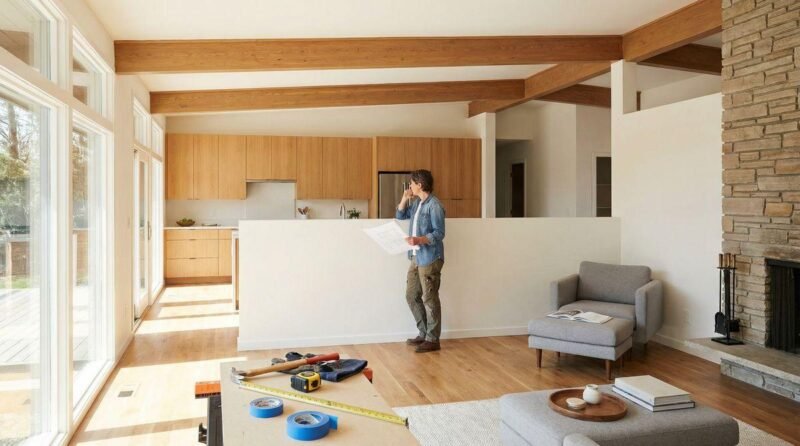
Identifying a load bearing wall in a ranch house is the critical first step before any open-concept renovation.
That classic 1960s ranch house has great bones, but the cramped, galley-style kitchen is a relic of a bygone era. You dream of knocking down the wall separating it from the living room, creating a bright, open-concept space perfect for modern living. But one crucial question stands in your way: is it a load-bearing wall?
Removing a structural wall without proper support is a catastrophic mistake. This guide will teach you how to identify a load bearing wall in a ranch house, providing specific clues unique to this architectural style. While the ultimate verdict should always come from a professional, you can make a surprisingly accurate preliminary assessment yourself. The most reliable sign is often a central wall running parallel to the front of the house, but the full story is written in the bones of your home—from the foundation to the roof.
The Anatomy of a Ranch House: Why They Are Different
Ranch homes, with their long, low-slung profiles, have a distinct structural design compared to multi-story houses. Understanding this anatomy is the first step in correctly identifying which interior walls are doing the heavy lifting. Their single-story nature means the entire roof load must be transferred to the foundation through a relatively simple, but robust, framework.
Most ranch homes built during their mid-century peak utilize prefabricated roof trusses. These engineered, web-like structures are designed to span the entire width of the house, from one exterior wall to the other. This means the roof’s weight is primarily supported by the perimeter walls, leaving many interior walls with the simple job of dividing rooms. However, if the roof is stick-built with individual rafters, a central load-bearing wall becomes essential to support the roof’s peak.
5 Foolproof Ways to Identify a Load-Bearing Wall in a Ranch House
With the unique structure of a ranch house in mind, you can now play detective. These five methods will help you gather the clues needed to make an informed assessment of any interior wall.
1. Start in the Basement or Crawlspace
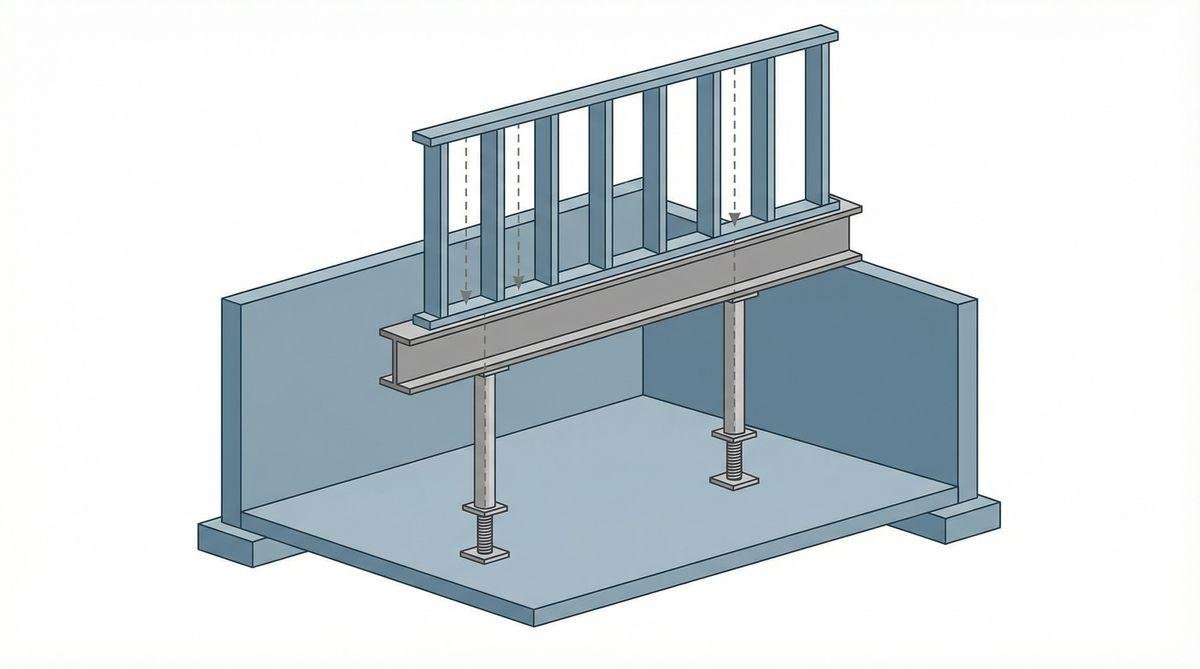 A wall sitting directly above a main steel beam and lally columns in the basement is a definitive sign of a load-bearing wall in a ranch house.
If your ranch has a basement or crawlspace, this is the most definitive place to start. Look for a main beam, often made of steel or laminated veneer lumber (LVL), that runs the length of the house, typically down the center. Any interior wall on the main floor located directly above this beam is almost certainly load-bearing. You may also see adjustable steel columns, often called lally columns, supporting this beam; these are clear indicators of major load points.
2. Check the Attic for Joist Direction
Your attic holds the second set of crucial clues. After safely getting into the attic, look at the ceiling joists, which are the horizontal framing members that make up the floor of the attic (and the ceiling of the rooms below). A fundamental rule of framing is that walls running perpendicular to joists are often load-bearing, as they help support the span of the joists.
3. Examine Wall Alignments
Loads are transferred directly downwards. Even in a single-story ranch, a wall that is continuous or aligns with support structures in the basement (like the main beam or columns) is a strong candidate for being load-bearing. This vertical alignment is a clear path for the weight of the roof and ceiling to travel to the foundation.
4. The Exterior Wall Rule
This rule is simple and universal: all exterior walls of a house are load-bearing. They support the roof and resist lateral forces like wind. This is true for a ranch house just as it is for any other style of home.
5. Consult the Original Blueprints
If you can get your hands on them, the original blueprints for your home are a treasure map. Check with your local building department or the previous owner. Look for pages marked “S” for “Structural,” which will show the home’s skeleton, including which walls were designed to carry loads. These plans will clearly indicate the direction of joists and the location of primary support beams.
The Ranch House Exception: What if You Have a Slab Foundation?
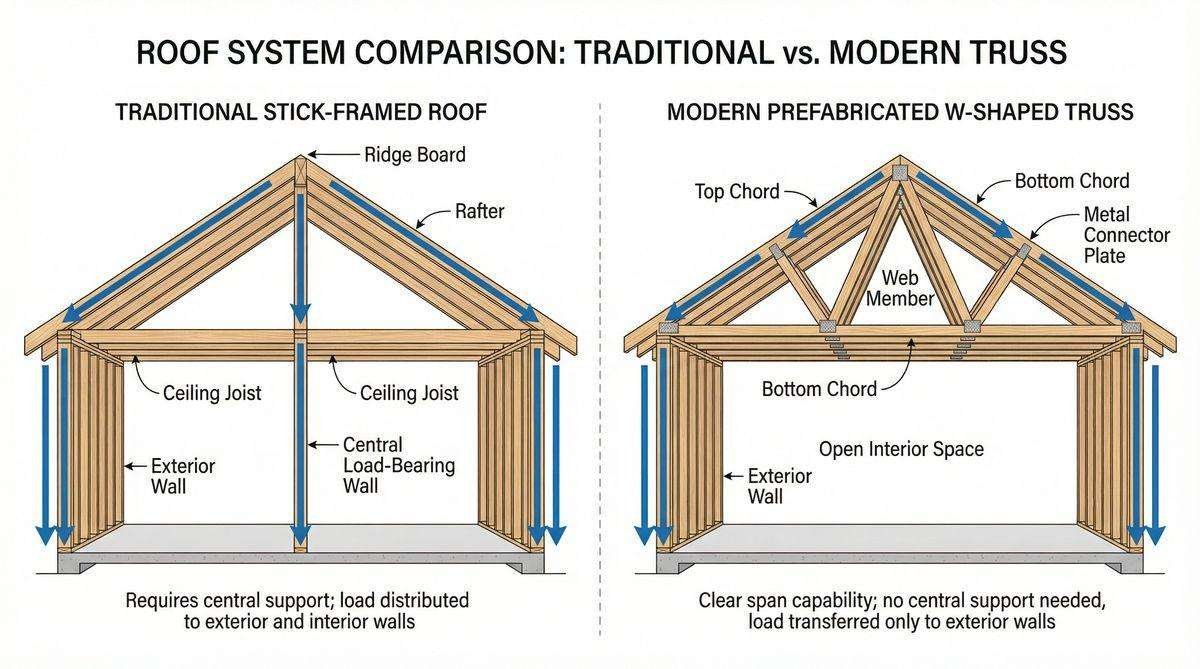 A stick-framed roof (left) requires a central load-bearing wall, while a prefabricated truss system (right) spans the full width without interior support.
A significant number of ranch homes were built on concrete slabs, leaving no basement or crawlspace to inspect. This removes one of the most reliable methods of identification, but it doesn’t leave you without clues. In this scenario, the story is told almost entirely by the roof structure.
For a slab-on-grade ranch, you must determine if the roof is built with trusses or is conventionally stick-framed. If the roof is composed of engineered trusses, most interior walls are likely not load-bearing. These trusses are designed to be self-supporting, spanning from one exterior wall to the other. However, if the roof was built with traditional rafters and ceiling joists (stick-framing), there will almost certainly be a central, load-bearing wall to support the span.
Decision Time: A Quick Checklist for Your Ranch House Wall
Use this table to consolidate your findings and make a preliminary judgment. If you have more checks in the “Load-Bearing” column, it’s time to proceed with caution and likely call a professional.
| Clue | Load-Bearing (Likely) | Non-Load-Bearing (Likely)
|
| Location | Center of the house, parallel to the front | Off-center, dividing secondary rooms |
| Basement / Crawlspace | Directly above a main beam or support columns | No support structure directly beneath it |
| Attic Joists | Wall is perpendicular to ceiling joists | Wall is parallel to ceiling joists |
| Roof Structure | Stick-framed roof with rafters | Prefabricated roof trusses |
| Foundation | Ranch on a basement or crawlspace | Ranch on a slab with trusses |
When to Call a Structural Engineer (and What to Expect)
This guide is designed to give you the confidence to make an educated guess, not to give you a license to start swinging a sledgehammer. The final word on any wall’s structural role must come from a qualified professional. If you see any red flags—sagging ceilings, or cracks appearing above doorways or where walls meet the ceiling—you should call a structural engineer immediately.
A typical consultation involves a site visit where the engineer will perform a visual inspection, take measurements, and may need to make a few small, strategic holes in the drywall to confirm the framing details. They can then provide a verbal assessment or, for a higher fee, a formal stamped letter or drawing that a contractor can use to obtain a permit and perform the work. Expect to pay between $300 and $700 for this initial assessment—a small price for peace of mind.
To find a qualified professional in your area, a great resource is the National Council of Structural Engineers Associations (NCSEA).
Frequently Asked Questions (FAQ)
Is the wall between my kitchen and living room load-bearing in a ranch house?
In many classic ranch layouts, this central wall is indeed load-bearing. It often sits directly above the main support beam of the house. It is best to assume it is structural until a professional can confirm otherwise.
What do load-bearing walls look like in a 1960s ranch house?
They are typically framed with 2×4 lumber, just like non-load-bearing walls. The key differentiator is not the wall’s thickness, but its location over a beam or foundation support and its perpendicular relationship to the ceiling joists above.
Can I remove a load-bearing wall myself?
No. This is not a DIY project. Removing a load-bearing wall requires a licensed professional to design and install a new beam and support system to properly redistribute the load. Attempting this without professional guidance can lead to catastrophic failure of your home’s structure.
Do blueprints always show load-bearing walls?
Yes, the original structural plans will accurately show which walls are load-bearing. However, be cautious if your home has undergone previous renovations, as these changes may not be reflected in the original blueprints.
How much does it cost to remove a load-bearing wall in a ranch house?
While costs vary significantly by location and the span of the new beam, you can generally expect a range from $1,200 to $3,000 for a simple opening, and it can exceed $10,000 for a long, complex span that requires significant structural work and finishing.
Conclusion
That wall standing between you and your dream open-concept ranch house holds more than just drywall and studs—it might be holding up your roof. By following the clues hidden in your home’s structure, from the main beam in your crawlspace to the direction of the joists in your attic, you can make a very educated guess about whether a wall is load-bearing. The predictable framing of a ranch house makes this process more straightforward than in other homes.
However, your investigation should always end with a call to a professional. A structural engineer provides the definitive answer, ensuring your renovation is built on a foundation of safety and confidence. Investing in their expertise is the first, and most important, step in transforming your classic ranch into a modern masterpiece.