




A heat pump is worth it for most homeowners replacing aging HVAC equipment — the typical payback period falls between 5 and 12 years, and federal tax credits under the Inflation Reduction Act now cover up to $2,000 of installation costs. That said, the strength of the financial case depends on three variables: what system you are replacing, where you live, and whether you stack state rebates on top of federal incentives.
Households swapping out a dying gas furnace and central AC simultaneously see the fastest return. Those upgrading from AC only add heating capability at modest incremental cost. New construction faces the simplest math of all — no sunk costs, no legacy equipment, just the most efficient path forward. The answer also extends beyond home HVAC: heat pump dryers, heat pump water heaters, and EV heat pumps each carry their own cost-benefit calculus.
How Heat Pumps Work and Why Efficiency Matters
A heat pump moves thermal energy from one place to another rather than burning fuel to create it, which is why it delivers 2 to 4 units of heating or cooling for every 1 unit of electricity consumed. No gas furnace, no matter how efficient, can match that ratio.
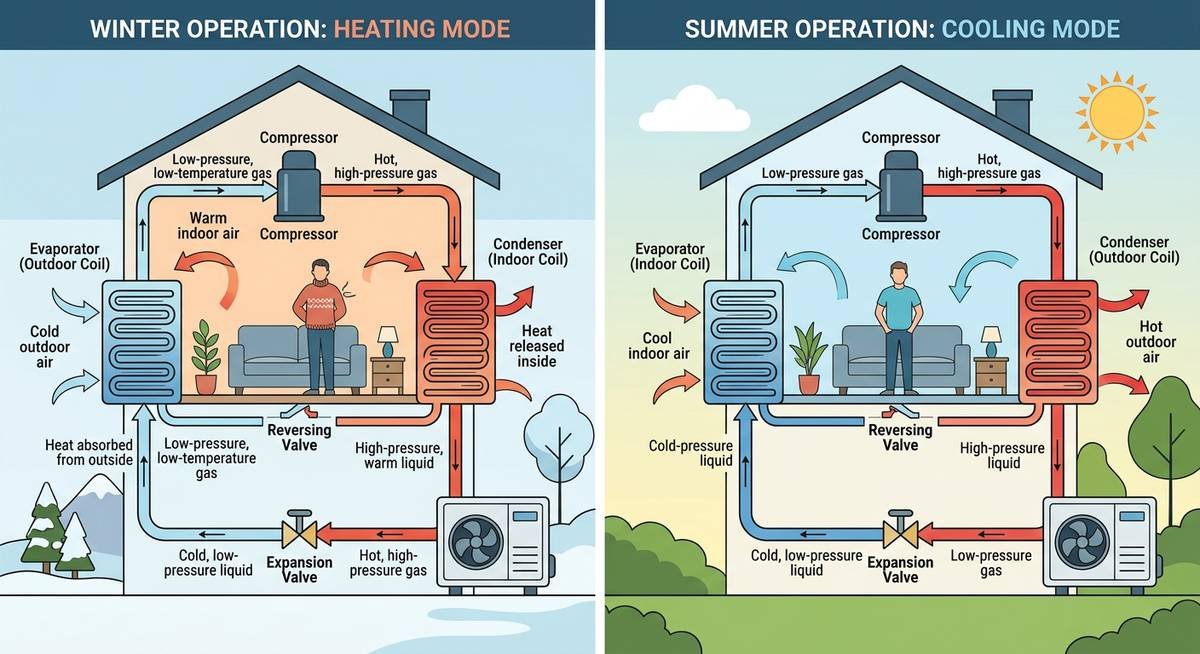
The efficiency metric is the coefficient of performance (COP) — a COP of 3.0 means the system delivers 3 kilowatt-hours of heat for every 1 kilowatt-hour of electricity drawn from the grid. According to the U.S. Department of Energy, air-source heat pumps achieve COPs between 1.5 and 4.0 depending on outdoor temperature. A high-efficiency gas furnace tops out at roughly 98% fuel-to-heat conversion — a COP equivalent of just under 1.0.
Heat pumps are reversible by design. In winter, refrigerant absorbs heat from outdoor air and releases it indoors. In summer, the cycle reverses to expel indoor heat outside. One system handles both heating and cooling — it is not just air conditioning, though it functions as highly efficient AC during warm months. A heat pump is the HVAC system: it is the furnace, the air conditioner, and the outdoor unit, all integrated into one platform that runs on electricity, not gas, oil, or propane.
Ducted, Ductless, and Geothermal Options
| System Type | Best For | Ductwork Required | Typical Installed Cost |
|---|---|---|---|
| Central Ducted Heat Pump | Homes with existing forced-air ductwork | Yes | $4,000 — $8,000 |
| Ductless Mini-Split | Older homes, additions, apartments | No | $2,000 — $7,000 |
| Geothermal (Ground-Source) | Net-zero builds, large properties | Either | $15,000 — $35,000 |
| Hydronic Heat Pump | Radiant floor heating systems | No (uses water pipes) | $8,000 — $18,000 |
Central ducted systems connect to existing forced-air ductwork and condition the whole home from a single outdoor unit. Ductless mini-splits mount individual air handlers in each room and require only a small conduit hole through an exterior wall. Geothermal heat pumps tap stable underground temperatures for even higher efficiency — a COP of 4.0 to 5.0 year-round — but the drilling cost makes them realistic mainly for new construction or homeowners committed to net-zero performance. All types qualify for the Inflation Reduction Act heat pump tax credit under the 25C provision.
Heat Pump Costs vs. Long-Term Savings
Do you really save money with a heat pump? Most homeowners recoup their investment in 5 to 12 years, with the timeline tightening substantially after federal and state incentives. A heat pump is a good investment when replacing both a furnace and central AC simultaneously, because one installation eliminates two aging systems and the energy savings compound every year.
Upfront Costs and the Consolidation Math
Replacing a gas furnace and central AC as two separate projects over time typically costs $8,000 to $14,000 combined. A single heat pump handles both jobs for $4,000 to $8,000 — or $5,000 to $10,000 for a cold-climate model engineered to maintain efficiency at temperatures as low as -13 degrees Fahrenheit. The often-overlooked insight: consolidation itself is a savings event.
Annual Energy Savings by Scenario
| Replacement Scenario | Estimated Annual Savings | Key Variable |
|---|---|---|
| Gas furnace only to heat pump | $300 — $700/year | Natural gas price; widens as gas rises |
| Central AC only to heat pump | $150 — $400/year | Cooling load and climate zone |
| Gas furnace + AC to heat pump (both) | $500 — $900/year | Combined heating + cooling efficiency gain |
| Electric resistance to heat pump | $800 — $1,200/year | Resistance heating operates at COP 1.0 |
According to the U.S. Department of Energy, heat pumps can reduce electricity use for heating by approximately 50% compared to electric resistance systems. Savings over gas depend on local fuel prices — a trend that has been volatile since 2021. A cold-climate heat pump with a COP of 2.5 at 17 degrees Fahrenheit outperforms even a high-efficiency gas furnace on a cost-per-BTU basis in most markets.
Federal Tax Credits and Rebates
| Incentive | Maximum Value | Who Qualifies |
|---|---|---|
| IRA 25C Federal Tax Credit | $2,000/year (30% of cost) | Most homeowners |
| HEEHRA/IRA Rebate | Up to $8,000 | Households earning up to 150% of area median income |
| State + utility rebates | $200 — $3,000+ | Varies by state and utility |
The Inflation Reduction Act 25C tax credit is dollar-for-dollar, not a deduction. A $7,000 installation after a $2,000 federal credit and a $1,000 state rebate has a net cost of $4,000. At $600 per year in savings, payback lands at roughly 6.7 years — with 8 to 13 additional years of savings-only operation before the system needs replacement. The Database of State Incentives for Renewables and Efficiency (DSIRE) lists current rebates by ZIP code. Heat pumps also qualify as energy-efficient improvements under IRS guidelines, though classification as qualified improvement property depends on the specific building and tax situation.
Heat Pump vs. Furnace, AC, Gas, and Boiler
A heat pump outperforms a gas furnace on operating efficiency in most climates, delivers the same cooling as a standalone AC unit, and eliminates the combustion-related safety risks of gas and oil systems. The comparison shifts in each matchup.
| Comparison | Heat Pump Advantage | Alternative Advantage | Verdict |
|---|---|---|---|
| Heat pump vs. gas furnace | 2-4x efficiency (COP), no combustion risk, dual heating/cooling | Lower upfront cost, proven in extreme cold | Heat pump wins on lifetime cost in most zones |
| Heat pump vs. air conditioner | Adds heating capability at minimal extra cost | Slightly lower purchase price for cooling-only | Heat pump is better value — heats and cools |
| Heat pump vs. boiler | No radiator infrastructure needed, cooling included | Radiant heat comfort, works with existing radiators | Heat pump wins for new installs; boiler wins if radiators already exist |
| Heat pump vs. electric resistance | 2-4x more efficient, dramatically lower bills | Lowest upfront cost | Heat pump wins overwhelmingly on operating cost |
The gas-versus-heat-pump question often comes down to local energy prices. According to the U.S. Energy Information Administration (EIA), natural gas prices have risen approximately 25% since 2020 in most residential markets, steadily closing the operating-cost gap that once favored gas. In regions where electricity is relatively cheap — the Pacific Northwest, parts of the Southeast — heat pumps already cost less to run than gas furnaces. It does cost slightly more to heat than to cool with a heat pump in cold climates, because COP drops as outdoor temperature falls, but modern cold-climate models keep that gap narrow.
Heat Pumps in Cold Climates and by Region
Cold-climate heat pumps now operate efficiently down to -13 degrees Fahrenheit, which means geography is rarely the dealbreaker it was a decade ago. According to the Northeast Energy Efficiency Partnerships (NEEP), cold-climate models from Mitsubishi, Bosch, and Daikin maintain a COP above 1.5 even at 0 degrees Fahrenheit.
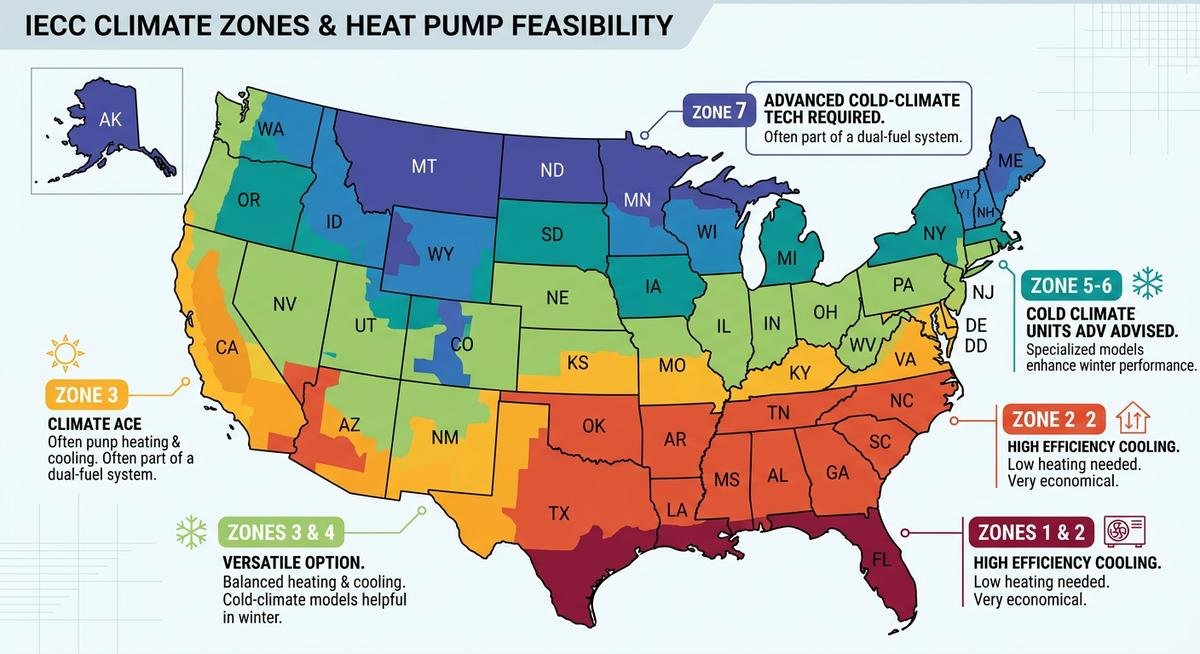
| Region / Climate | Heat Pump Worth It? | Key Consideration |
|---|---|---|
| Cold climates (Minnesota, Ontario, Alberta, Massachusetts, Scotland) | Yes, with cold-climate model | Pair with backup resistance strip; payback 7-12 years |
| Mixed climates (Ohio, UK, Ireland, Pacific Northwest) | Strong yes — the sweet spot | Standard models work well; shortest payback periods |
| Hot climates (Florida, California, Australia) | Yes — primarily for efficient cooling | ROI driven by cooling savings; mini-splits popular |
| Canada (Ontario, Alberta, cold provinces) | Yes, with provincial rebates | Canada Greener Homes Grant adds to federal incentives |
| UK and Ireland | Yes, with Boiler Upgrade Scheme | Up to 7,500 GBP grant; air source heat pumps dominate |
In the UK, the Boiler Upgrade Scheme provides up to 7,500 GBP toward air source heat pump installation, making the switch from a gas boiler financially viable for most homeowners. Air source heat pumps are worth it in the UK particularly for households still running older non-condensing boilers, where efficiency gains are largest. Heat pumps are worth it in Ontario and across Canada especially with stacking provincial and federal rebates that can cover 40-60% of installation costs.
For homeowners without solar panels, a heat pump is still worth it — solar pairing improves the economics but is not required for a positive ROI. The heat pump runs on grid electricity regardless, and the efficiency advantage over gas holds whether the electricity comes from solar, wind, or the local utility.
Reliability, Noise, and Lifespan
A heat pump is good — and reliable. Modern units last 15 to 20 years with routine maintenance, comparable to a gas furnace and longer than most central AC units that top out around 12 to 15 years. Annual maintenance runs $100 to $200 for filter changes, coil cleaning, and refrigerant checks.
Noise is one of the most common concerns, and modern inverter-driven heat pumps have largely resolved it. Current outdoor units operate at 50 to 60 decibels — roughly the volume of a normal conversation. Indoor air handlers run even quieter, typically 25 to 40 decibels. An inverter heat pump is worth considering specifically for noise-sensitive situations, as inverter compressors ramp up and down gradually rather than cycling on and off at full blast. Leaving a heat pump running continuously at low speed is generally more efficient and quieter than cycling it on and off.
Heat Pump Dryers: Worth the Premium?
A heat pump dryer is worth it for most households — it uses 40 to 50% less energy than a conventional vented dryer and requires no external vent, which means it can be installed in apartments, closets, or any room with a standard electrical outlet.
| Feature | Heat Pump Dryer | Condenser Dryer | Vented Dryer |
|---|---|---|---|
| Energy use per cycle | ~1.5 kWh | ~3.0 kWh | ~3.5 kWh |
| Venting required | No (ventless) | No | Yes |
| Drying temperature | Lower — gentler on fabrics | Higher | Highest |
| Typical price | $800 — $1,400 | $500 — $900 | $400 — $800 |
| Annual energy cost | ~$30 — $50 | ~$60 — $90 | ~$70 — $100 |
A heat pump dryer is better than a condenser dryer on energy efficiency and fabric care. Both are ventless, but the heat pump version recycles warm air through a closed loop rather than exhausting it, cutting energy consumption roughly in half. A heat pump tumble dryer is the best option for households prioritizing long-term savings and garment longevity, though drying cycles run 15 to 30 minutes longer than vented models. The premium pays for itself in 2 to 4 years through lower electricity bills — faster in regions with high energy rates.
Heat Pump Water Heaters and EV Heat Pumps
Heat pump water heaters use the same heat-transfer principle as HVAC systems, pulling warmth from surrounding air to heat water at 2 to 3 times the efficiency of a conventional electric tank. They run on electricity, not gas, and qualify for the same IRA tax credits.
A heat pump water heater is not tankless — it uses a storage tank, typically 50 to 80 gallons, with an integrated heat pump compressor on top. Installation costs run $1,500 to $3,500 including the unit, and annual operating costs are roughly $100 to $150 less than a standard electric water heater. The hot water system is fully electric and produces no combustion byproducts.
EV Heat Pumps: Worth the Upgrade?
In electric vehicles, a heat pump cabin heater is worth it because it significantly extends winter driving range. Resistive cabin heaters in EVs draw directly from the battery, reducing range by 20 to 40% in cold weather. An EV heat pump reduces that penalty to roughly 10 to 15% by moving heat rather than generating it. Tesla, Hyundai, BMW, and most newer EVs include heat pumps as standard or optional equipment. EV heat pumps are worth it in the UK and other cold-weather markets where winter range anxiety is a primary concern — the efficiency gain translates directly to fewer charging stops.
Frequently Asked Questions
Is a heat pump electric or gas?
A heat pump runs on electricity. It does not burn natural gas, propane, or oil. Some dual-fuel systems pair a heat pump with a gas furnace as backup for extreme cold, but the heat pump itself is always electrically powered. A heat pump is not gas powered — it uses an electric compressor to move refrigerant through a heat-transfer cycle.
Is a heat pump the same as central air?
A central ducted heat pump replaces both a central AC and a furnace. It connects to the same forced-air ductwork and conditions the entire home. A heat pump is central air in the sense that it delivers whole-home cooling through ducts, but it also heats — making it a more complete system than a standalone AC unit.
Should I buy a house with a heat pump?
A home with an existing heat pump is generally a positive sign — it means the previous owner invested in an efficient HVAC system, and your heating and cooling costs will likely be lower than a comparable gas-heated home. Check the unit age, brand, and whether it is a standard or cold-climate model. A heat pump installed within the last 10 years has significant remaining lifespan.
Do heat pumps work in very cold climates?
Yes, with the right equipment. Cold-climate heat pumps from Mitsubishi, Bosch, and Daikin operate efficiently down to -13 degrees Fahrenheit and maintain a COP above 1.5 at 0 degrees Fahrenheit. Pairing with a backup electric resistance strip covers the rare extreme-cold days without sacrificing year-round efficiency.
Is a heat pump loud or noisy?
Modern heat pumps are quiet. Outdoor units operate at 50 to 60 decibels, comparable to a refrigerator. Indoor air handlers run at 25 to 40 decibels. Inverter-driven compressors are the quietest option because they adjust speed continuously rather than cycling on and off at full power.
Is a heat pump cheaper to run than gas?
In most markets, yes. A heat pump with a COP of 3.0 delivers three times more heat per dollar of electricity than a gas furnace delivers per dollar of gas. The margin depends on local electricity and gas rates — households in regions with cheap electricity and expensive gas see the largest savings. According to the U.S. Energy Information Administration, residential natural gas prices have trended upward since 2020, widening the heat pump advantage.
How long does a heat pump last?
Heat pumps typically last 15 to 20 years with annual maintenance. That is comparable to a gas furnace and longer than most central AC units, which average 12 to 15 years. Replacing both a furnace and AC with a single heat pump eliminates staggered replacement cycles and simplifies long-term HVAC planning.
Is a heat pump worth it without solar panels?
Yes. Solar panels improve the economics by reducing electricity costs, but a heat pump delivers positive ROI on grid electricity alone. The efficiency advantage over gas and electric resistance heating holds regardless of the electricity source. Adding solar later amplifies existing savings but is not a prerequisite.
Is it better to leave a heat pump on all the time?
Generally, yes. Heat pumps with inverter compressors run most efficiently at steady low speed rather than cycling on and off. Setting a consistent temperature and letting the system modulate is more energy-efficient and quieter than frequent on-off cycling. Programmable setbacks of 2 to 3 degrees are fine, but deep setbacks (dropping 10+ degrees overnight) force the system to work harder to recover, reducing efficiency.
What government rebates are available for heat pumps?
The IRA 25C tax credit covers 30% of heat pump installation costs up to $2,000 annually. The HEEHRA program offers up to $8,000 for qualifying lower-income households. State and utility rebates stack on top. In the UK, the Boiler Upgrade Scheme provides up to 7,500 GBP. In Canada, the Greener Homes Grant covers a portion of installation costs. Check DSIRE for U.S. state-level incentives or energy.gov for federal program details.
Conclusion
For most homeowners replacing aging HVAC equipment, a heat pump is worth the money. The Inflation Reduction Act covers up to $2,000 in tax credits, state rebates can push payback below five years, and operating savings compound every year for the system’s 15-to-20-year lifespan. Cold-climate models have eliminated the geographic barrier, and consolidating a furnace and AC into one unit is itself a savings event.
Beyond home HVAC, heat pump technology delivers clear value in dryers, water heaters, and electric vehicles — each with its own payback timeline but the same underlying efficiency advantage. Get three local quotes, check your utility’s rebate portal, and let the numbers close the case.