


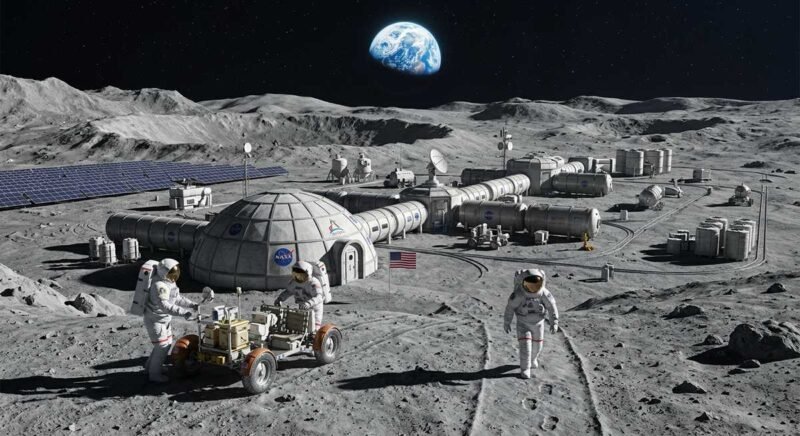
NASA committed roughly $20 billion to building a permanent crewed base near the Moon’s south pole, making it the most expensive single piece of lunar surface infrastructure ever proposed. The plan extends the Artemis program from short-stay landings into something no space agency has attempted: a continuously occupied outpost that doubles as a proving ground for Mars missions and an anchor for the emerging cislunar economy.
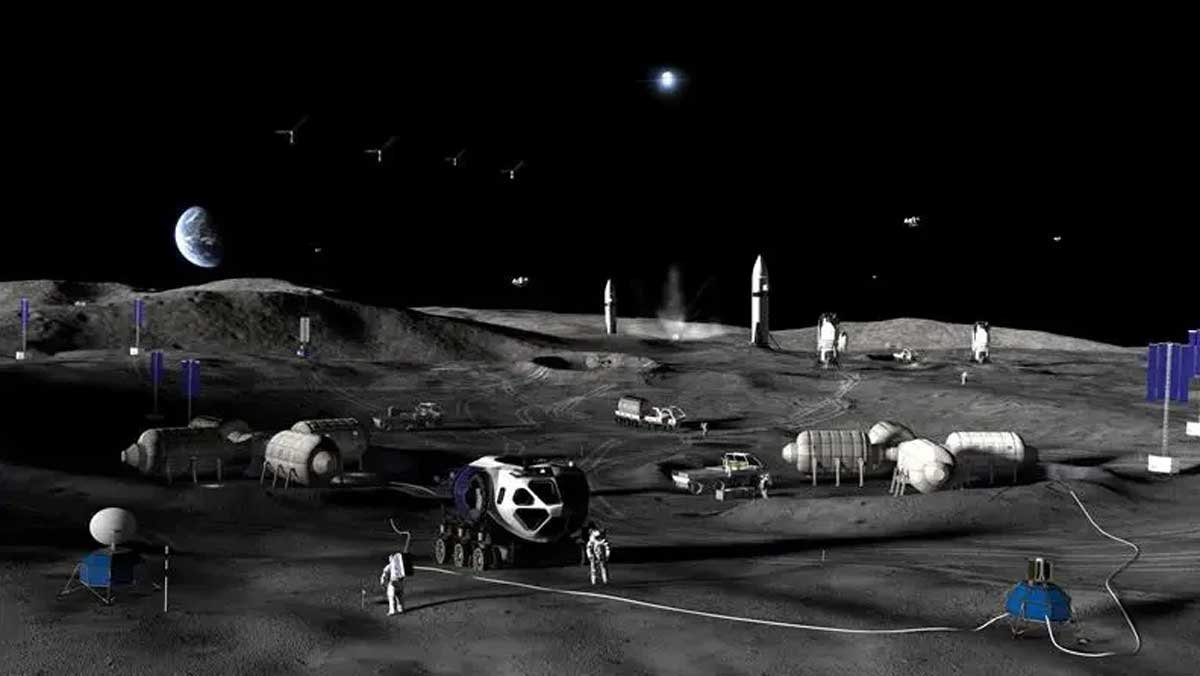
That $20 billion figure landed in a political climate where NASA’s annual budget hovers around $25 billion and congressional appetite for long-horizon space spending faces constant pressure. The number itself is almost certainly a floor. Every major NASA program in the past half-century has exceeded its initial estimate, and the Moon to Mars architecture this base sits within carries its own separate cost layers.
What follows breaks down where the money goes, how the construction phases are planned, where NASA’s budget has been trending, how the China rivalry accelerates the timeline, and why lunar rock diplomacy has become its own geopolitical subplot.
What Is NASA’s $20 Billion Moon Base?
NASA’s $20 billion moon base is a phased infrastructure program to establish a permanently crewed outpost at the lunar south pole, designed for rotating crew stays of 30 to 60 days with eventual year-round operation. The investment covers pressurized habitat modules, nuclear fission surface power, in-situ resource utilization systems, and the logistics chain needed to keep humans alive 384,000 kilometers from the nearest hospital.
The Artemis Foundation
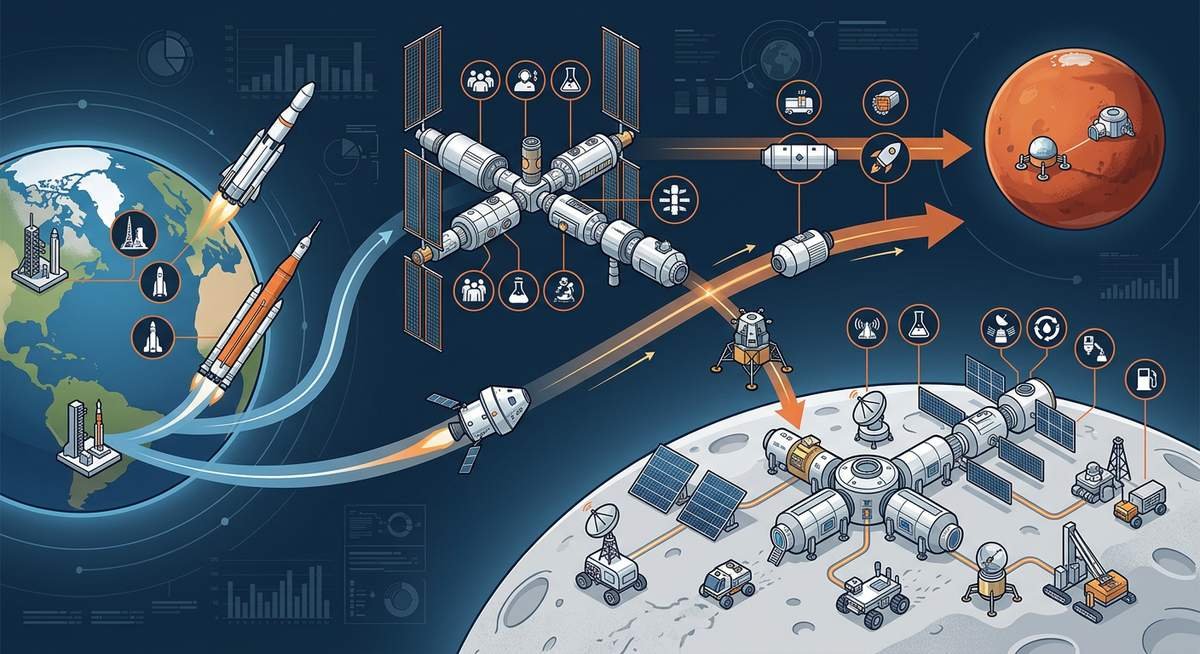
The base grows directly from the Artemis program. Artemis I completed its uncrewed test flight in 2022. Artemis II, now targeting early 2026, will carry four astronauts around the Moon. Artemis IV, planned for early 2028, represents the first crewed lunar landing since Apollo 17 in 1972. Each successive mission layers more surface assets until the outpost becomes self-sustaining between crew rotations.
Central to the architecture is the Lunar Gateway, a small space station being assembled in lunar orbit with contributions from the European Space Agency (ESA) and the Japan Aerospace Exploration Agency (JAXA). Gateway functions as a transit hub, crew shelter, and science platform. More than 60 nations have signed the Artemis Accords governing cooperation on lunar exploration.
Why the South Pole
The target site is the lunar south pole, chosen for one resource above all others: water ice. Permanently shadowed craters in this region contain confirmed deposits of frozen water, a raw material that can be split into breathable oxygen and hydrogen-oxygen rocket propellant through in-situ resource utilization (ISRU). According to NASA’s lunar surface infrastructure planning documents, ISRU capability alone could reduce resupply mass from Earth by 30 to 40 percent per mission, fundamentally altering the economics of a permanent presence on the Moon.
Where the $20 Billion Goes
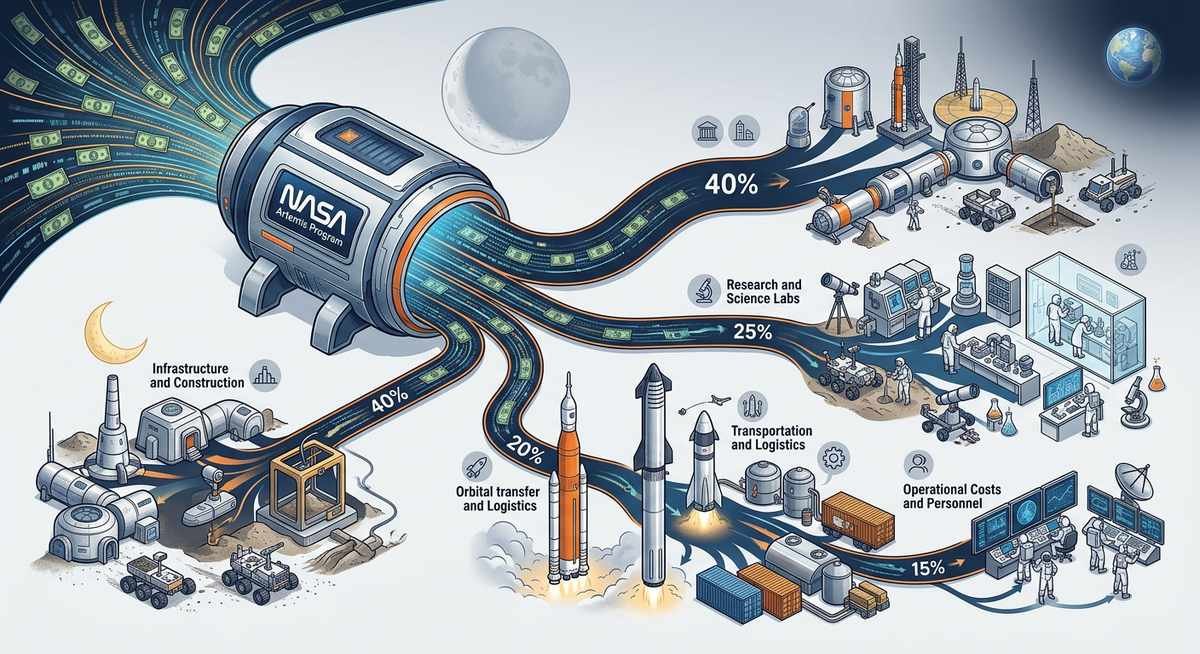
The $20 billion covers five major spending categories, with no single line item dominating because sustaining humans on the Moon is expensive at every layer. The breakdown reflects NASA’s current allocation framework for permanent lunar surface infrastructure, separate from broader Artemis launch and vehicle costs.
| Spending Category | Primary Components | Key Cost Driver |
|---|---|---|
| Surface Habitat | Pressurized modules, ISRU systems, site prep | ISRU hardware complexity |
| Power & Life Support | Fission surface power (10 kW/unit), closed-loop recycling | Nuclear system development (~$1B per unit) |
| Cislunar Communications | Relay satellites, ground station upgrades | Orbital relay procurement |
| Crew Transport | Human Landing System, Gateway station | Fixed capital per vehicle |
| Logistics & Resupply | Cargo landers, launch cadence | Per-flight costs (hundreds of millions) |
Habitat and ISRU Systems
Pressurized living quarters are the most visible budget item, but the harder engineering challenge is ISRU. NASA’s systems must extract oxygen and water from lunar regolith reliably enough to support life between resupply missions. Surface assembly costs include robotic pre-construction, landing pad grading, and radiation shielding with regolith berms, all completed before crew arrival.
Fission Surface Power
The lunar night lasts approximately 14 Earth days. Solar panels alone cannot sustain a permanent base through that darkness. NASA’s fission surface power program, the successor to the Kilopower reactor prototype, targets 10 kilowatts of continuous electrical output per unit. According to NASA’s fission surface power documentation (2023), a single deployed unit carries an estimated cost of roughly $1 billion through full deployment. A permanent outpost requires multiple units operating in parallel to reach the 40-kilowatt threshold needed for full habitat operations, closed-loop life support, and ISRU processing.
Transport and Recurring Logistics
Recurring costs are where lunar base budgets historically balloon. Each cargo delivery to the surface, whether via SpaceX’s Starship-derived lander or a competing commercial provider, runs into hundreds of millions of dollars per flight. Blue Origin secured a competing Human Landing System contract in 2023, giving NASA redundancy but also doubling development costs. The $20 billion figure is widely understood within NASA as a floor rather than a ceiling once continuous operations begin.
NASA Budget Trends and the Moon Base Math
NASA’s annual budget sits at approximately $24.9 billion as of fiscal year 2024, a figure that has held roughly steady in nominal terms but declined in purchasing power against inflation. A $20 billion infrastructure commitment spread over 15 years sounds manageable against a $25 billion annual budget, but the math gets complicated fast when competing priorities claim the same dollars.
Budget Trajectory: 2020 to 2025
The NASA budget trend over the past five years tells a story of nominal stability masking real erosion. Appropriations rose from approximately $22.6 billion in fiscal year 2020 to $24.9 billion in 2024, an increase that barely kept pace with cumulative inflation over the same period. According to The Planetary Society’s historical budget analysis, NASA’s share of federal spending has dropped from a post-Apollo average of 0.71 percent to roughly 0.35 percent in 2025.
| Fiscal Year | Approx. NASA Budget | Trend Signal |
|---|---|---|
| FY 2020 | ~$22.6 billion | Moderate increase |
| FY 2021 | ~$23.3 billion | Slight increase |
| FY 2022 | ~$24.0 billion | Steady growth |
| FY 2023 | ~$25.4 billion | Peak recent year |
| FY 2024 | ~$24.9 billion | Slight decrease |
| FY 2025 | ~$24.9 billion (est.) | Flat |
Budget Cuts Versus Budget Increases
NASA budget cuts and NASA budget increases tend to arrive in cycles driven by political administrations and congressional priorities rather than technical milestones. The Constellation program, NASA’s previous attempt at a lunar return, was cancelled in 2010 after consuming roughly $9 billion, a precedent that haunts every long-horizon NASA initiative. The James Webb Space Telescope survived multiple near-cancellations while its budget ballooned from $1 billion to $10 billion.
The 2025 budget environment presents specific headwinds. Proposed cuts to science divisions and Earth observation programs have drawn sharp criticism, and the Artemis program itself faces scrutiny from lawmakers questioning whether a $20 billion surface infrastructure commitment is sustainable alongside the Space Launch System’s per-launch costs, which the NASA Office of Inspector General estimated at over $4 billion per flight in a 2024 audit report.
Historical Cost Comparison
Context matters. The Apollo program cost approximately $280 billion in inflation-adjusted dollars across its full run. The International Space Station has absorbed more than $150 billion in total lifecycle costs shared among partner nations. NASA’s Inspector General estimated the full Artemis program at $93 billion through 2025. Against those benchmarks, $20 billion for permanent lunar surface infrastructure is not historically extraordinary, but it competes for the same constrained annual budget that must also fund science missions, Earth observation, aeronautics research, and the agency’s workforce.
Construction Timeline: Three Phases to a Permanent Outpost
NASA’s planning documents target a continuously crewed lunar outpost by the late 2030s, with construction unfolding across three phases over roughly 15 years. No single mission builds the base. The outpost accumulates through Artemis landing cadence, robotic pre-deployment, and progressive habitat assembly.
| Phase | Years | Key Milestones | Primary Infrastructure |
|---|---|---|---|
| Phase 1 | 2026-2028 | Artemis II-IV; first crewed south pole landing | Rovers, power relays, site survey |
| Phase 2 | 2028-2032 | First habitat module; fission power online | Pressurized habitat, 40 kW reactor array, robotic assembly |
| Phase 3 | 2032-2040 | Continuous crew rotation; ISRU oxygen production | Full life support, cislunar comms relay, operational base |
Phase 1: Landings and Site Preparation (2026-2028)
Artemis IV represents the linchpin, delivering the first crew to the lunar south pole aboard SpaceX’s Starship Human Landing System. Earlier missions establish the orbital architecture. Subsequent Artemis V and VI missions deploy early surface assets: unpressurized rovers, power relay nodes, and prospecting equipment that maps water-ice concentrations in permanently shadowed craters.
Phase 2: Outpost Assembly (2028-2032)
The first pressurized habitat module, incorporating contributions from ESA under the Artemis Accords framework, targets surface delivery during this window. Multiple fission surface power units, each generating 10 kilowatts, are deployed and connected in parallel to provide the sustained 40-kilowatt output a permanent outpost demands. Robotic systems run construction tasks between crewed visits: grading landing pads, positioning shielding berms, and connecting power infrastructure.
Phase 3: Operational Permanent Base (2032-2040)
NASA defines operational as a facility hosting rotating crews for 30 to 60 days without resupply gaps. Reaching that threshold requires closed-loop life support, ISRU systems producing breathable oxygen from regolith, and reliable cislunar communications. This phase also marks the transition into Mars mission preparation, where lunar operations generate crew readiness data that directly informs deep-space planning.
The NASA-China Lunar Rivalry and Moon Rock Diplomacy
China’s space program has emerged as the primary geopolitical driver behind NASA’s accelerated lunar timeline. The China National Space Administration (CNSA) and Roscosmos are jointly developing the International Lunar Research Station (ILRS), targeting the same south pole region with a robotic construction phase already underway and a crewed presence goal in the mid-2030s.
China’s ILRS Timeline
CNSA’s Chang’e program has already demonstrated capabilities that took NASA decades to develop. Chang’e 5 returned lunar samples from the near side in 2020. Chang’e 6, which landed on the far side of the Moon in June 2024, collected and returned the first-ever samples from the lunar far side, a technical achievement no other nation has matched. The ILRS roadmap calls for robotic base construction between 2028 and 2035, followed by intermittent crewed operations.
Moon Rock Diplomacy
NASA moon rock access has become a surprisingly charged diplomatic issue. U.S. law, specifically the Wolf Amendment passed in 2011, prohibits NASA from engaging in bilateral cooperation with China. This restriction means NASA scientists cannot directly access Chang’e 5 or Chang’e 6 lunar samples without a specific congressional waiver. Meanwhile, China has shared samples with researchers from over a dozen countries, building scientific relationships that the U.S. exclusion policy inadvertently strengthens for Beijing.
The dynamic creates an unusual situation: two nations racing to build permanent bases on the same stretch of lunar terrain, competing for the same water-ice resources, while a Cold War-era cooperation ban prevents their scientists from comparing notes on the rocks beneath their feet.
Why Competition Drives Funding
Geopolitical rivalry is arguably the single strongest argument for sustained congressional appropriations. The Apollo program existed because of Sputnik. The $20 billion moon base commitment exists, at least in part, because China’s lunar ambitions made inaction politically untenable. Bipartisan support for Artemis funding has held more consistently than most NASA programs precisely because the alternative, ceding the lunar south pole to a strategic competitor, carries costs that extend well beyond space policy.
Frequently Asked Questions
How much does NASA’s moon base cost?
The $20 billion figure covers infrastructure investment across habitat modules, fission surface power systems, ISRU hardware, life support, and crew transport spread over approximately 15 years. This total excludes recurring operational costs and broader Artemis program spending, which pushes the all-in figure considerably higher.
When will the moon base be finished?
NASA targets a continuously crewed, operational outpost by the late 2030s. Crewed south pole landings begin around 2028 with Artemis IV, the first habitat modules arrive between 2028 and 2032, and full crew rotation capability is projected by approximately 2040.
Why build a permanent moon base?
The lunar south pole holds confirmed water-ice deposits that provide raw material for oxygen and rocket propellant, reducing Earth-launch mass on every resupply mission. A permanent base also serves as the primary staging point for crewed Mars missions and anchors U.S. leadership in the cislunar economy against China’s competing lunar program.
How does NASA’s plan compare to China’s?
China and Russia’s International Lunar Research Station targets the same south pole region, with robotic construction planned from 2028 to 2035 and crewed operations in the mid-2030s. Both programs are racing toward the same terrain and the same water-ice resources, creating a direct rivalry not seen since the original space race.
What year was NASA established?
NASA was established on July 29, 1958, when President Eisenhower signed the National Aeronautics and Space Act into law. The agency turned 67 in 2025 and has operated continuously through Mercury, Gemini, Apollo, the Space Shuttle era, the International Space Station, and now the Artemis program.
Is the $20 billion moon base plan realistic given current budgets?
At roughly $1.3 billion per year over 15 years, the infrastructure cost fits within NASA’s approximately $25 billion annual budget on paper. The real risk is competing priorities: every dollar directed toward the moon base is a dollar unavailable for science missions, Earth observation, and other programs. NASA’s own history, including the $9 billion Constellation cancellation in 2010, demonstrates that multi-decade commitments rarely survive intact.
Conclusion
NASA’s $20 billion moon base sits at a genuine crossroads between engineering ambition and fiscal gravity. The technology exists or is in advanced development. The geopolitical pressure from China’s ILRS program makes delay politically costly. The scientific case for a south pole outpost, built around confirmed water-ice deposits and ISRU capability, is stronger than any previous lunar return argument.
The budget math is the weak link. A $25 billion annual agency budget absorbing a $20 billion infrastructure commitment while simultaneously funding SLS launches, Gateway assembly, science missions, and a workforce of 18,000 civil servants requires sustained political will across multiple administrations. The Constellation precedent looms large.
Three milestones will determine whether this base becomes reality: Artemis IV’s first crewed south pole landing around 2028, the first fission surface power deployment, and whether the Artemis budget survives the next three federal budget cycles intact. Those data points will separate a 2030s reality from a 2040s aspiration.