




On October 31, 2008, a message appeared on a cryptography mailing list from someone calling themselves Satoshi Nakamoto, attaching a nine-page paper titled “Bitcoin: A Peer-to-Peer Electronic Cash System.” Within two months, Bitcoin’s first block was mined. Within two years, Satoshi had quietly vanished. The name remains a pseudonym, the person or group behind it unknown, and the 1.1 million Bitcoin they left sitting untouched is now worth somewhere north of $100 billion.
On April 8, 2026, the New York Times published what it called its most compelling identification yet: Adam Back, a British cryptographer who invented Hashcash in 1997, the proof-of-work system that Bitcoin directly references. Back denied it the same day. Bitcoin remained decentralized and leaderless, exactly as designed.
The Bitcoin Whitepaper and What Satoshi Actually Built
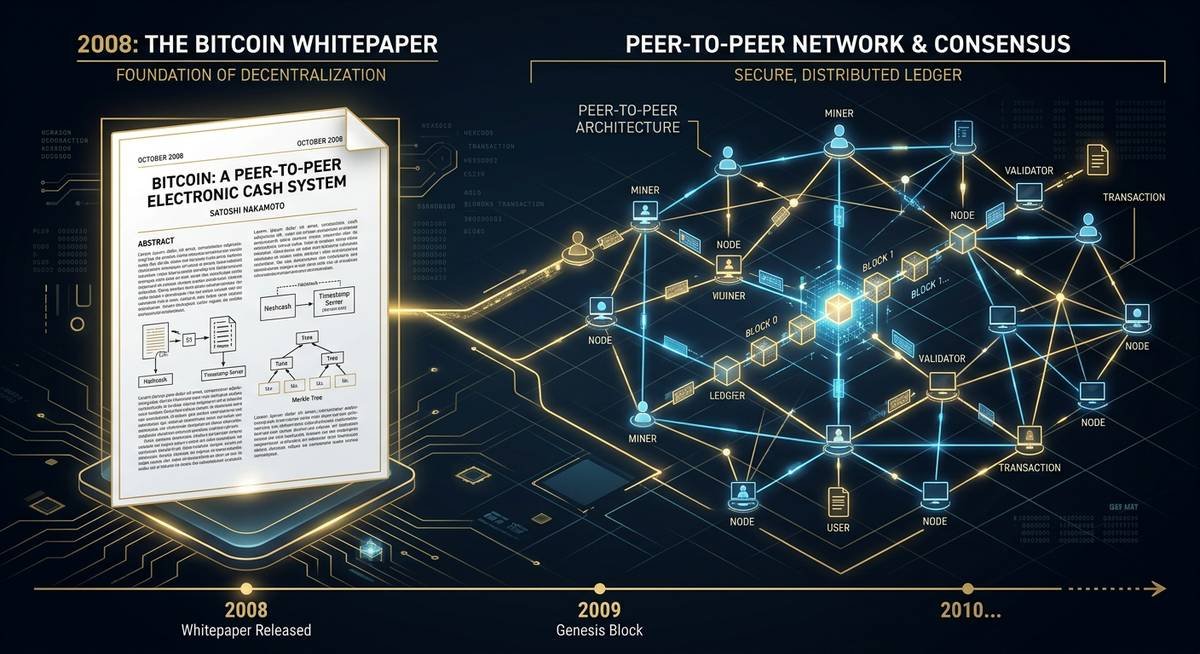
Satoshi Nakamoto published “Bitcoin: A Peer-to-Peer Electronic Cash System” on October 31, 2008, and mined the network’s first block on January 3, 2009. That genesis block contained an embedded message — “The Times 03/Jan/2009 Chancellor on brink of second bailout for banks” — a timestamp referencing a front-page headline from that day, signaling Bitcoin was born in direct response to the financial crisis. The detail is so precise it functions both as proof-of-date and as a political statement.
The core technical problem Satoshi solved had defeated cryptographers for decades: double-spending. Unlike physical cash, digital files can be copied infinitely. Any previous attempt at digital currency required a trusted central authority to verify that a coin hadn’t already been spent. Satoshi’s solution was elegant in its brutality: replace the trusted authority with mathematics, distributing the transaction ledger across thousands of independent nodes, each verifying transactions through a computationally expensive consensus mechanism called proof-of-work.
The system borrowed heavily from prior work. Adam Back’s Hashcash, published in 1997, provided the proof-of-work mechanism. Nick Szabo’s Bitgold concept, articulated in 2005, outlined a decentralized digital currency running on proof-of-work. Wei Dai’s b-money, published in 1998, proposed anonymous distributed electronic cash. Satoshi cited all of these. The genius was synthesis, taking a decade of scattered cryptographic ideas and assembling them into a working system.
Satoshi was active on the Bitcointalk forum and via email from 2008 through late 2010. The last public post on Bitcointalk came on December 12, 2010. The last known email, sent to developer Gavin Andresen, said simply that Satoshi “had moved on to other things.” Andresen had told Satoshi he was planning to give a presentation on Bitcoin to the CIA. Within days, Satoshi was gone.
That departure was not panic. It was, by most interpretations, the act of someone who understood that attaching a known identity to a decentralized network would undermine everything they had built.
Everyone Named as Satoshi Nakamoto — And What the Evidence Shows
Identifying Satoshi Nakamoto has become the internet’s most durable unsolved investigation. At least six individuals have been formally named, claimed the identity themselves, or been subjected to sustained investigative journalism. None have been confirmed. One was definitively ruled out by a court of law.
Adam Back (2026): The NY Times Claim
The strongest recent identification comes from investigative journalist John Carreyrou, whose April 8, 2026 New York Times piece compared Back’s emails and online posts directly to Satoshi’s communications, finding writing style similarities, matching technical vocabulary, and a striking timeline: Back’s forum activity declined sharply around the same period Satoshi became most active, then returned after Satoshi’s disappearance.
Back pushed back immediately on X. “I’m not satoshi, but I was early in laser focus on the positive societal implications of cryptography, online privacy and electronic cash,” he wrote. He called the evidence “a combination of coincidence and similar phrases from people with similar experience and interests” and noted that he “did a lot of yakking” on Bitcoin forums during the period Carreyrou claimed he was absent. He also joked, with some self-deprecating honesty, that he didn’t have nearly enough Bitcoin.
Back has attended Craig Wright’s fraud trials and testified against Wright’s claims. He remains a leading figure in Bitcoin development as CEO of Blockstream. Denying it has become something of a ritual for Bitcoin’s founding generation.
Craig Wright: The One Person a Court Ruled Out
Australian computer scientist Craig Wright spent years claiming to be Satoshi, producing increasingly elaborate technical “proofs” and pursuing legal actions to assert intellectual property rights over Bitcoin. In May 2024, the UK High Court ended the matter decisively. Justice James Mellor found that Wright “lied to the Court extensively and repeatedly” and was “entirely satisfied” that Wright is not Satoshi Nakamoto. The Crypto Open Patent Alliance had brought the case to stop Wright from weaponizing the Satoshi identity against Bitcoin developers. Wright was also ordered to pay $132,000 in legal costs.
Nick Szabo: The Technical Case That Hasn’t Gone Away
Among cryptographers, Nick Szabo remains the most discussed candidate. He created Bitgold in 2005, a direct predecessor to Bitcoin that shared the same proof-of-work mechanism and decentralized architecture. Linguistic analysis conducted by researchers at Aston University compared Satoshi’s writing to multiple candidates, finding Szabo’s to be closest in style and vocabulary. On Hacker News, a commenter with knowledge of the cypherpunk community summarized the consensus view bluntly: “Nick Szabo remains the best Satoshi candidate by a mile.” Szabo has consistently denied being Satoshi.
Hal Finney: The First Recipient
Hal Finney, a cryptographer and early Bitcoin contributor, received the first Bitcoin transaction ever recorded, sent directly from Satoshi. He lived near Dorian Nakamoto in California, which some researchers found either suggestive or coincidental enough to explain how a pseudonym got picked. Finney died in 2014 from ALS. His family has said repeatedly that he was not Satoshi. Emails exchanged between Finney and Satoshi, released after Finney’s death, show someone learning the system, not building it.
Dorian Nakamoto: The Wrong Man
In March 2014, Newsweek published a front-page story identifying a Japanese-American engineer named Dorian Satoshi Nakamoto as Bitcoin’s creator. The article was built on a quote from Dorian that read as confirmation but that he said was misinterpreted. The Bitcoin community raised money for a defense fund. Satoshi’s P2P Foundation account, dormant since 2011, posted a denial: “I am not Dorian Nakamoto.” Dorian Nakamoto has since said the entire episode was one of the most disruptive events of his life, transforming a quiet retirement into a media spectacle.
“Does Unmasking Satoshi Nakamoto Change Anything… Or Is It Just Crypto’s Ultimate Red Herring?”
— r/Bitcoin, August 2025 (222 upvotes)
The question in that post title captures a real debate. For some, Satoshi’s identity is irrelevant: the code is open, the rules are set, and Bitcoin operates without needing its founder. For others, knowing who built the system, and whether they still control a trillion-dollar stake in it, matters enormously. Both positions have merit, which is probably why the mystery has generated this much sustained attention.
How Much Bitcoin Does Satoshi Own, And Has Any of It Moved?
Blockchain forensics firms have identified approximately 1.1 million Bitcoin across thousands of wallets linked to the early mining patterns of Bitcoin’s first year, a period when only Satoshi and a handful of contributors were running nodes. As of February 2026, that stake was worth approximately $77.9 billion. At October 2025 peak pricing, it exceeded $134 billion, making Satoshi, if still in control, richer than Bill Gates, richer than Warren Buffett, and among the ten wealthiest individuals on earth.
None of those coins have moved. Not one transaction. Over 17 years, Bitcoin has been through bubbles, crashes, forks, regulatory crackdowns, and institutional adoption. The wallets attributed to Satoshi sat undisturbed through all of it.
The only exception is the Genesis Block wallet, which holds the 50 BTC mined in Bitcoin’s first block. Those specific coins are technically unspendable due to how the Genesis Block was coded. The community has sent thousands of additional Bitcoin to that address over the years, effectively burning them as a form of tribute. As of late 2024, the Genesis address held over 100 BTC from these symbolic transfers.
“Satoshi Nakamoto was John Nash (the inventor of game theory from A Beautiful Mind), it’s literally spelled out in Satoshi Nakamoto.”
— r/CryptoCurrency (422 upvotes), one of dozens of creative identity theories the community generates regularly
The theory above is wrong. But the comment’s 422 upvotes reflect something true: the mystery invites creative projection precisely because so little is actually confirmed. The community on r/CryptoCurrency, a forum focused on discussing all things cryptocurrency, has spent years generating and debating Satoshi theories. The volume of speculation is itself evidence of how deeply the question matters to people inside the ecosystem.
Why Satoshi’s Anonymity Was the Right Call
Satoshi Nakamoto built a system designed to function without trust in any person or institution. Revealing the creator’s identity would have introduced precisely the kind of central authority the entire protocol was designed to eliminate. If Satoshi had remained a public figure, every Bitcoin governance dispute would eventually become: “what does Satoshi want?” That question would have been asked in courtrooms, by regulators, and in conference keynotes for decades.
The disappearance solved the problem preemptively. With Satoshi gone, there is no one to pressure, subpoena, or co-opt. Bitcoin’s rules are encoded in software, maintained by a distributed developer community, and validated by a global network of nodes. No single person can change them unilaterally. The 21 million coin cap cannot be altered by a phone call to the founder.
According to research from the Nakamoto Institute, which archives Satoshi’s original forum posts and emails, Satoshi showed an awareness of this dynamic from early in Bitcoin’s development. In one early email, Satoshi noted concern about Bitcoin becoming a significant energy consumer, not as a problem to solve, but as an acknowledged trade-off in a trustless system. The person who wrote that understood what they were building.
62 Bitcoin-related statues, plaques, and public art installations exist worldwide as of 2026, from Budapest to El Zonte in El Salvador to Switzerland and Italy. None of them depict an actual face, because there is no face to depict. Most show abstract figures, blockchain nodes, or simply the Bitcoin symbol. The community has built a mythology around someone who never wanted one, and the absence at the center of that mythology is, in retrospect, part of the design.
Frequently Asked Questions About Satoshi Nakamoto
When did Satoshi Nakamoto publish the Bitcoin whitepaper?
Satoshi Nakamoto published “Bitcoin: A Peer-to-Peer Electronic Cash System” on October 31, 2008, sending it to a cryptography mailing list. The Bitcoin network launched when Satoshi mined the genesis block on January 3, 2009, embedding a headline from The Times newspaper in the block data.
How much Bitcoin does Satoshi Nakamoto own?
Blockchain analysis attributes approximately 1.1 million Bitcoin to Satoshi Nakamoto, held across thousands of wallets from Bitcoin’s earliest mining period. At February 2026 prices, this stake was valued at roughly $77.9 billion. None of these coins have ever been moved or spent in over 17 years.
Is Craig Wright Satoshi Nakamoto?
No. In May 2024, UK High Court Justice James Mellor ruled definitively that Craig Wright is not Satoshi Nakamoto, finding that Wright had “lied to the Court extensively and repeatedly” while attempting to claim intellectual property rights over Bitcoin. The ruling followed a case brought by the Crypto Open Patent Alliance.
Did Adam Back invent Bitcoin?
Adam Back invented Hashcash in 1997, the proof-of-work system that Bitcoin’s whitepaper directly references. The New York Times published an investigation on April 8, 2026, arguing Back was the most credible Satoshi candidate yet based on writing style and timing analysis. Back denied the claim the same day, calling it “confirmation bias.”
When did Satoshi Nakamoto disappear?
Satoshi Nakamoto’s last public forum post appeared on December 12, 2010, on Bitcointalk. The last known private email was sent to developer Gavin Andresen, shortly after Andresen mentioned he would be presenting Bitcoin to the CIA. Satoshi has not been publicly heard from since.
Is Satoshi Nakamoto one person or a group?
Nobody knows. Linguistic analysis of Satoshi’s writing has been interpreted as pointing to a single author, while the technical breadth of Bitcoin’s design has led others to argue a small team was involved. The P2P Foundation profile lists a male individual born April 5, 1975, in Japan, but this information was almost certainly fictional, chosen to create a plausible persona rather than reveal real details.
What was Satoshi Nakamoto’s last message?
Satoshi’s final email to developer Gavin Andresen stated that he had “moved on to other things.” Before that, his last Bitcointalk forum post in December 2010 addressed technical issues related to Bitcoin’s early denial-of-service vulnerabilities. The combination of timing, immediately after being told about a CIA presentation, has fueled speculation about whether Satoshi feared government attention.