



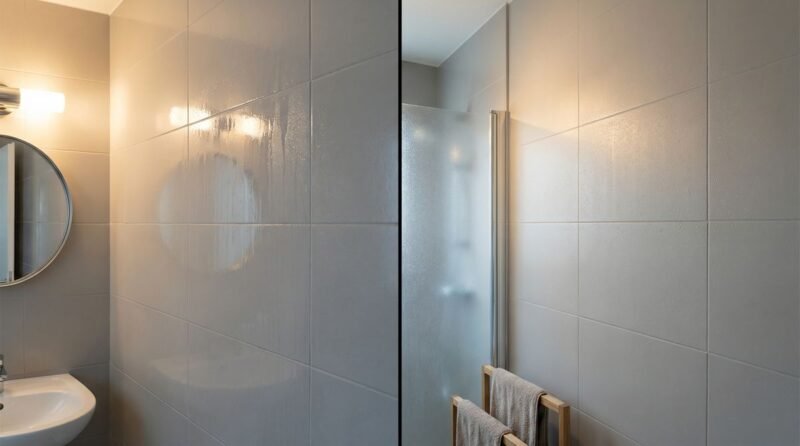
Walk into any paint store and ask which finish is best for a bathroom, and the answer will depend entirely on who is asked. Contractors often default to semi-gloss for its durability. Interior designers frequently recommend satin for its softer, more elegant appearance. Both camps have valid arguments — and the right answer depends on the specific bathroom, its moisture level, and the aesthetic goal.
This guide cuts through the debate with a direct, data-informed comparison of semi-gloss vs satin paint for bathrooms, covering moisture resistance, cleanability, light reflection, and the specific scenarios where each finish genuinely outperforms the other.
1. Understanding Sheen Levels: Where Semi-Gloss and Satin Sit
Answer Capsule: Paint sheen is measured by the percentage of light reflected (gloss units). Satin reflects approximately 35–50% of light, producing a soft, pearl-like finish. Semi-gloss reflects 50–70%, creating a noticeably shinier surface. Both are significantly more moisture-resistant than flat or eggshell finishes, making both appropriate for bathroom use.
The sheen spectrum runs from flat (0–10% reflectivity) through matte, eggshell, satin, semi-gloss, and high-gloss (70–90%). Each step up the sheen scale increases moisture resistance and cleanability while also making surface imperfections — roller marks, patches, uneven texture — more visible.
This visibility tradeoff is the central tension in the semi-gloss vs satin debate. Semi-gloss is more durable and easier to clean, but it amplifies every wall imperfection. Satin is slightly less durable but far more forgiving of imperfect walls — a significant practical advantage in older homes with textured or patched drywall.
2. Moisture Resistance: The Critical Bathroom Factor
Answer Capsule: Both semi-gloss and satin paints provide adequate moisture resistance for bathroom walls when applied correctly over a properly primed surface. Semi-gloss has a marginally harder, less porous film that resists moisture penetration slightly better — an advantage in high-humidity bathrooms with poor ventilation. In well-ventilated bathrooms, the difference is negligible.
The key variable is bathroom ventilation, not paint sheen. A bathroom with an exhaust fan that runs during and after every shower will experience far less moisture stress on the walls than one without ventilation, regardless of whether semi-gloss or satin paint is used. The International Residential Code requires exhaust ventilation in bathrooms without operable windows — a standard that, when met, largely equalizes the moisture performance of both finishes.
For shower enclosures and areas directly adjacent to the tub or shower, neither semi-gloss nor satin is the correct choice — tile, waterproof panels, or specialized bathroom paint with mildewcide additives are required for these high-splash zones.
3. Cleanability and Durability
Answer Capsule: Semi-gloss paint is easier to wipe clean and more resistant to scuffing than satin. Its harder film surface allows soap scum, toothpaste splatter, and water spots to be wiped away with minimal effort. Satin is also cleanable but requires slightly more care — abrasive cleaning pads can dull the finish over time.
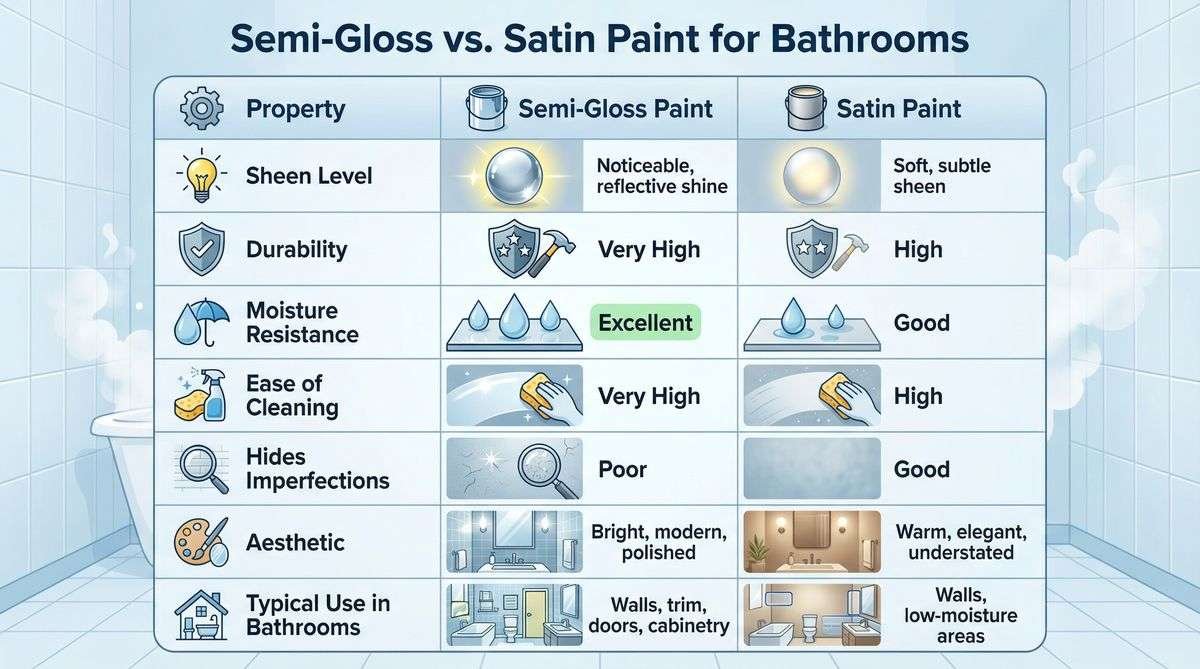
| Factor | Semi-Gloss | Satin | Winner |
|---|---|---|---|
| Moisture resistance | Excellent | Very good | Semi-gloss (slight edge) |
| Cleanability | Excellent | Good | Semi-gloss |
| Hides wall imperfections | Poor | Good | Satin |
| Aesthetic softness | Shiny, clinical | Soft, elegant | Satin |
| Light reflection | High (brightens small spaces) | Moderate | Semi-gloss (for small bathrooms) |
| Application forgiveness | Low (shows brush marks) | Higher | Satin |
4. Which Finish Is Right for Each Bathroom Type?
Answer Capsule: Semi-gloss is the better choice for small, poorly ventilated bathrooms and for trim, doors, and cabinets in any bathroom. Satin is the better choice for larger bathrooms with good ventilation, older walls with imperfections, and any bathroom where a softer, more spa-like aesthetic is the goal. Many designers use both: satin on walls, semi-gloss on trim.
The combination approach — satin walls with semi-gloss trim — is the most widely recommended solution among professional painters and interior designers. The satin walls provide a soft, refined backdrop that photographs well and feels elegant in person. The semi-gloss trim provides a crisp, clean contrast that highlights the architectural details of door frames, window casings, and baseboards while offering maximum durability in the areas most likely to be touched and scuffed.
5. Application Tips for Both Finishes
Answer Capsule: Both semi-gloss and satin require a properly primed surface for best adhesion and appearance. Use a high-quality synthetic brush for cutting in and a short-nap roller (3/8 inch) for walls. Apply two coats, allowing full drying time between coats. Semi-gloss requires more careful application to avoid visible brush marks and lap lines.
Surface preparation is more critical for semi-gloss than for satin. Every patch, nail hole, and surface irregularity will be visible under semi-gloss. Sand all patches smooth, prime them, and apply a skim coat of joint compound if the wall texture is uneven. For satin, standard patching and priming is typically sufficient.
Frequently Asked Questions
What paint finish should be used on a bathroom ceiling?
Flat or matte ceiling paint with a mildewcide additive is the standard recommendation for bathroom ceilings. Ceilings accumulate moisture from steam rising upward, but they are rarely touched or scrubbed, so the cleanability advantage of semi-gloss or satin is less relevant. A flat finish hides ceiling imperfections and reduces glare from overhead lighting.
Is a separate primer needed before painting a bathroom?
Yes, in most cases. A moisture-resistant primer creates a better bonding surface for the topcoat and adds an additional layer of moisture protection. For previously painted walls in good condition, a bonding primer applied before the first coat is sufficient. For bare drywall or heavily patched surfaces, a full coat of drywall primer is required.
Does paint finish affect mold resistance?
Paint finish alone does not prevent mold. Mold resistance comes from mildewcide additives in the paint formulation, adequate bathroom ventilation, and controlling moisture at its source. Many premium bathroom paints in both satin and semi-gloss finishes include mildewcide additives — this is a more important specification to check than sheen level when selecting bathroom paint.
Conclusion
The semi-gloss vs satin debate for bathrooms does not have a single correct answer — it has a correct answer for each specific situation. Semi-gloss wins on durability, cleanability, and moisture resistance, making it the practical choice for small, high-humidity bathrooms and all trim surfaces. Satin wins on aesthetics, forgiveness of wall imperfections, and overall elegance, making it the preferred choice for larger bathrooms and homeowners who prioritize visual quality.
The most professional approach uses both: satin on walls, semi-gloss on trim. This combination delivers the best of both finishes and is the standard practice of experienced painters for good reason.
References
- Sherwin-Williams. “Choosing the Right Paint Finish.” Paint Guide. 2025.
- Benjamin Moore. “Paint Finishes Explained.” 2025.
- International Residential Code (IRC). Section R303: Light, Ventilation, and Heating. 2024.
- Painting and Decorating Contractors of America (PDCA). “Surface Preparation Standards.” 2024.