




The GameArchives Gameverse is a browser-based retro gaming platform that bundles classic titles from the NES, SNES, Sega Genesis, and early PlayStation era into a single searchable library. It runs across three connected properties: tgarchivegaming.net for web-based play, tgagamestick.co.uk for a plug-and-play hardware stick sold in the UK, and a YouTube channel publishing gameplay footage and archive showcases.
Retro game libraries have multiplied fast since the Internet Archive added its Console Living Room collection in 2014. GOG.com sells DRM-free classics. RetroArch wraps dozens of emulator cores into one open-source shell. This newer platform enters that crowded field with a specific pitch: curated browsing, cloud save states, and a hardware companion device. Whether that pitch holds up depends on the catalog, the access model, and the legal footing underneath it all.
What Is the GameArchives Gameverse?
This curated retro game preservation platform streams classic titles through browser-based emulation, spanning arcade cabinets from the early 1980s through 32-bit consoles of the late 1990s. Three web properties share the brand, each serving a different function.
Three Properties, One Brand
The brand fragmentation confuses first-time visitors more than anything else about this platform. Here is how the three properties break down:
| Property | Type | Primary Function | Region |
|---|---|---|---|
| tgarchivegaming.net | Web platform | Browser-based game library and archive access | Global |
| tgagamestick.co.uk | Hardware storefront | TGA Game Stick sales with pre-loaded titles | UK-focused |
| YouTube (TheGameArchive) | Video channel | Gameplay footage, archive showcases, trailers | Global |
The primary destination for most users is tgarchivegaming.net. The YouTube channel functions as a discovery layer, and the UK storefront sells the hardware stick independently. No single property contains the full experience, which is why coverage from outlets like Vents Magazine and eerone.com has struggled to pin down exactly what this retro gaming brand actually is.
How It Differs from ROM Sites
A raw ROM site drops files behind a download button. This platform wraps those same retro titles in a browsing interface with genre filters, era-based sorting, and cloud-synced save states for registered accounts. That structural layer is the core differentiator. According to the Video Game History Foundation, fewer than 13% of classic video games remain commercially available through any official channel as of their 2023 study. Platforms built around organized access rather than raw file dumps fill a gap that publishers have largely abandoned.
Games and Collections Available
The library spans four console generations and multiple genres, with the deepest coverage sitting in the 8-bit and 16-bit eras where preservation demand is highest. Specific titles from the NES, SNES, Sega Genesis, Game Boy, and PlayStation catalogs anchor the collection.
Eras and Platforms Covered
| Era | Platforms | Notable Titles Available | Genre Strength |
|---|---|---|---|
| Early Arcade (pre-1985) | Arcade cabinets | Space Invaders, Pac-Man, Galaga | Shoot-em-ups, maze games |
| 8-bit (1985-1992) | NES, Game Boy | Super Mario Bros., Mega Man 2, Castlevania | Platformers, action |
| 16-bit (1990-1998) | SNES, Sega Genesis | Sonic the Hedgehog, Street Fighter II, Chrono Trigger | RPGs, fighting, action-adventure |
| 32-bit / Early 3D (1994-2001) | PlayStation, Saturn | Final Fantasy VII, Resident Evil, Castlevania: Symphony of the Night | RPGs, survival horror, action |
The 16-bit section is where the catalog runs deepest. SNES RPGs like Chrono Trigger and Final Fantasy VI sit alongside lesser-known titles that never left Japan during their original retail window. Sega Genesis coverage leans toward the Sonic franchise and beat-em-ups like Streets of Rage, with sports titles from the EA and Konami libraries filling out the roster.
Hidden Gems and Regional Exclusives
What separates a preservation archive from a ROM dump is whether it surfaces titles that casual players would never find on their own. The archive catalogs Japan-only releases and limited-run cartridges that fell through the cracks of Western distribution. Titles like Treasure’s Gunstar Heroes (Genesis), the Japan-exclusive Terranigma (SNES), and Radiant Silvergun (Saturn) represent exactly the kind of deep-cut catalog that retro collectors value.
The platform also indexes homebrew and fan-translation projects for titles that never received official English localizations. Star Ocean (SNES), for instance, was a Japan-only release until fan translators made it accessible to English-speaking players years after its 1996 launch.
How to Access the GameArchives Gameverse
Browser-based access through tgarchivegaming.net works on Chrome, Firefox, and Edge across Windows, macOS, and Linux without installing anything. Mobile browsers on Android and iOS load the interface but the experience is optimized for screens 10 inches and larger.
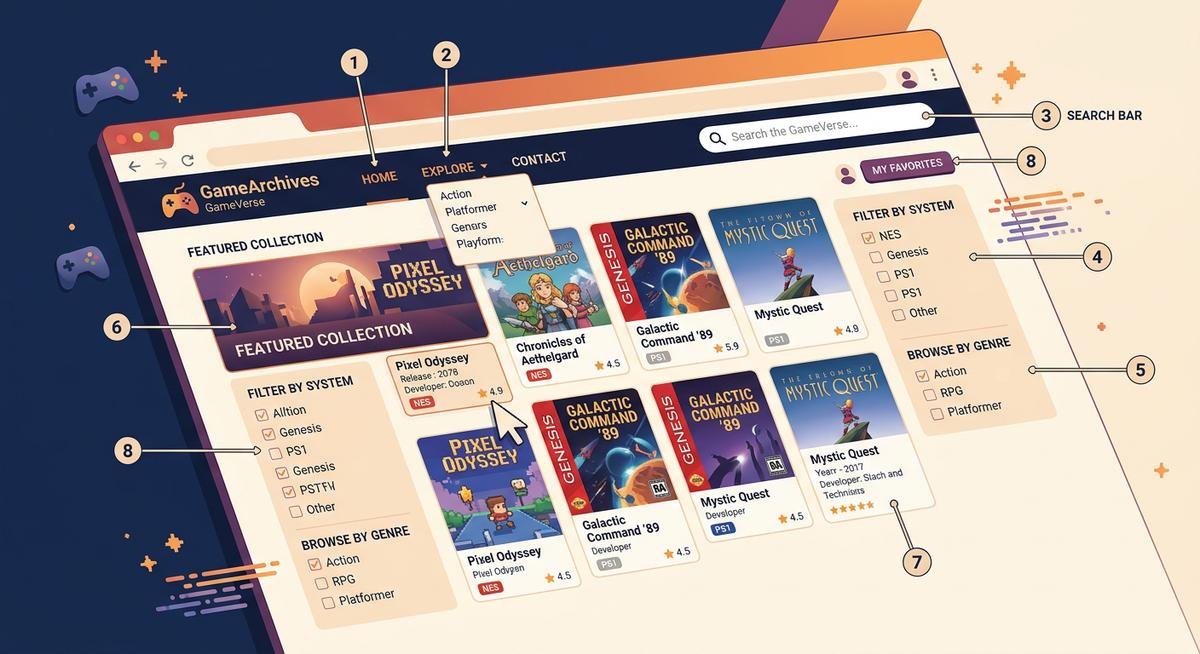
Registration and Setup Steps
- Navigate to tgarchivegaming.net in any modern browser.
- Create a free account with an email address to unlock save states and full catalog browsing.
- Use genre filters or the search bar to locate titles by name, platform, or release year.
- Click any title to launch it directly in the browser window through the built-in emulation layer.
- Save progress to your account for cloud-synced pickup across devices.
Free Versus Paid Access Tiers
| Feature | Guest (No Account) | Free Registered | Paid Subscription |
|---|---|---|---|
| Browse catalog | Yes | Yes | Yes |
| In-browser play | Limited selection | Expanded library | Full catalog |
| Save states | No | Yes | Yes |
| Favorites shelf | No | Yes | Yes |
| Premium and licensed collections | No | No | Yes |
The TGA Game Stick Hardware Option
The TGA Game Stick, sold through tgagamestick.co.uk, is a plug-and-play HDMI device preloaded with thousands of retro titles. It connects directly to any television and uses wireless controllers bundled in the box. The device targets buyers who want an offline, console-style experience without configuring emulators or managing ROM files. Pre-loaded title counts on similar retro game sticks in the UK market typically range from 3,000 to 20,000 depending on the model tier, according to retailer listings on Amazon UK.
Legality, Licensing, and Emulation
The legal standing of any retro gaming platform depends on how it acquires distribution rights, not on the age of the games it hosts. Three licensing models dominate the space, each carrying a different risk profile for end users.
Three Licensing Models in Retro Gaming
| Model | Legal Basis | Example | User Risk |
|---|---|---|---|
| Direct publisher license | Commercial agreement with rights holder | GOG.com, Nintendo Switch Online | Low |
| Institutional preservation | U.S. Copyright Act Section 108 | Internet Archive Console Living Room | Low (institution bears liability) |
| Unlicensed ROM hosting | No formal legal standing | Most ROM download sites | High |
The concept of abandonware carries no legal weight under U.S. or EU copyright law despite its widespread use as informal justification. A game whose publisher has dissolved still carries copyright protection for the standard term, which in most jurisdictions extends 70 years after the creator’s death or 95 years from publication for corporate works.
Where the GameArchives Gameverse Stands
The platform presents itself as a curated library rather than a direct ROM download hub. Browser-based streaming through a proprietary interface occupies a legally distinct position from sites that transfer ROM files to a user’s local storage. That said, no public documentation confirms specific publisher licensing agreements for the titles hosted on the platform.
Users should treat any unverified retro gaming platform with the same caution they would apply to a torrent site or unlicensed streaming service. Verify licensing claims before downloading any file. Streaming through an authorized interface is generally lower-risk than downloading a ROM to local storage, but neither is risk-free without confirmed rights clearance.
How It Compares to Other Retro Gaming Platforms
This retro archive competes with at least four established alternatives, each built on a different access model. The comparison below maps key differences across catalog size, legal standing, and cost.
| Platform | Access Model | Catalog Focus | Cost | Legal Standing |
|---|---|---|---|---|
| Gameverse | Browser streaming + hardware stick | NES through PS1 era | Free tier + paid subscription | Unverified licensing |
| Internet Archive | Browser emulation | DOS, arcade, early consoles | Free (nonprofit) | Section 108 institutional exemption |
| GOG.com | DRM-free downloads | PC classics, select console ports | Per-title purchase ($5-$40) | Fully licensed |
| RetroArch | Open-source multi-emulator | User-supplied ROMs (any platform) | Free (open source) | Emulator legal, ROMs user responsibility |
| Nintendo Switch Online | Subscription streaming | NES, SNES, N64, Genesis | $50/year (Expansion Pack) | Fully licensed (first-party) |
GOG.com and Nintendo Switch Online carry the strongest legal footing because every title is individually licensed. The Internet Archive operates under a nonprofit preservation mandate. RetroArch is a tool, not a content provider, so legal responsibility falls entirely on the user sourcing the ROMs. The Gameverse sits in murkier territory because its licensing model is not publicly documented.
On catalog depth for the 8-bit and 16-bit eras, the Gameverse and RetroArch both outpace Nintendo Switch Online, which is limited to first-party and select third-party agreements. For users who prioritize legal certainty over catalog breadth, GOG.com remains the safest bet for PC-era classics.
Frequently Asked Questions
What exactly is the GameArchives Gameverse?
This browser-based retro gaming platform streams classic titles from the NES, SNES, Genesis, and PlayStation eras through tgarchivegaming.net, with a companion hardware device (TGA Game Stick) sold via tgagamestick.co.uk. It combines a searchable game library with cloud save states, genre-based browsing, and a YouTube channel publishing gameplay content.
Is it free to use?
A free registered account unlocks an expanded selection of titles, save states, and a personal favorites shelf. Full catalog access including premium and licensed collections requires a paid subscription. The TGA Game Stick hardware is a separate one-time purchase that bundles pre-loaded content with no recurring fees.
Is it legal to use?
The platform positions itself as a curated library using browser-based streaming rather than direct ROM downloads, which occupies a different legal position than file-sharing sites. No publicly available documentation confirms specific publisher licensing agreements, so users should verify rights status before downloading any files from the platform.
What games are in the catalog?
The catalog spans arcade titles from the early 1980s through 32-bit PlayStation-era games, with the strongest coverage in 8-bit NES and 16-bit SNES and Genesis libraries. Titles like Super Mario Bros., Sonic the Hedgehog, Chrono Trigger, and Final Fantasy VII anchor the collection alongside lesser-known regional exclusives and fan-translated Japanese RPGs.
What is the TGA Game Stick?
The TGA Game Stick is an HDMI plug-and-play device sold through tgagamestick.co.uk that comes preloaded with retro game titles and wireless controllers. It connects directly to any television for offline play without requiring browser access, emulator setup, or ROM management.
What are the best alternatives?
GOG.com offers fully licensed DRM-free classic PC games at per-title pricing. The Internet Archive provides free browser-based emulation under a nonprofit preservation mandate. RetroArch is an open-source multi-emulator that supports user-supplied ROMs across virtually every retro platform. Nintendo Switch Online bundles NES, SNES, N64, and Genesis titles for $50 per year with the Expansion Pack tier.
Conclusion
The GameArchives Gameverse fills a genuine niche between bare-bones ROM sites and fully licensed storefronts like GOG.com. Its browser-based streaming model, organized catalog, and TGA Game Stick hardware give it more structure than most independent retro gaming platforms offer. The trade-off is transparency: without confirmed publisher licensing, users carry more legal uncertainty than they would on a platform with verified rights agreements.
For retro gaming enthusiasts willing to navigate that ambiguity, the platform delivers a well-organized browsing experience across four decades of console history. For users who need legal certainty, GOG.com and Nintendo Switch Online remain the safer choices, even if their catalogs are narrower.