




A single tow truck call in the United States costs between $75 and $125 on average, according to AAA. That price tag reflects just one meaning of a word carrying at least six distinct definitions across vehicles, textiles, military hardware, aviation, scripture, and slang. “Tow” ranks among the most versatile four-letter words in English, yet most dictionaries stop after two senses.
The confusion runs deeper than definitions alone. “Tow,” “toe,” and “two” are near-homophones that generate persistent spelling errors, and the acronym TOW names one of the most widely deployed anti-tank missiles in NATO history. Below: every meaning sorted, sourced, and stripped of ambiguity.
What Does Tow Mean? The Three Core Definitions
Tow carries three standard dictionary meanings: a verb meaning to pull or drag, a noun describing that act of pulling, and a separate noun referring to coarse plant fiber. Merriam-Webster lists all three senses with continuous usage traced to Old English.

Tow as a Verb
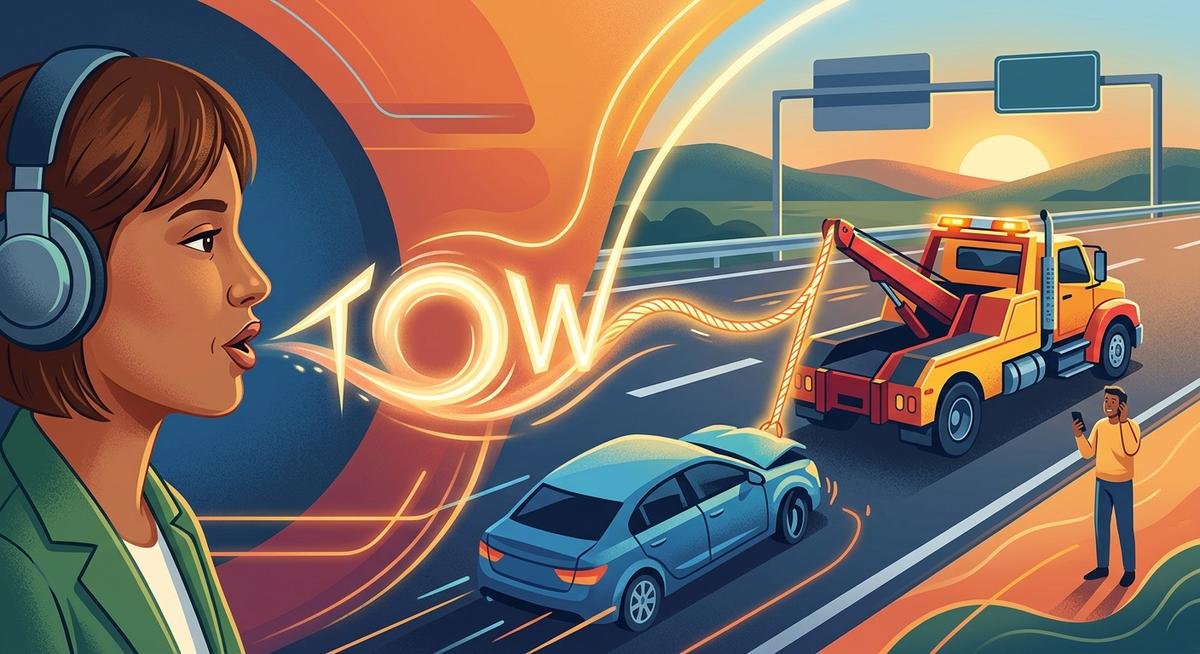
Used as a verb, tow means to pull or drag something by attaching it with a rope, chain, cable, or hitch to a vehicle supplying the force. The towed object follows passively. A pickup towing a boat trailer to a marina on Saturday morning, a tow truck dragging a stalled sedan off a rain-slicked highway shoulder, a tugboat pulling a barge through a shipping channel — all capture this verb sense.
Grammatically, tow is transitive: it requires a direct object. You tow something. The past tense is towed, the present participle is towing, and the agent noun is tower (rarely used) or, more commonly, towing vehicle.
Tow as a Noun: The Act of Pulling
As a count noun, tow refers to a single instance of being pulled. “The car needed a tow” means it required another vehicle to pull it — not that it needed a truck specifically. Common collocations: give someone a tow, call for a tow, get a tow. According to the American Automobile Association (AAA), its members request approximately 33 million roadside assistance calls annually, with towing among the most frequent services dispatched.
Tow as a Noun: Coarse Plant Fiber
The lesser-known sense has nothing to do with vehicles. Here, tow refers to short, coarse, broken fibers left after flax, hemp, or jute is processed — the rough material separated when longer, finer strands are combed away during textile production. The Oxford English Dictionary traces this sense to a different Old English root than the pulling verb, making these two “tow” words genuine homonyms with separate lineages.
Historically, tow fiber was twisted into rope, stuffed into ship caulking, and woven into rough cloth. Its pale, almost white-blond color gave rise to the compound tow-headed — still used today to describe very light blond hair.
| Sense | Part of Speech | Meaning | Example |
|---|---|---|---|
| Pull / drag | Verb | To pull something using a mechanical link | The truck towed the trailer to the marina. |
| Act of pulling | Count noun | A single instance of being pulled | The car needed a tow after the breakdown. |
| Coarse fiber | Noun | Rough flax, hemp, or jute strands | Tow was twisted into rope for sailing ships. |
Tow in the Automotive World
Most everyday encounters with the word tow involve vehicles — from the tow truck arriving after a highway breakdown to the tow package listed on a pickup’s window sticker. The automotive industry has built an entire vocabulary around this single verb.
Tow Truck, Tow Bar, and Tow Hitch
A tow truck is a specialized vehicle equipped to transport disabled cars, typically using a flatbed, wheel-lift, or hook-and-chain system. A tow bar is a rigid A-frame device connecting a towed vehicle directly to the towing vehicle’s rear, commonly used for flat-towing cars behind motorhomes. A tow hitch (also called a trailer hitch) is the receiver mounted to a vehicle’s frame that accepts a tow ball — the spherical coupling that locks a trailer tongue in place.
Related hardware: a tow chain is a heavy steel chain used for short-distance emergency pulls, a tow cable serves the same purpose with braided steel wire, and a tow strap uses woven nylon for lighter loads.
Tow Package, Tow Capacity, and Tow Haul Mode
A tow package is a factory-installed option bundle — typically including a hitch receiver, wiring harness, transmission cooler, and sometimes upgraded suspension — that prepares a vehicle for towing duty. Tow capacity (also called towing capacity) is the maximum weight a vehicle can safely pull, determined by frame strength, engine power, braking ability, and transmission cooling. According to the National Highway Traffic Safety Administration (NHTSA), exceeding rated tow capacity is a leading contributor to trailer sway accidents.
Tow/haul mode is a transmission setting on automatic-equipped trucks and SUVs that adjusts shift points and may activate engine braking to maintain control while pulling heavy loads.
Tow Zone, Tow Away, and Tow Yard
A tow zone (or tow-away zone) is a designated area where illegally parked vehicles will be towed at the owner’s expense. Tow away means to remove a vehicle by towing it from a location — the phrase appears on millions of parking signs worldwide. A tow yard is the impound lot where towed vehicles are stored until claimed and fees paid. A tow job is informal shorthand for the act of calling a towing service, and a tow company is any business providing vehicle towing and recovery.
| Term | Meaning | Context |
|---|---|---|
| Tow truck | Vehicle that transports disabled cars | Emergency roadside assistance |
| Tow bar | Rigid A-frame connecting towed and towing vehicle | Flat-towing behind RVs |
| Tow hitch | Receiver mounted to frame for trailer connection | Trailer towing |
| Tow package | Factory option bundle for towing readiness | New vehicle purchase |
| Tow capacity | Maximum safe towing weight | Vehicle specifications |
| Tow/haul mode | Transmission setting for heavy pulling | Trucks and SUVs |
| Tow zone | Area where illegal parking triggers towing | Parking enforcement |
| Tow yard | Impound lot for towed vehicles | Vehicle recovery |
TOW: The Military Missile Acronym
In military usage, TOW is an acronym standing for Tube-launched, Optically tracked, Wire-guided — a class of anti-tank missile first deployed by the United States Army in 1970. The system has nothing to do with pulling or dragging; the name describes its guidance mechanism.
Manufactured by Raytheon (now RTX Corporation), the TOW missile is fired from a portable launcher tube, tracked visually through an optical sight, and steered via commands transmitted through thin wires that unspool behind the missile in flight. According to the U.S. Army, TOW systems have been deployed in over 40 countries and have seen combat in conflicts from Vietnam through the Middle East. The BGM-71 TOW remains one of the most widely produced anti-tank guided missiles in NATO history, with over 700,000 units manufactured.
When someone searches “tow meaning military” or “tow meaning gun,” they are almost certainly asking about this weapon system, not the act of pulling equipment.
Tow in Aviation, F1, and the Bible
Beyond vehicles and missiles, tow carries specialized meanings in aviation, motorsport, construction, and even scripture — each distinct enough to generate its own search queries.
Tow in Aviation
In aviation, tow refers to the practice of launching a glider (sailplane) by pulling it aloft behind a powered aircraft using a tow rope or cable. This method, called aerotow, is the most common glider launch technique worldwide. The glider pilot releases the tow rope at the desired altitude — typically 600 to 900 meters — and transitions to soaring flight. On the ground, aircraft towing means pulling a plane with a specialized tug vehicle across taxiways and aprons.
Tow in F1 Racing
In Formula 1, a tow (also called a slipstream or draft) is the aerodynamic advantage gained by driving closely behind another car. The lead car punches a hole through the air, and the trailing car encounters reduced drag, gaining a straight-line speed advantage of roughly 5 to 10 km/h. Teams regularly coordinate tows during qualifying laps — a driver gives a tow to a teammate by running ahead on the straight to create that low-drag pocket.
Tow in Construction and the Bible
In construction, tow elevation refers to the top-of-wall elevation — a measurement marking the highest point of a wall structure, used in engineering drawings and surveying.
In biblical usage, tow appears in the King James Version (KJV) as a material reference. Isaiah 1:31 reads: “And the strong shall be as tow, and the maker of it as a spark.” Here, tow means the coarse flax fiber — highly flammable and easily consumed by fire — used as a metaphor for fragility and impermanence. Judges 16:9 uses the same image: Samson’s bonds snapped “as a thread of tow is broken when it toucheth the fire.”
Tow-Headed, Tow Slang, and Other Derived Terms
The fiber meaning of tow spawned several English compounds, and the pulling sense generated its own set of slang terms — some regional, some largely obsolete.
Tow-Headed and Tow-Haired
Tow-headed describes someone with very light, pale blond hair — the color of raw, unprocessed flax tow. The term appears prominently in American literature; Mark Twain described Huckleberry Finn as tow-headed in Adventures of Huckleberry Finn (1884), cementing the word’s association with rural, sun-bleached childhood imagery. Tow-haired and tow-colored are synonymous variants. The connection is purely visual: raw tow fiber is strikingly pale, almost white, matching the lightest natural hair colors.
Tow Slang and Informal Usage
In American Southern dialect, tow up (sometimes spelled “tore up”) means drunk, disheveled, or emotionally wrecked. “She was tow up after the party” describes someone visibly intoxicated or in rough condition. The phrase appears in hip-hop and country music lyrics.
A tow rag historically referred to a rag made from tow fiber — coarse, cheap, disposable. In British slang, “toe rag” (often confused with “tow rag” due to homophone overlap) became an insult meaning a worthless or contemptible person, with usage documented in British English since the 19th century.
Tow path (or towpath) is a trail alongside a canal or river, originally used by horses or humans who pulled boats by rope. Many towpaths survive today as recreational walking and cycling routes across England, France, and the eastern United States.
“In Tow” and “Toe the Line” — Idioms and Confusions
Two of the most searched phrases involving tow are the idiom “in tow” and the commonly misspelled “toe the line.” Both generate thousands of monthly queries from writers checking whether they have the right word.
What “In Tow” Means
When someone or something is in tow, they are following closely behind or being led by another person. The phrase originated as a precise maritime term — a dinghy riding behind a sailboat on a rope is literally in tow. The Oxford English Dictionary records figurative uses from the early 18th century: “She arrived at the airport with two interns and a rolling suitcase in tow” captures the modern figurative sense perfectly. The image of being pulled along, grouped, and slightly subordinate transfers from ships to people without losing clarity.
Toe the Line vs. Tow the Line
The correct phrase is “toe the line” — meaning to conform to rules or meet expectations. “Tow the line” is an eggcorn: a plausible-sounding substitution driven by the fact that tow and toe are perfect homophones (both pronounced /toh/). Bryan Garner flags this explicitly in Garner’s Modern English Usage as a homophone-driven error.
The idiom traces to athletic and military contexts where participants physically placed their toes against a marked line before a race or formation. The physical act of standing at attention became a metaphor for institutional obedience by the early 19th century. Memory trick: picture a sprinter crouching at the starting blocks, toes pressed against the painted line. No rope, no hitch, no towing vehicle involved.
| Phrase | Correct? | Meaning | Origin |
|---|---|---|---|
| Toe the line | Yes | Conform to rules or expectations | Athletic / military starting-line practice |
| Tow the line | No | Common eggcorn with no standard meaning | Homophone confusion |
| In tow | Yes (idiom) | Following closely behind; being led | Maritime rope-towing of vessels |
Tow Meaning in Other Languages
The English verb tow (to pull or drag) translates differently across languages, though the core concept remains identical. Searches for “tow meaning in Hindi,” “tow meaning in Tamil,” and similar queries account for a significant share of traffic around this keyword — mostly from bilingual speakers confirming a translation.
| Language | Translation of Tow (verb) | Script |
|---|---|---|
| Hindi | khinchna / tow karna | खींचना / टो करना |
| Tamil | izhuththu selluththal | இழுத்துச் செலுத்துதல் |
| Bengali | tana / tow kora | টানা / টো করা |
| Telugu | eeddchu | ఈడ్చు |
| Kannada | ezheyuva | ಎಳೆಯುವ |
| Urdu | khinchna | کھینچنا |
| Malayalam | valikkuka | വലിക്കുക |
| Marathi | odhne | ओढणे |
| Gujarati | khinchvun | ખેંચવું |
| Sinhala | adinawa | ඇදීම |
| Nepali | tanu | तान्नु |
Frequently Asked Questions
What does tow mean in simple terms?
Tow most commonly means to pull or drag something — a car, boat, or trailer — by connecting it to another vehicle with a rope, chain, or hitch. It also names the act of being pulled (“needed a tow”) and, separately, refers to coarse flax or hemp fiber used in textile manufacturing.
What does TOW stand for in the military?
TOW stands for Tube-launched, Optically tracked, Wire-guided. It designates a family of anti-tank missiles first fielded by the U.S. Army in 1970, manufactured by Raytheon. Over 700,000 units have been produced, and the system has been deployed in more than 40 countries.
What does tow mean in aviation?
In aviation, tow refers to launching a glider by pulling it behind a powered aircraft using a tow rope — a technique called aerotow. The glider releases the rope at the desired altitude, typically 600 to 900 meters, and transitions to independent soaring flight.
What does tow mean in F1?
In Formula 1 racing, a tow is the aerodynamic speed boost gained by driving closely behind another car on a straight. The lead car reduces air resistance for the trailing car, providing a straight-line speed advantage of roughly 5 to 10 km/h. Teams coordinate tows between teammates during qualifying sessions.
What does tow mean in the Bible?
In the King James Version, tow refers to flax fiber — highly flammable and quick to burn. Isaiah 1:31 uses it as a metaphor: “the strong shall be as tow, and the maker of it as a spark.” The image conveys fragility and divine judgment through a material that disintegrates at the touch of flame.
What does “in tow” mean?
“In tow” means following closely behind or being led by someone. Originally a maritime term for a vessel being pulled by rope, it extended into figurative English by the 18th century. “She arrived with three children in tow” describes someone leading a group, not literally pulling them.
Is it “tow the line” or “toe the line”?
“Toe the line” is correct, meaning to follow rules or conform to expectations. “Tow the line” is a common misspelling caused by the identical pronunciation of tow and toe. The idiom originates from athletes placing their toes on a starting line — no pulling or dragging involved.
What does tow-headed mean?
Tow-headed describes someone with very light, pale blond hair — the color of raw flax tow fiber. Mark Twain famously described Huckleberry Finn as tow-headed. The term connects directly to the textile meaning of tow: unprocessed flax strands that are strikingly pale, almost white.
What does tow mean in slang?
“Tow up” (or “tore up”) is Southern American slang meaning drunk, disheveled, or emotionally wrecked. In British slang, “tow rag” (often confused with “toe rag”) became an insult for a worthless person, originally referring to a rag made from cheap tow fiber.
What does tow mean for kids?
Tow means to pull something behind you. When a big truck pulls a broken car to a repair shop, that truck is towing the car. The truck doing the pulling is called a tow truck, and the broken car is being towed.
Conclusion
Six distinct meanings, one spelling. Tow names the act of pulling a vehicle, the event of being pulled, coarse flax fiber, a NATO missile guidance system, an aerodynamic racing tactic, and a biblical metaphor for fragility. The word tow-headed preserves the fiber sense in modern hair descriptions, while “in tow” and the “toe the line” eggcorn keep this four-letter word generating confusion — and search queries — centuries after it entered English from Old English togian.
The automotive meaning dominates daily life. The military acronym dominates defense procurement budgets. The fiber meaning dominates literary history. Each carries its own etymology, its own field of expertise, and its own reason for surviving into the 21st century.