




Most software methodologies promise structure. The V model for software development actually delivers it — and that distinction matters enormously when a defect caught late costs ten times more to fix than one caught early.
Born from German defense contracting standards in the 1980s, the V Model has outlasted dozens of competing frameworks precisely because regulated industries — aerospace, medical devices, automotive, fintech — cannot afford ambiguity between what a system is supposed to do and whether it actually does it. Every development phase maps directly to a corresponding test phase, planned in parallel, not as an afterthought.
What follows covers the full picture: a phase-by-phase breakdown with a structured mapping table, a practical step-by-step implementation guide with entry and exit criteria, an honest comparison against Agile and hybrid approaches, and answers to the questions engineers and project managers ask most often.
What Is the V Model in Software Development?
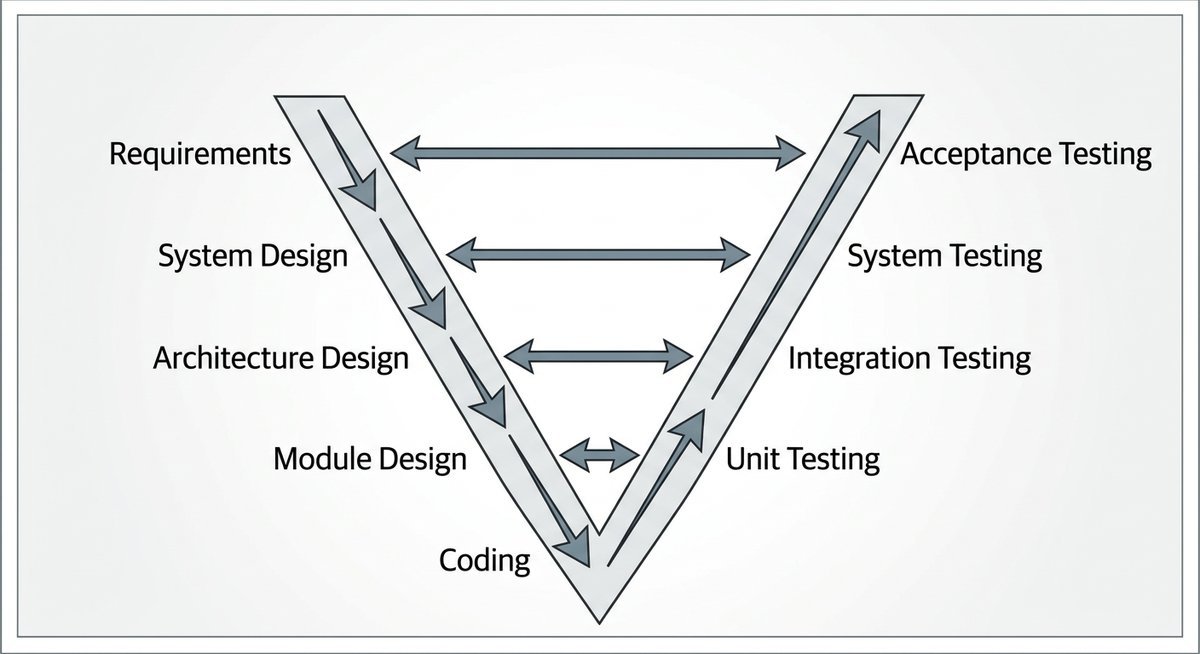
The V model for software development is a sequential lifecycle (SDLC) framework where every development phase has a corresponding testing phase planned in parallel — not after the fact. Each left-side activity produces a deliverable; each right-side activity verifies or validates that deliverable. The result is a disciplined, traceable process that catches defects at the phase where they originate, not six months later during system testing.
The Core Concept Behind the V Model: Verification vs. Validation
The two arms of the V represent two fundamentally different quality questions. Verification — the left side — asks: are we building the product correctly? Validation — the right side — asks: are we building the correct product? These aren’t interchangeable concerns.
Each development phase on the left arm triggers the design of a corresponding test phase on the right arm simultaneously. System design doesn’t just produce architecture documents — it also produces the system test plan. That parallel planning is what separates the V Model from a simple waterfall with testing bolted on at the end.
QA engineers join the conversation early in this structure. Defects caught during requirements review cost a fraction of what they cost when discovered during user acceptance testing — a principle well-documented in software quality research and supported by data from organizations like the National Institute of Standards and Technology (NIST).
A Brief History of the V Model
The V Model’s roots trace directly to the German federal government. The Bundesministerium des Innern — Germany’s Federal Ministry of the Interior — formalized the V-Modell standard in 1992 as a mandatory development framework for government IT projects, though its conceptual foundations emerged from defense and aerospace practices in the 1980s.
The United States Department of Defense and NATO adopted structurally similar phase-gate models during the same era, particularly for embedded systems and mission-critical software where a post-development bug wasn’t an inconvenience — it was a safety failure. Aerospace and defense remain the V Model’s spiritual home for exactly that reason.
Germany later released V-Modell XT in 2005, a modernized and more flexible variant that introduced tailoring options for different project types. Outside Germany, the framework evolved into the generic “V Model” recognized across regulated industries globally — from automotive functional safety standards like ISO 26262 to medical device software guidelines under IEC 62304.
V Model Phase-by-Phase Breakdown (With Mapping Table)
The V Model organizes software development into ten distinct phases — five on the left (development) and five on the right (testing). Every left-side phase has a corresponding test phase designed in parallel, not sequentially. Defects caught during verification phases cost a fraction of those discovered post-coding, which is why the paired structure exists.
V Model Left Side — Development Phases
Business Requirements Analysis is where the project’s scope gets locked down. Business analysts, product owners, and key stakeholders collaborate to document what the system must do — not how. The primary output is a signed-off Business Requirements Document (BRD), which simultaneously triggers the planning of User Acceptance Testing.
System Design translates business requirements into a technical blueprint. Architects define the overall system architecture, technology stack, hardware interfaces, and data flows. The System Design Specification produced here becomes the direct input for System Test planning.
High-Level Design (Architecture) breaks the system into subsystems and modules. Teams define how components interact, which APIs connect them, and how data moves across boundaries. Integration Test cases are drafted at this stage, while the code is still months away from being written.
Low-Level Design (Module Design) zooms into individual components. Developers produce detailed pseudocode, database schemas, and algorithm logic for each module. This phase directly informs Unit Test design — QA engineers write test cases against module specifications, not finished code.
Coding and Implementation is the V’s vertex. Developers write source code against the Low-Level Design specifications. Thorough upstream design has already resolved the hard decisions, so this phase is often shorter than teams anticipate.
V Model Right Side — Testing Phases
Unit Testing validates individual modules against their Low-Level Design specs. Tests are executed immediately after coding, catching logic errors at the cheapest possible point in the lifecycle. A module must pass all unit tests before it can participate in integration.
Integration Testing verifies that assembled modules communicate correctly — confirming the interfaces defined during High-Level Design actually behave as specified. Failures here typically expose mismatched data contracts or incorrect API assumptions, not missing features.
System Testing evaluates the fully assembled system against the System Design Specification. Performance, security, and end-to-end functional behavior get validated under conditions that mirror production as closely as possible.
User Acceptance Testing (UAT) is the final gate before release. Business stakeholders execute test scenarios derived directly from the original BRD, confirming the delivered system satisfies the requirements they signed off on at the project’s start. UAT sign-off is the formal exit criterion for the entire V.
Phase Mapping Table
| Development Phase | Testing Phase | Key Deliverable | Entry Criteria | Exit Criteria |
|---|---|---|---|---|
| Business Requirements Analysis | User Acceptance Testing (UAT) | Business Requirements Document (BRD) | Stakeholder sign-off on project scope | BRD approved; UAT test plan drafted |
| System Design | System Testing | System Design Specification | Approved BRD baseline | System test plan reviewed and approved |
| High-Level Design (Architecture) | Integration Testing | Architecture Design Document | Approved system design specification | Integration test plan drafted |
| Low-Level Design (Module Design) | Unit Testing | Module Design Specification | Approved architecture design | Unit test cases written and reviewed |
| Coding / Implementation | Unit Test Execution | Source Code + Build | Approved module design; test cases ready | Code peer-reviewed; all unit tests pass |
How to Implement the V Model: A Step-by-Step Guide
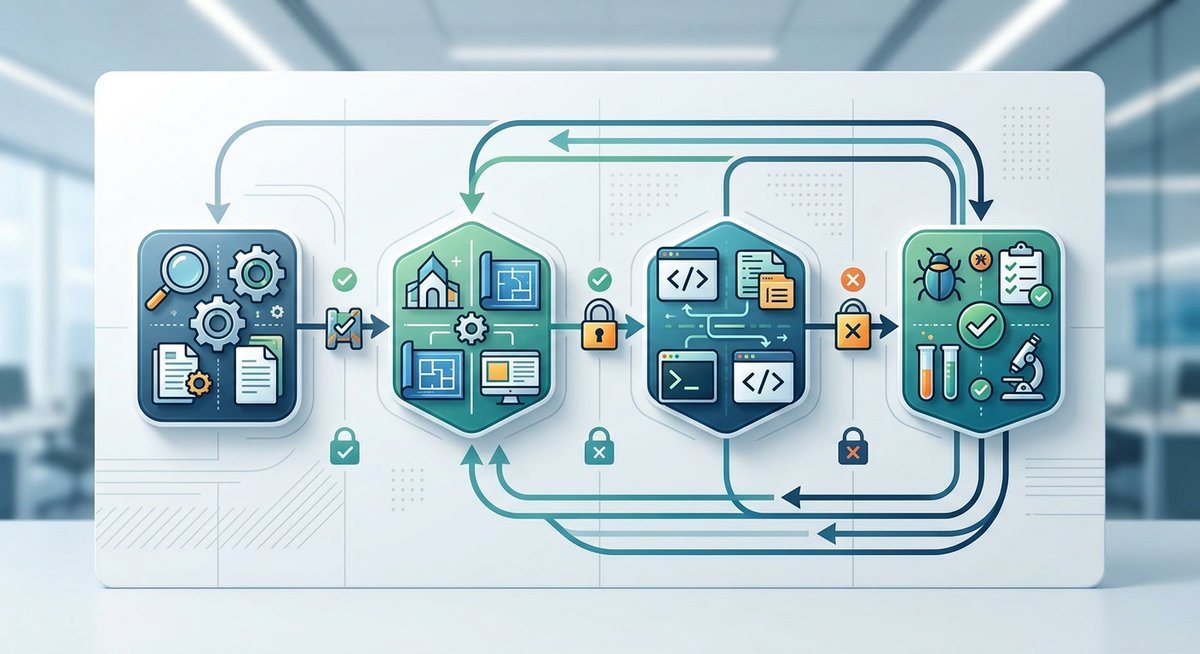
Successful V model for software development implementation hinges on four sequential actions: baselining requirements before work begins, defining phase gate criteria upfront, assigning parallel ownership between development and QA, and maintaining a living traceability matrix throughout execution. Teams that skip any one of these steps typically discover the omission during system testing — the most expensive place to find it.
Step 1 — Define Scope and Requirements Baseline
Before a single design decision is made, requirements must be frozen and formally baselined. A baselined requirement set is version-controlled, signed off by stakeholders, and locked against informal change — any modification after baseline triggers a formal change request with documented impact analysis.
Ownership of this process typically spans three roles: the Business Analyst drafts and elicits requirements, the Product Owner holds sign-off authority, and the QA Lead reviews each requirement for testability. A requirement that cannot be tested is, practically speaking, unverifiable — and unverifiable requirements are the primary driver of late-stage rework in V Model projects.
Mandatory documentation at this stage includes a Software Requirements Specification (SRS), a stakeholder sign-off register, and a preliminary test scope document. In regulated industries such as medical device development, IEC 62304 explicitly requires traceable requirements documentation before design activities begin.
Step 2 — Build Your Phase Gate Checklist
Phase gates are the structural backbone of V Model governance. Each gate sits between two phases and enforces a binary decision: proceed or pause. Without defined entry and exit criteria, gates become ceremonial — teams pass through them regardless of readiness, and defects propagate downstream where they cost significantly more to fix.
A minimal viable checklist for each phase gate should address four questions: Are all entry documents complete and approved? Have all action items from the previous phase been closed? Has a peer review or inspection been conducted? Are exit criteria measurable and met?
| Phase Gate | Key Entry Criterion | Key Exit Criterion |
|---|---|---|
| Requirements → System Design | Baselined, signed-off SRS | All requirements rated testable |
| System Design → Architecture | Approved system design document | System test plan drafted and reviewed |
| Architecture → Module Design | Approved architectural design | Integration test plan drafted |
| Module Design → Coding | Approved low-level design specs | Unit test cases written and reviewed |
| Coding → Unit Testing | Code complete, peer-reviewed | Zero open critical defects in review |
Step 3 — Assign Roles and Responsibilities
The V Model demands parallel workstreams, not sequential handoffs. While developers progress through the left arm, QA engineers build test plans and test cases simultaneously on the right. A project manager governs phase gate reviews and owns the decision to proceed or pause.
A practical RACI breakdown looks like this: developers are Responsible for design documents and code; QA engineers are Responsible for test plans and test execution; the project manager is Accountable for phase gate decisions; and business stakeholders are Consulted during requirements and UAT, then Informed at every gate review.
Teams that run both workstreams with a single manager often struggle. The development lead’s incentive is forward progress; the QA lead’s incentive is defect prevention. Those goals genuinely conflict at times, and having a neutral project manager arbitrate phase gate decisions prevents either workstream from overriding the other.
Step 4 — Execute, Test, and Trace
A requirements traceability matrix (RTM) links every business requirement to its design artifact, code module, and test case. Without it, the V Model’s paired structure is conceptual rather than operational — teams cannot prove that a test validates a specific requirement.
In practice, the RTM is a living document updated at every phase gate. When a defect is found on the right side, the matrix identifies exactly which left-side deliverable needs correction. This bidirectional traceability is what makes the V Model auditable — and why regulatory bodies like the FDA and EASA accept it as evidence of systematic verification.
Defect feedback loops run from right to left across the V. A system test failure traces back through the RTM to a system design specification, not just to a code commit. That level of precision accelerates root cause analysis and prevents the “fix one thing, break another” pattern common in less structured processes.
V Model vs. Agile, Waterfall, and Hybrid Approaches
The V model for software development outperforms Waterfall in defect detection and outperforms Agile in auditability — but neither comparison is absolute. Each methodology has a structural advantage in specific contexts, and choosing wrong costs more than time.
| Dimension | V Model | Waterfall | Agile / Scrum |
|---|---|---|---|
| Requirements flexibility | Low — baselined upfront | Very low — locked at start | High — evolves each sprint |
| Test planning timing | Parallel to development phases | After coding completes | Continuous, within sprints |
| Regulatory auditability | Excellent — full traceability | Good — linear documentation | Weak without augmentation |
| Defect detection speed | Early — phase-gate driven | Late — post-build testing | Continuous — sprint reviews |
| Best-fit industry | Healthcare, defense, aerospace | Construction, hardware | SaaS, consumer apps |
| Change cost after start | High after baseline | Very high | Low by design |
V Model vs. Waterfall
Waterfall and the V Model share a sequential DNA, but the V Model’s defining advantage is that testing is designed during development, not scheduled as an afterthought. In Waterfall, a defect discovered in system testing can require unwinding months of completed work. The V Model’s phase gates catch that same defect at the architecture review — before a single line of code is written.
V Model vs. Agile
Agile wins on adaptability; the V Model wins on compliance. In regulated environments — think FDA 21 CFR Part 11 for medical software or DO-178C for avionics — Agile’s iterative, documentation-light approach creates audit gaps that are genuinely difficult to close. The V Model’s mandatory traceability artifacts satisfy those regulatory frameworks by design, not by retrofit.
The V-Model + Agile Hybrid
Some teams in fintech and medical device development now run Agile sprints within individual V Model phases — using Scrum to manage the work inside a phase while still enforcing phase-gate exit criteria before progression. This hybrid preserves regulatory traceability while recovering some of Agile’s speed advantage. It works best when requirements are stable at the system level but flexible at the module level.
When to Use the V Model (And When Not To)
The V model for software development is strongest when three conditions hold simultaneously: requirements are well-understood before development begins, regulatory compliance demands documented traceability, and the cost of failure is high enough to justify the overhead of formal phase gates.
Healthcare software regulated under IEC 62304 is a textbook fit. Avionics systems governed by DO-178C and DO-254 are another. Automotive functional safety projects under ISO 26262 practically mandate V Model-style traceability. Financial trading platforms subject to MiFID II audit requirements also benefit from the model’s documentation discipline.
The V Model is a poor fit for exploratory products where requirements are genuinely unknown, for startups iterating toward product-market fit, or for any project where the cost of heavy documentation exceeds the cost of the defects it prevents. A five-person team building an internal tool does not need formal phase gates — the overhead would dwarf the product itself.
Frequently Asked Questions
What is the V model for software development?
The V model for software development is a sequential SDLC framework where each development phase (requirements, system design, architecture, module design, coding) has a corresponding testing phase (UAT, system testing, integration testing, unit testing) planned in parallel. The “V” shape represents development activities descending on the left and testing activities ascending on the right, with coding at the bottom vertex.
How does the V Model differ from Waterfall?
Both follow a sequential flow, but the V Model plans test activities during each development phase rather than deferring all testing until after coding. Waterfall treats testing as a single post-development stage. The V Model catches defects earlier because test plans are reviewed against design documents before code exists.
Is the V model for software development still relevant in 2026?
Yes — particularly in regulated industries. Medical device software (IEC 62304), automotive systems (ISO 26262), avionics (DO-178C), and defense contracts all require the kind of documented traceability the V Model enforces. Hybrid approaches combining V Model governance with Agile execution are increasingly common in these sectors.
What are the main advantages of the V model for software development?
Early defect detection through parallel test planning, strong regulatory auditability through traceability matrices, clear phase-gate governance that prevents defect propagation, and forced collaboration between development and QA from the project’s first day. These advantages compound in projects where the cost of late-stage defects is catastrophic.
What are the disadvantages of the V Model?
Rigid requirements handling makes it poorly suited for projects with evolving scope. The documentation overhead is substantial — every phase gate requires formal deliverables, reviews, and sign-offs. Baselined requirements are expensive to change, and the model offers no built-in mechanism for iterative discovery. Small teams or fast-moving startups typically find the governance burden disproportionate to the risk it mitigates.
Can the V Model be combined with Agile?
Yes. The most common hybrid runs Agile sprints within individual V Model phases while preserving phase-gate exit criteria between phases. Requirements and system design remain baselined (V Model governance), but the implementation work within each phase uses sprint planning, daily standups, and iterative delivery (Agile execution). This approach is gaining adoption in regulated fintech and medical device development.
What industries use the V Model most?
Aerospace and defense (DO-178C, DO-254), automotive (ISO 26262), medical devices (IEC 62304, FDA 21 CFR Part 11), railway signaling (EN 50128), nuclear energy (IEC 61513), and regulated financial services (MiFID II). Any industry where a software defect could cause physical harm, financial loss at scale, or regulatory sanction tends to favor the V Model or a structurally similar phase-gate framework.
Making the V Model Work
The V model for software development is not a silver bullet — no methodology is. But for projects where requirements are stable, compliance is mandatory, and defect costs escalate sharply with time, it remains one of the most reliable frameworks available. Its core insight is deceptively simple: plan your testing at the same time you plan your development, not after.
Teams that succeed with the V model for software development invest heavily in two areas: requirements quality at the front end and phase-gate discipline throughout. Skip the upfront baselining, and the entire right side of the V loses its foundation. Skip the gate reviews, and defects propagate exactly as they would in an undisciplined waterfall. The structure only works if you trust it enough to enforce it.