



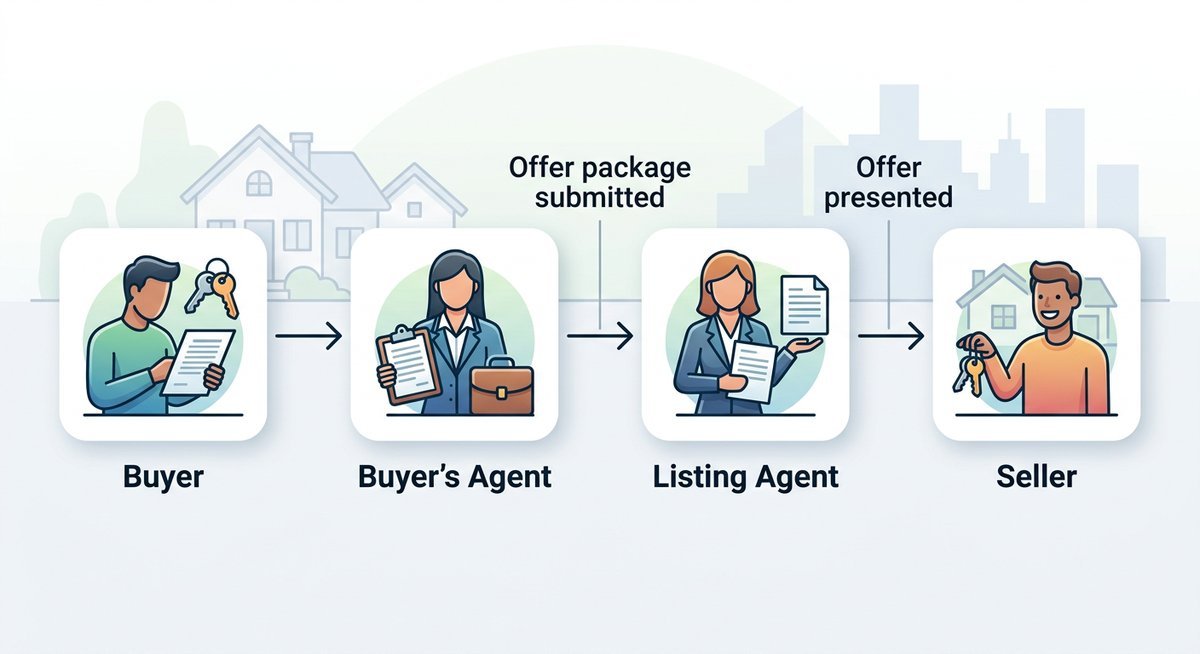
In most real estate transactions, the buyer’s agent delivers your offer to the seller’s listing agent — not directly to the seller. The listing agent, also called the seller’s agent, then presents the purchase agreement to the seller, typically within 24 to 48 hours of receipt. That two-step handoff is the backbone of the standard offer presentation process, and understanding it can save buyers from costly assumptions.
The mechanics shift, though, depending on how the transaction is structured. A for-sale-by-owner property has no listing agent in the chain, which means the offer goes straight to the seller. A dual-agency situation — where one agent or brokerage represents both sides — compresses the process in ways that can create real conflicts of interest. And platform-based iBuyer transactions bypass human intermediaries almost entirely, routing everything through automated digital portals.
Each of those scenarios changes who delivers your offer, how fast it moves, and what protections you have if something goes wrong. The real estate transaction process is rarely as simple as “sign and submit” — and knowing exactly what happens after you write that offer is the first step to making sure it actually lands.
Who Actually Delivers Your Offer in a Standard Sale
In a standard residential transaction, the buyer’s agent delivers the purchase agreement and supporting documents to the listing agent, who is then legally obligated to present that offer to the seller promptly. The buyer never contacts the seller directly. Each party in that chain carries a specific, defined responsibility — and understanding who does what protects buyers when something goes wrong.
The Buyer’s Agent’s Role
The buyer’s agent prepares the full offer package — typically a signed purchase agreement, a mortgage pre-approval letter, and earnest money details — and transmits it to the listing agent. Delivery most commonly happens via email, an MLS-integrated messaging portal, or a digital transaction platform such as DocuSign or DotLoop, both of which auto-log timestamps. In competitive markets, speed is a genuine advantage: an offer that arrives at 9 a.m. on the day a property lists can land ahead of a dozen others submitted by noon.
Professionalism in presentation also signals buyer seriousness. A clean, complete package with all required attachments is far less likely to be deprioritized than a partial submission that requires follow-up.
The Listing Agent’s Legal Duty to Present
Once the listing agent — also called the seller’s agent — receives the offer, presenting it to the seller is not optional. Under Article 1 of the National Association of Realtors (NAR) Code of Ethics, listing agents are required to present all offers and counter-offers objectively and as quickly as possible. Withholding or deliberately delaying an offer is a fiduciary violation that can result in license suspension, NAR disciplinary action, and civil liability.
Buyers who suspect an offer was buried have recourse: they can file a complaint with their state’s real estate commission or with NAR directly. Requesting written confirmation of delivery from the buyer’s agent — including a timestamp — creates the documentation needed to pursue that complaint if the offer is never acknowledged.
| Party | Role in Offer Delivery | Key Obligation |
|---|---|---|
| Buyer’s Agent | Prepares and transmits offer package | Complete, timely submission with all supporting documents |
| Listing Agent | Receives and presents offer to seller | NAR Code of Ethics Article 1 — prompt, objective presentation |
| Seller | Reviews offer and responds | Accept, reject, or issue a counteroffer within any agreed timeframe |
Three Delivery Scenarios Every Buyer Should Know
How an offer gets delivered depends on who is — or isn’t — representing the seller. In a traditional sale, a buyer’s agent sends the purchase agreement to a listing agent, who presents it to the seller. In a for-sale-by-owner deal, that middle layer disappears entirely. In an iBuyer transaction, a digital portal replaces both humans. Each scenario carries different risks, timelines, and documentation requirements. According to the National Association of Realtors 2023 Profile of Home Buyers and Sellers, approximately 7% of recent home sales were FSBO transactions, meaning a meaningful share of buyers will encounter at least one non-standard delivery scenario in their purchase history.

| Scenario | Who Delivers the Offer | Who Presents It to the Seller | Key Risk | Recommended Safeguard |
|---|---|---|---|---|
| Traditional (agent-represented) | Buyer’s agent → listing agent | Listing agent (seller’s agent) | Delayed or deprioritized presentation | Request timestamped delivery confirmation |
| FSBO (for-sale-by-owner) | Buyer’s agent or buyer directly | The seller themselves | No licensed intermediary to manage contract compliance | Hire a real estate attorney to review the purchase agreement |
| iBuyer / platform-based | Buyer via online portal | Automated system (no human presentation) | No negotiation nuance; algorithmic counteroffers only | Understand platform’s non-negotiable terms before submitting |
Traditional Agent-to-Agent Delivery
In the standard real estate transaction process, the buyer’s agent transmits the completed offer package — purchase agreement, pre-approval letter, earnest money details — to the listing agent via email, MLS messaging portal, or a platform like DocuSign or DotLoop. The listing agent then presents the offer to the seller, typically within 24 hours of receipt. Buyers should always ask their agent for a timestamped delivery confirmation; that record becomes critical evidence if a competing offer is accepted under suspicious timing or if a seller later claims they never saw the offer.
Speed matters here. In competitive markets, a buyer’s agent who delays transmission by even a few hours can cost a client the deal entirely.
FSBO: Delivering an Offer Directly to the Seller
In a for-sale-by-owner transaction, there is no listing agent — which means the buyer’s agent contacts the seller directly, or in fully unrepresented deals, the buyer does so themselves. This is a scenario most real estate content glosses over, but it introduces real procedural complexity. The buyer’s agent should reach out by phone first to establish contact, then follow up with the offer via email using a read-receipt-enabled service; for paper contracts, certified USPS mail creates a verifiable delivery record.
Etiquette matters in FSBO deals. Sellers going it alone are often managing a stressful process without professional support, so a courteous, clearly organized offer package stands out. Regardless of how smooth the seller seems, buyers should retain a real estate attorney to review the purchase agreement — FSBO sellers are not obligated to use standard forms, and contract gaps can create costly problems at closing.
iBuyer and Platform-Based Transactions
Platforms like Opendoor and Offerpad bypass the traditional offer presentation process entirely. Buyers submit offers through a proprietary digital portal, the submission is system-logged with an automatic timestamp, and any counteroffer is generated algorithmically — often within minutes. There is no listing agent to call, no human presentation, and no opportunity to include a personal letter or negotiate tone.
The trade-off is efficiency versus nuance. Delivery is instant and fully documented, which eliminates proof-of-delivery disputes. But buyers who want to negotiate specific contingencies or make a case for their offer beyond the numbers will find the platform’s rigid structure limiting.
Dual Agency and Conflict of Interest in Offer Delivery
Dual agency is one of the most consequential risks in the offer delivery process. When a single agent or brokerage represents both the buyer and the seller in the same transaction, the purchase agreement travels through a pipeline where the person delivering it has a financial incentive tied to both sides of the deal. According to the Consumer Federation of America, dual agency arrangements can suppress buyer negotiating leverage precisely because the agent presenting the offer has a competing obligation to the seller. Three states — Florida, Colorado, and Wyoming — have banned the practice outright.
What Is Dual Agency and Why It Creates Delivery Risk
Dual agency occurs when the listing agent — or another agent within the same brokerage — also represents the buyer submitting an offer. The structural problem is straightforward: that agent cannot fully advocate for a buyer’s terms while simultaneously serving the seller’s best interests. In practice, this can affect how urgently an offer is presented, how favorably it’s framed during offer presentation, or whether a counteroffer is communicated with the buyer’s leverage in mind.
The National Association of Realtors Code of Ethics requires disclosure of dual agency, but disclosure is not the same as protection. A buyer’s offer may technically be delivered on time while still being presented without enthusiasm, context, or competitive framing — none of which leaves a paper trail.
| State | Dual Agency Status | Buyer Protection Level |
|---|---|---|
| Florida | Illegal | High — separate representation required |
| Colorado | Illegal | High — transaction broker model used instead |
| Wyoming | Illegal | High — statutory prohibition |
| California | Legal with written consent | Moderate — disclosure required |
| New York | Legal with written consent | Moderate — attorney involvement common |
How to Protect Yourself as a Buyer
Ask upfront — before submitting anything — whether the listing agent’s brokerage also represents buyers on this specific property. That single question can surface a dual agency situation before it affects your offer’s fate.
- Request written confirmation that your offer was delivered, including the exact date and time it was transmitted to the seller.
- In states where dual agency is permitted, seriously consider hiring an independent buyer’s agent from a separate brokerage, or retaining a real estate attorney to review the transaction process.
- If you’re already in a dual agency situation, document every communication — emails, texts, and MLS portal messages — so you have a timestamped record of the entire real estate transaction process.
Buyers in Florida, Colorado, and Wyoming have statutory protection built in — dual agency simply isn’t an option. Everywhere else, the responsibility for catching and managing this conflict falls almost entirely on the buyer.
The Framework Behind a Sales Contract and Offer Delivery
A framework sales contract is the structured legal document that governs how an offer moves from buyer to seller and what happens once both parties sign. Every residential purchase agreement follows a recognizable framework: identification of the parties, property description, purchase price, contingencies (financing, inspection, appraisal), earnest money terms, closing timeline, and signatures. The way in which the offering is delivered to the customer — or more precisely, to the seller — depends on how that framework is structured and which intermediaries are involved.
How to Deliver the Offer Within a Contract Framework
To deliver the offer properly, the buyer’s agent packages the signed purchase agreement along with proof of funds or a mortgage pre-approval letter and transmits it to the listing agent. An offer to deliver is not the same as an accepted contract — it is a formal proposal that the seller can accept, reject, or counter. The delivery offered by the buyer’s agent must conform to whatever method the listing agreement specifies: electronic transmission, physical delivery, or both. According to the American Bar Association’s Real Property Section, contract delivery requirements vary by state, with some jurisdictions requiring “actual receipt” and others recognizing dispatch-based delivery under the mailbox rule.
Timing is critical. Most purchase agreements include an expiration clause — typically 24 to 72 hours — after which the offer automatically lapses if the seller has not responded. An offer that sits in an inbox over a weekend without acknowledgment is not technically pending; it may already be void.
Guidance Offers vs. Binding Contracts
Some offers carry explicit disclaimers stating that “this offer is for guidance only — please request more precise information from the seller.” These guidance offers are common in commercial real estate and international property transactions, where initial pricing is often indicative rather than firm. A guidance offer signals interest and establishes a negotiation range but does not create a binding obligation on either party. Buyers encountering guidance language should follow up with a formal written offer once they have confirmed the seller’s exact terms, property condition disclosures, and any regulatory requirements specific to the jurisdiction.
Seller or Vendor: Who Handles What in Offer Fulfillment
The distinction between a seller or vendor matters more than most buyers realize. In real estate, the seller is the property owner who accepts or rejects purchase offers. A vendor, in broader commercial usage, is whatever it takes to deliver a service or product from the seller to the buyer — the entity responsible for fulfillment, logistics, and post-sale execution. In property transactions, both roles often collapse into the same person, but in commercial deals involving development companies, REITs, or auction platforms, the seller and the vendor deliveree (the party who actually executes the handover) can be entirely separate entities.
When the Seller Will Ship Your Order — Timelines and Obligations
In e-commerce and product sales, the phrase “seller will ship your order by” a specific date is a binding commitment governed by the Federal Trade Commission’s Mail Order Rule. In real estate, the equivalent is the closing date — the contractual deadline by which the seller must transfer title and possession. Missing that deadline without a written extension can trigger default provisions, entitling the buyer to earnest money refunds or specific performance claims. The seller’s obligation to deliver is not aspirational; it is enforceable.
Cross-Sell Offers and Vendor Delivery Strategies
A cross-sell offer — sometimes abbreviated as x sell offer — is a vendor strategy where an additional product or service is presented alongside the primary transaction. In real estate, cross-sell offers commonly include home warranties, title insurance upgrades, moving services, or mortgage refinancing packages bundled with the purchase. Companies like Seller X Asia Limited and other regional vendor platforms operating out of Hong Kong and broader Asia-Pacific markets have built entire business models around cross-selling ancillary services to property buyers at the point of sale. These platforms coordinate between the primary seller, third-party vendors, and the buyer to ensure all delivery offered components reach the closing table on schedule.
What Makes a Good Seller to Deal With
Any buyer can respect a seller who delivers on time and communicates transparently throughout the transaction. The difference between a great seller to deal with and a difficult one often comes down to three measurable behaviors: responsiveness to offers, accuracy of property disclosures, and willingness to negotiate repair credits after inspection. According to a 2024 Zillow Consumer Housing Trends Report, 78% of buyers who rated their transaction as “positive” cited seller responsiveness as the single most important factor — ahead of price flexibility.
Sellers Who Deliver on Promises
A seller who can deliver on promises — agreed repairs completed before closing, documents submitted on schedule, possession transferred on the contracted date — earns a reputation that benefits future transactions. In tight-knit markets, listing agents track which sellers follow through and which ones cause last-minute chaos. A good seller to deal with does not renegotiate agreed terms after the inspection period closes, does not delay document signing, and does not introduce surprise conditions during the final walkthrough.
Repeat sellers — investors, flippers, developers — depend on that reliability to attract competitive offers on future listings. Agents talk. A seller known for smooth closings will receive more showings, faster offers, and stronger buyer confidence from day one.
Frequently Asked Questions
Who is responsible for presenting an offer to the seller?
The listing agent — also called the seller’s agent — is legally and ethically responsible for presenting all offers to the seller promptly. Under Article 1 of the National Association of Realtors Code of Ethics, withholding or delaying an offer is a fiduciary violation. The buyer’s agent delivers the offer package to the listing agent, who then presents it to their client.
Can a buyer deliver their own offer directly to the seller?
In a for-sale-by-owner transaction, yes — a buyer can deliver an offer directly to the seller, since no listing agent exists. In a traditionally listed property, bypassing the listing agent is strongly discouraged and may violate the seller’s listing agreement. Buyers in FSBO deals should still use a real estate attorney to review the purchase agreement before delivery.
How long does a seller have to respond to an offer?
There is no universal legal deadline — response windows are set within the offer itself, typically ranging from 24 to 72 hours. Some states impose agent-level obligations; California, for instance, requires agents to present offers “as soon as practicable.” If a seller doesn’t respond before the offer expires, it is legally void.
What happens if a seller’s agent doesn’t present my offer?
A listing agent who fails to present a valid offer can face disciplinary action from their state real estate commission and potential NAR ethics complaints. Buyers who suspect suppression should request written confirmation of delivery with a timestamp. Documenting every step — email receipts, MLS portal logs, follow-up texts — is the most reliable protection against this scenario.
Can you submit a real estate offer by email or text?
Email is the standard delivery method for real estate offers in most markets, and many states explicitly recognize electronic signatures and digital transmission as legally valid under the Uniform Electronic Transactions Act (UETA). Text message alone is generally insufficient for a formal purchase agreement. For FSBO transactions or high-stakes competitive offers, pairing email with a certified delivery service creates the strongest documentation trail.
What is the difference between a seller and a vendor in a real estate transaction?
A seller is the property owner who holds title and accepts or rejects purchase offers. A vendor is the broader commercial term for the party responsible for delivering a product or service to the buyer. In most residential transactions, the seller and vendor are the same person. In commercial deals, development projects, or platform-based sales involving companies like Seller X Asia Limited, the vendor deliveree — the entity that actually executes the property handover — may be a separate corporate entity from the titleholder.
What does “delivery offered” mean in a real estate context?
Delivery offered refers to the formal transmission of a purchase agreement from the buyer’s side to the seller’s side. It encompasses both the physical or electronic act of sending the offer and the legal acknowledgment that the offer has been received. Delivery is considered complete when the listing agent (or the seller in FSBO transactions) confirms receipt — not when the buyer’s agent hits “send.”
| Delivery Method | Legal Validity | Documentation Strength | Best Use Case |
|---|---|---|---|
| Email with read receipt | High | Strong | Standard agent-to-agent delivery |
| MLS messaging portal | High | Very strong (auto-timestamped) | Competitive markets, dispute prevention |
| Certified mail | High | Very strong | FSBO paper contracts |
| Text message | Low | Weak | Follow-up confirmation only |
Conclusion
In the vast majority of residential transactions, the buyer’s agent delivers the offer to the listing agent — also called the seller’s agent — who then presents the purchase agreement directly to the seller. That two-step handoff is the backbone of the real estate transaction process. But FSBO deals, dual agency arrangements, state-specific delivery rules, and documentation requirements all change how that handoff works in practice.
Before submitting any offer, confirm with your agent exactly how and when it will be delivered, and ask for written proof of receipt. A timestamped email confirmation takes seconds to request and can be critical evidence if a dispute arises over competing offers or counteroffer timing.
Ready to make your offer stand out once it lands in front of the seller? Read our guide on writing a competitive offer that gets accepted.