




“Younger Now” is the title track and lead single from Miley Cyrus’s sixth studio album, released on September 29, 2017, via RCA Records. The song marked a deliberate stylistic reset — swapping the trap-heavy production of Bangerz for a warmer, country-pop sound that caught many listeners off guard and earned Miley Cyrus a different kind of critical attention.
The track is built around a deceptively simple idea: that change itself is the most honest thing a person can claim. For Miley, that wasn’t just a lyrical concept — it was a public statement. Coming off years of deliberate provocation and one deeply experimental detour with Miley Cyrus & Her Dead Petz, the “Younger Now” era represented a quieter, more grounded version of an artist who had spent a decade shape-shifting in front of the entire world.
What makes the song worth examining closely is how much it does without saying much directly. The lyrics never name names, never point fingers, and never explicitly reference her past. Yet the biographical undertow is impossible to miss — and that tension between the personal and the universal is exactly what gives “Younger Now” its staying power.
What Is “Younger Now”? Release, Genre, and Background
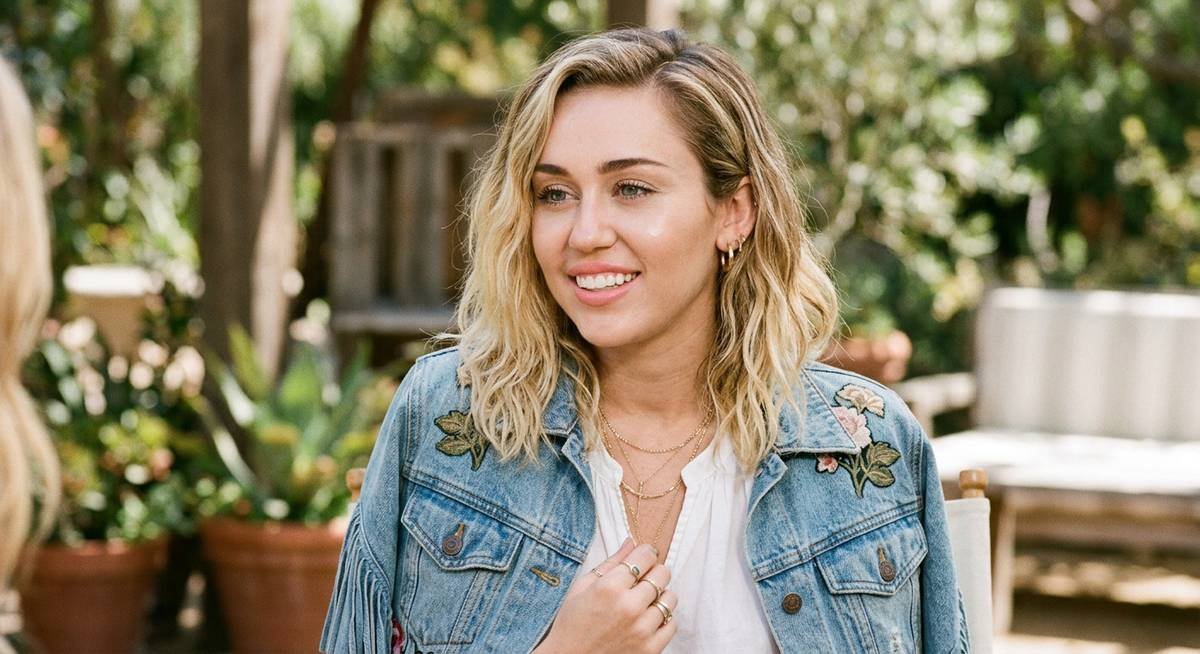
“Younger Now” is the lead single and title track from Miley Cyrus’s sixth studio album, released September 29, 2017, on RCA Records — a country-pop pivot produced by Israeli-American songwriter and producer Oren Yoel that replaced the trap-heavy Bangerz aesthetic with acoustic warmth and roots-music sincerity. Miley Cyrus younger now sounded nothing like the artist the world had grown accustomed to, and that was exactly the point.
Release Date and Album Details
The Younger Now album arrived on September 29, 2017, the same day as the title track’s wide release, and spans 10 tracks. Oren Yoel co-wrote and produced the majority of the record alongside Cyrus, giving the project an unusually intimate, consistent voice. The album marked Cyrus’s first release under a more streamlined creative partnership after the sprawling, loosely structured Miley Cyrus & Her Dead Petz (2015).
Genre and Sound
The song sits squarely at the intersection of country-pop and soft rock — a deliberate departure from the trap-influenced production of Bangerz (2013) and the psychedelic free-form experimentation of Dead Petz. Acoustic guitar, warm reverb, and unhurried phrasing define the sonic palette. The production incorporates a subtle Elvis Presley vocal homage, nodding to the classic American roots music that Cyrus leaned into throughout the album cycle.
| Album | Year | Primary Genre | Key Sound Marker |
|---|---|---|---|
| Bangerz | 2013 | Pop / Hip-hop | Trap beats, maximalist production |
| Miley Cyrus & Her Dead Petz | 2015 | Psychedelic rock / Experimental | Lo-fi, Wayne Coyne collaboration |
| Younger Now | 2017 | Country-pop / Soft rock | Acoustic warmth, Elvis vocal nod |
Lyrics Meaning and Themes Explained
The Miley Cyrus younger lyrics revolve around a single paradox: the older she gets, the more herself she feels. “Younger Now” frames personal transformation not as loss but as ongoing renewal — a perspective that sets it apart from the typical nostalgia-drenched pop ballad and makes the song one of the most quoted tracks from Cyrus’s post-Bangerz catalog.
The Central Message: Change as a Constant
The hook — “feels like I just woke up / like all this time I’ve been asleep” — carries the song’s emotional weight. Cyrus isn’t lamenting lost time; she’s describing the clarity that follows a period of numbness or performance. Waking up, here, is a metaphor for self-recognition.
The line “no one stays the same” functions less as a lyrical observation and more as a permission slip. The line is directed inward as much as outward — an acknowledgment that changing your identity isn’t betrayal, it’s biology. That universality is precisely why the song resonates beyond Miley Cyrus’s specific biography.
Nostalgia, Innocence, and Looking Inward
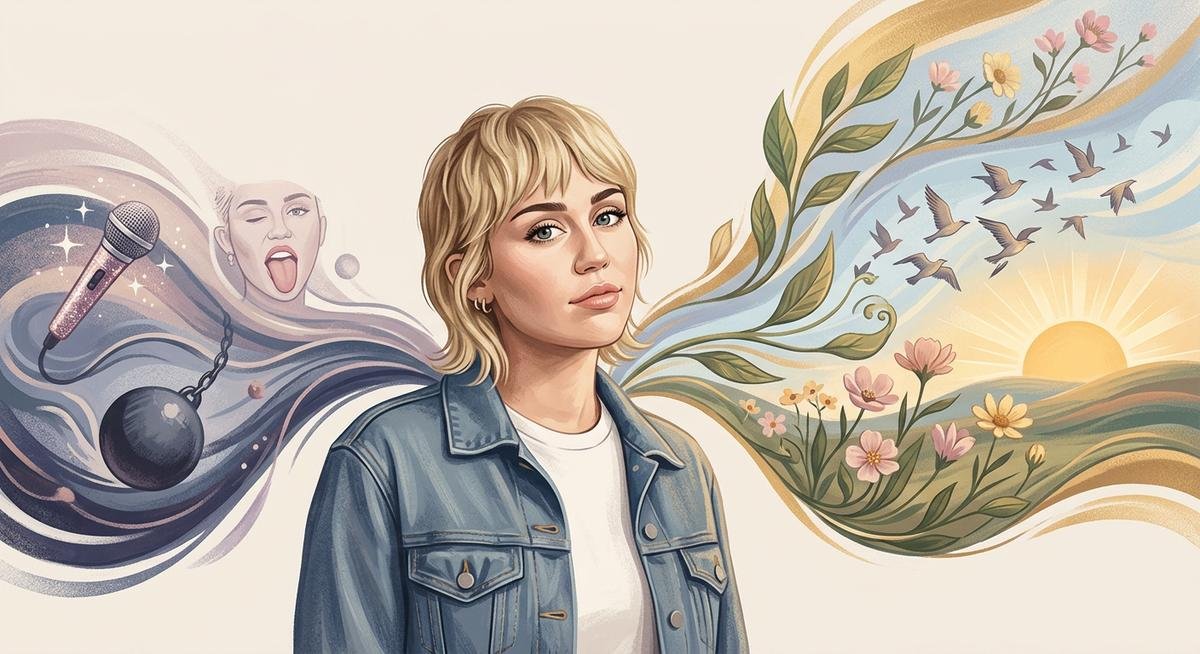
Feeling “younger now than ever before” isn’t a wish to reverse time. The phrase is a reclamation — of authenticity, of a self that existed before the noise of public life accumulated. The lyrical framing suggests that stripping away artifice actually restores something essential rather than revealing an absence.
This connects directly to themes of shedding persona. The song’s gentleness — its acoustic warmth, its unhurried tempo — mirrors the emotional state it describes. Form and content reinforce each other in a way that Cyrus’s more maximalist work rarely attempted.
| Lyric | Surface Reading | Deeper Meaning |
|---|---|---|
| “Feels like I just woke up” | Sudden awareness | Emergence from a performed identity |
| “No one stays the same” | Universal truth | Self-directed acceptance of change |
| “Younger now than ever before” | Nostalgia for youth | Reclaiming authenticity, not literal age |
Biographical Subtext
The song never names names or references specific events — and that restraint is deliberate. Yet the arc is unmistakable: a child star who became a cultural provocateur, then stepped back to find something quieter and more durable underneath. As Rolling Stone’s 2017 review noted, the album captures Cyrus “shedding skins” with an earnestness that feels hard-won rather than performed.
Cyrus moves through three distinct public selves across roughly a decade — Hannah Montana’s wholesomeness, Bangerz-era transgression, and this introspective third act — and “Younger Now” sits at the hinge point. The younger you Miley Cyrus theme isn’t just lyrical; it maps directly onto a publicly documented identity journey that few pop artists have undergone so transparently.
Miley Cyrus’s Reinvention: The Younger Now Era in Context
The Miley Cyrus younger now single marked the most deliberate artistic reset of her career — a conscious retreat from provocation toward sincerity, arriving after two records that had pushed her image and sound to opposite extremes. According to Billboard (2017), the album debuted at number four on the Billboard 200, signaling that Cyrus’s audience followed her through the pivot even as radio play remained modest.
From Bangerz to Younger Now
Bangerz (2013) was trap-laced, confrontational, and engineered for maximum cultural disruption. Its follow-up, Miley Cyrus & Her Dead Petz (2015), swung to the opposite extreme — a sprawling, psychedelic free-form record Cyrus released for free through SoundCloud in collaboration with Wayne Coyne and the Flaming Lips. Neither album had much interest in being liked on conventional terms.
After wrapping the Dead Petz touring cycle in 2016, Cyrus stepped back from public life almost entirely. Critics had been harsh — some called the Miley Cyrus too young argument a convenient dismissal, while others pointed to it as evidence that the industry had pushed a teenager into spectacle before she was ready. What emerged in 2017 was rootsier, quieter, and built around melodic songwriting rather than spectacle. Israeli-American producer Oren Yoel, whose credits span work with Adam Lambert and Demi Lovato, helped shape a sound that nodded to classic country-pop and soft rock.
Personal Life Influences
Cyrus was publicly open during this period about her sobriety and the clarity it brought her creative process. Her rekindled relationship with actor Liam Hemsworth — the two became engaged again in late 2016 — gave the album’s themes of groundedness and renewal a biographical undercurrent.
Those personal circumstances informed the record’s reflective tone without dictating it. Younger Now works as an artistic statement independent of its backstory — but knowing the context makes the pivot feel earned rather than calculated.
Chart Performance and Commercial Reception
“Younger Now” peaked at number 56 on the Billboard Hot 100 and earned gold certification from the Recording Industry Association of America (RIAA), reflecting over 500,000 equivalent units in the United States. The accompanying album reached number four on the Billboard 200, demonstrating that album-buyers responded more strongly than single-streamers to this quieter, country-inflected direction.
Chart Results
Internationally, the single charted in several European markets, including the United Kingdom, though the single did not crack the upper tiers of those charts. According to the RIAA’s official certification database, the gold certification reflects over 500,000 units in equivalent sales and streams in the United States.
| Chart | Peak Position |
|---|---|
| Billboard Hot 100 | #56 |
| Billboard 200 (Album) | #4 |
| RIAA Certification | Gold |
Critical Reception
Critics largely welcomed the tonal shift. Pitchfork awarded the album a 5.5, praising Cyrus’s sincerity while questioning whether the songwriting matched the ambition of the reinvention. Rolling Stone was warmer, calling the record “her most cohesive work since Bangerz.” Fans expecting the abrasive energy of the twerking era found the gentler sound disorienting, while others saw it as overdue maturity.
Aggregate critical sentiment landed between appreciative and cautiously impressed. The consensus held that Younger Now succeeded more as a mood and a statement than as a commercial juggernaut — a deliberate trade-off Cyrus appeared willing to make.
How “Younger Now” Fits Into Miley Cyrus’s Full Discography
Younger Now occupies a precise and often overlooked position in Miley Cyrus’s catalog: the calm midpoint between two of her most sonically extreme eras, arriving after the psychedelic chaos of Miley Cyrus & Her Dead Petz and before the hard rock swagger of Plastic Hearts (2020). Among Miley Cyrus younger career phases, this one stands alone as the only adult-era return to Nashville-rooted songwriting.
A Discography Timeline Snapshot
Mapped across her seven studio albums, a clear cyclical pattern of reinvention emerges. Cyrus has never released two stylistically identical records in a row — each album represents a deliberate departure from the last.
| Album | Year | Primary Genre | Career Phase |
|---|---|---|---|
| Meet Miley Cyrus | 2007 | Pop / Teen pop | Hannah Montana crossover |
| Breakout | 2008 | Pop rock | Post-Disney independence |
| Can’t Be Tamed | 2010 | Electropop / dance | Adult image pivot |
| Bangerz | 2013 | Hip-hop / trap pop | Cultural provocation era |
| Miley Cyrus & Her Dead Petz | 2015 | Psychedelic rock / experimental | Free-form artistic rebellion |
| Younger Now | 2017 | Country-pop / soft rock | Introspective roots pivot |
| Plastic Hearts | 2020 | Hard rock / glam rock | Rock identity consolidation |
What Made This Era Unique
Younger Now is the only album in Miley Cyrus’s catalog where Cyrus fully commits to country-pop crossover territory as an adult artist — not as a Disney-adjacent teenager, but as a 24-year-old consciously returning to her Tennessee roots. That distinction matters. Every other genre shift in her discography moved further from Nashville; the Younger Now era moved back toward it.
For music researchers and dedicated fans, that makes Younger Now a genuinely singular data point — underappreciated precisely because the album arrived between two louder, more attention-grabbing eras. The reinvention was quieter this time, which is exactly why it tends to get skipped over.
Frequently Asked Questions
What is the meaning behind Miley Cyrus’s song “Younger Now”?
“Younger Now” explores personal transformation as a form of renewal rather than loss. Miley Cyrus frames change as something universal and freeing — the central paradox being that shedding old versions of yourself can make you feel more authentically yourself than ever before. The lyrics implicitly reference her own public evolution from child star to provocateur to a quieter, more grounded artist.
What album is “Younger Now” on?
“Younger Now” is both the lead single and title track of Miley Cyrus’s sixth studio album, also called Younger Now, released via RCA Records on September 29, 2017. The album contains 10 tracks and was produced primarily by Oren Yoel.
What genre is “Younger Now”?
“Younger Now” sits at the intersection of country-pop and soft rock — a deliberate departure from the trap-influenced sound of Bangerz and the experimental psychedelia of Miley Cyrus & Her Dead Petz. The production incorporates a vocal homage to Elvis Presley, grounding the track in classic American roots music.
How did “Younger Now” perform on the charts?
“Younger Now” peaked at number 56 on the Billboard Hot 100 and received RIAA gold certification in the United States. The accompanying album reached number four on the Billboard 200. Internationally, the single charted across multiple territories in Europe and Australia, performing strongest on adult contemporary formats.
How does “Younger Now” compare to Miley Cyrus’s other albums?
Younger Now is the only album in Miley Cyrus’s adult catalog to fully commit to country-pop crossover territory. Positioned between the avant-garde Miley Cyrus & Her Dead Petz and the hard rock-leaning Plastic Hearts, the Younger Now era is a distinct — and often underappreciated — pivot point in one of pop music’s most restless discographies.
Was Miley Cyrus too young for the spotlight when she started?
Miley Cyrus was 11 years old when she auditioned for Hannah Montana and 13 when the show premiered on Disney Channel in 2006. Many critics and cultural commentators have argued that Miley Cyrus was too young to navigate the pressures of child stardom at that scale. The “Younger Now” era implicitly addresses that tension — the lyrics frame growing older as a form of reclaiming the authenticity that early fame disrupted, rather than mourning lost youth.
What are the Miley Cyrus “Younger Now” lyrics really about?
The Miley Cyrus younger lyrics center on the paradox that personal change brings you closer to your truest self rather than further from it. Key lines like “feels like I just woke up” and “no one stays the same” function as both universal observations and coded autobiography — referencing Cyrus’s decade-long journey from Disney star to cultural provocateur to introspective songwriter without naming any specific events directly.
| Question | Quick Answer |
|---|---|
| Release date | September 29, 2017 |
| Album | Younger Now (sixth studio album) |
| Genre | Country-pop / soft rock |
| Label | RCA Records |
| Producer | Oren Yoel |
Conclusion
“Younger Now” remains one of the most genuinely self-aware songs in Miley Cyrus’s catalog — a title track that captured a real turning point rather than a manufactured rebrand. Released in September 2017, the song marked the moment Cyrus stepped back from provocation and chose sincerity, producing the only album in her discography that commits fully to country-pop crossover as an adult artist.
That makes Younger Now underrated almost by design. Fans expecting another Bangerz moved on quickly, and critics filed the album under “surprise pivot.” But the song’s central paradox — that change itself is the most constant thing about a person — holds up as honest, durable songwriting.
Stream Younger Now on any major platform, or trace Miley Cyrus’s full discography from Breakout through Plastic Hearts to hear just how far that journey runs.