


Most office layouts don’t get questioned when they’re approved. The drawings look efficient. Density looks right. Everything fits within budget. The shift happens later. A few weeks after teams move in, patterns begin to change. Meeting rooms stay occupied longer than expected.
Managers step out for calls more often. People start looking for quieter corners during the day. Nothing breaks immediately, but something feels off. This is where the conversation becomes more relevant while evaluating Office Spaces in Pune. Not what looks good on a layout. What holds up once teams start working.
What Open Plan vs Private Offices Means Today
Briefly, this looks like a design choice. Open seating versus enclosed cabins. It is closer to an operating model decision. Open plan offices bring teams into shared environments with minimal barriers. The idea is simple: improve visibility, make collaboration easier, and use space more efficiently.
Private offices do the opposite. They create controlled environments where conversations stay contained, and focus is easier to maintain.
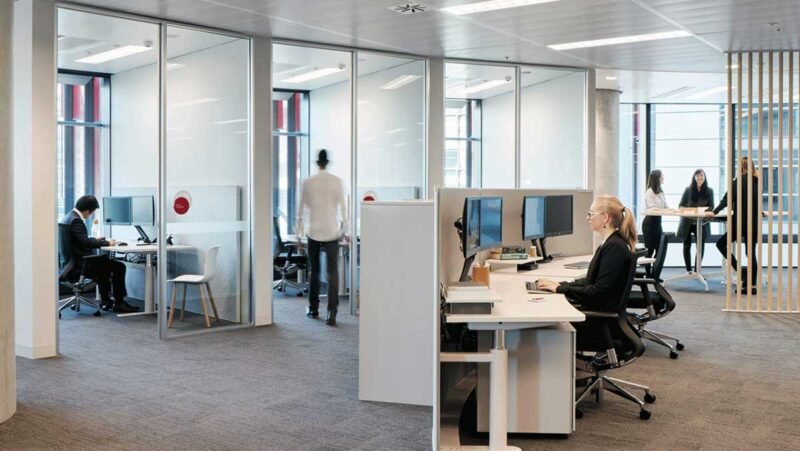
In many Grade A office spaces, companies no longer choose one over the other. They combine both. Open areas for execution teams, enclosed spaces for leadership and focused work. The mix is where things either work smoothly… or start creating friction over time.
What Research Actually Suggests
Workplace research has not dismissed open offices. It has been questioned how they behave in real environments. In large-scale office operations, one pattern consistently shows up. Fully open layouts don’t always increase collaboration.
In some cases, interaction reduces. Not because teams are disengaged, but because constant visibility creates hesitation. So, conversations move to internal chats. Calls shift into meeting rooms. Informal discussions become scheduled ones.
The outcome is subtle, but important. A space designed to feel open begins to function in a more closed way.
Where Open Plan Offices Work and Where They Start Slowing Things Down
Open layouts do work. Especially in early expansion phases. They allow faster onboarding. Reduce setup complexity. Help teams sit together without spending time on structure. In Office Space in Viman Nagar, this becomes particularly useful for companies scaling delivery or tech teams quickly.
But give it a few months.
As teams stabilise, the same setup starts showing pressure points. Noise becomes a factor. Meeting rooms get overbooked. Managers begin relying more on enclosed spaces that were not planned in enough numbers. Nothing dramatic. But enough to affect daily efficiency.
Why Private Offices Still Hold Their Ground
Private offices often get viewed as less flexible. That assumption doesn’t hold in operational environments. Certain functions depend on controlled settings. Leadership discussions, financial reviews, and client conversations are routine, not occasional.
In Office Space in Koregaon Park Annexe, this is visible in how layouts are structured. Companies don’t allocate cabins as a preference. They allocate them because decision-making requires fewer interruptions and tighter conversations.
It’s not about hierarchy. It’s about how quickly outcomes are reached.
The Shift Toward Hybrid Layouts in Office Spaces in Pune
Most companies are no longer debating open versus private. The shift is toward balance. Across Commercial Office Spaces in Pune, especially in areas like Baner and Viman Nagar, hybrid layouts are becoming the default. Open workstations handle execution-heavy roles. Enclosed spaces support leadership and critical functions.
Meeting rooms are distributed more thoughtfully across floors. In many Grade A office spaces, this balance is not fixed. It is designed to adjust as teams grow or change structure. Because the reality is that different roles require different environments, even within the same team.
Cost Isn’t Just About Density
Open layouts often look more cost-efficient on paper. Higher density, lower upfront cost per seat. But operationally, the picture changes. In Office Space in Baner, companies have seen that overly dense layouts create secondary costs. More demand for meeting rooms. Frequent layout adjustments.
Additional infrastructure to manage noise or create privacy. These are not always captured in initial budgets, but they show up within months. A slightly higher investment in balanced layouts tends to reduce these corrections later.
What Leadership Should Actually Evaluate
The decision is rarely about design preference. It is about alignment with how teams work. In many Grade A office spaces, leadership teams look at a few practical factors:
- How much of the team’s work requires focus versus collaboration
- How often sensitive or confidential discussions take place
- Expected team growth over the next 12–24 months
- The ratio of internal work to client-facing interactions
When these are mapped correctly to layout, the office tends to run without constant adjustments.
The Real Decision Behind the Layout
Open offices are not inherently better. Private offices are not outdated. The challenge usually comes from applying one model across all teams. It works initially. Then small inefficiencies start building longer meetings, reduced focus time, and dependency on limited enclosed spaces. Over time, these gaps affect how smoothly operations run.
Closing Perspective
Office design rarely gets revisited once teams settle in. That’s where the risk sits. Because by the time issues become visible, changing them involves cost, disruption, and time. While evaluating Managed Office Spaces in Pune, the more relevant question is not whether the layout looks efficient today.
It is whether it will still support teams six months later when hiring scales, pressure increases, and work becomes less predictable. That difference doesn’t show up in design plans. It shows up in how the business runs.